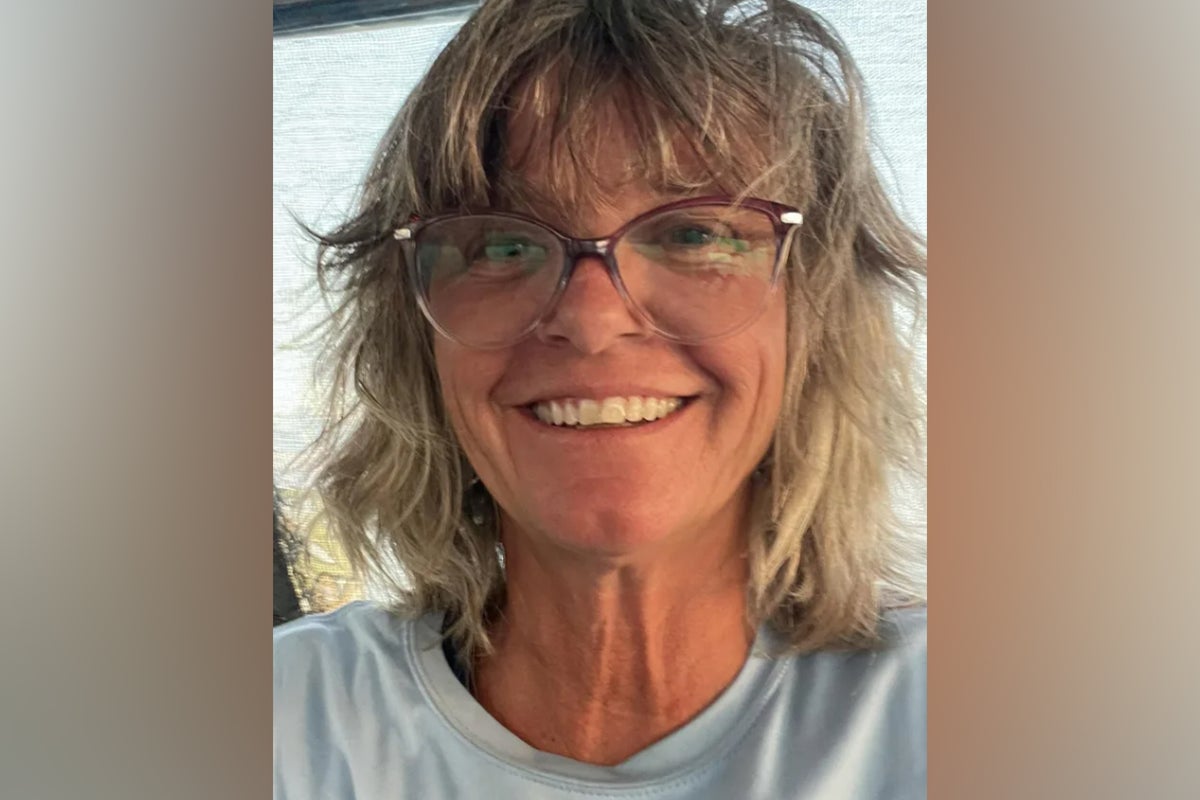
Federal investigators are preparing to deploy a specialized dive team to a newly targeted sector of the Sea of Abaco. This sudden escalation in the hunt for Lynette Hooker, a 55-year-old Michigan native who vanished in early April, comes after forensic analysts extracted location data from her husband's electronic devices that directly undercuts his version of events. The U.S. Coast Guard Investigative Service is currently petitioning Bahamian authorities for diplomatic clearance to enter their territorial waters, signaling that a standard missing-persons case has aggressively transitioned into an active federal criminal probe.
What was initially reported as a tragic maritime mishap in the pitch-black waters between Hope Town and Elbow Cay is now being treated as something far more calculating.
The Disconnect in the Data
Brian Hooker told local police a clean story. He claimed that on the night of April 4, his wife fell from their eight-foot dinghy into a choppy sea, accidentally taking the vessel’s kill-switch keys with her in her pocket. The engine died instantly. He claimed he was left to paddle blindly through rough currents for hours before scraping onto a beach to sound the alarm at 4:00 a.m.
Digital forensics do not suffer from a foggy memory.
The FBI laboratory in Quantico recently finished a preliminary extraction of data from a marine navigation application running on one of Brian Hooker's devices. The telemetry tells a story that does not match the husband's timeline. Instead of a frantic drift or a straight line to survival, the GPS coordinates map out a distinct trajectory into the Sea of Abaco. The device traveled out into the open water, stopped entirely at a specific coordinate, and then returned to shore.
The ocean hides secrets, but consumer electronics betray them.
Reported Account: Dinghy loses power instantly -> Drifts helplessly to shore
Forensic GPS Log: Vessel moves to open water -> Holds position -> Returns to shore
Federal agents are acting with a level of urgency that implies they believe they have found the exact coordinates where Lynette's body was deposited. The targeted search area features depths of roughly 25 feet, shallow enough for tactical divers to perform a meticulous grid search if the Bahamian government grants immediate access.
The Seizure of the Soulmate
The investigation is no longer confined to the waters of the Caribbean. Earlier this month, federal agents quietly descended upon a marina in Fort Pierce, Florida, to seize the couple’s primary vessel, a sailboat named Soulmate.
This was not a routine inspection. The Soulmate served as the staging ground for the couple’s social media persona, "The Sailing Hookers," where they documented their retirement dreams for thousands of digital onlookers. Behind the sun-drenched filters lay a different reality. Domestic records from Michigan reveal a volatile history, including a prior incident where local police were called to a scene involving mutual intoxication and physical injury.
Investigators are pulling apart the infrastructure of the Soulmate. They are not just looking for physical evidence; they are examining the boat's high-end technological array.
Overlooked Hardware Under Review
- The Infrared Camera System: The vessel was equipped with forward-looking infrared technology capable of recording thermal signatures in total darkness. Investigators are trying to determine if the system was active on the night of April 4.
- The Missing AIS Window: Satellite tracking data for the sailboat reportedly went completely dark for an 11-hour window spanning the night of the disappearance. Marine tracking systems rarely experience spontaneous, self-correcting blackouts unless power is intentionally severed.
- The Mystery Mooring: The Coast Guard has issued an appeal for information regarding a second, unidentified sailboat that was moored directly adjacent to the Soulmate in Aunt Pat's Bay hours before Lynette vanished.
Overlapping Jurisdictions
Pursuing a criminal investigation across international boundaries is a bureaucratic nightmare. Because the incident occurred within the territorial waters of the Bahamas, the Royal Bahamas Police Force holds primary jurisdiction over the initial event. They detained Brian Hooker for five days in April, questioned him, and ultimately released him without charge due to a lack of immediate physical evidence.
Once a suspect leaves the islands, the leverage shifts. Brian Hooker quickly departed for the United States to visit an ailing relative, and his current whereabouts have not been publicly disclosed by his legal team.
The U.S. Coast Guard Investigative Service relies on a specific legal mechanism to assert authority here. The Soulmate is a U.S.-flagged vessel, and federal law grants American law enforcement the right to investigate crimes committed by or against U.S. citizens on the high seas or within maritime environments tied to American jurisdiction. However, putting divers into Bahamian waters requires absolute diplomatic compliance.
The family of Lynette Hooker has already provided DNA samples to the FBI, preparing for the likelihood that the upcoming dive operation will be a recovery mission rather than a rescue. Her daughter, Karli Aylesworth, has publicly rejected the idea that her mother simply stumbled off an eight-foot boat, pointing out that Lynette was an exceptionally strong swimmer and a disciplined mariner who respected safety protocols.
The المقبل dive operation will test whether the physical realities of the Sea of Abaco match the binary code extracted from Brian Hooker’s phone. In the expanse of the ocean, an unmonitored dinghy ride leaves no tracks, but the digital shadow it cast back to a satellite may be enough to dismantle an alibi completely.