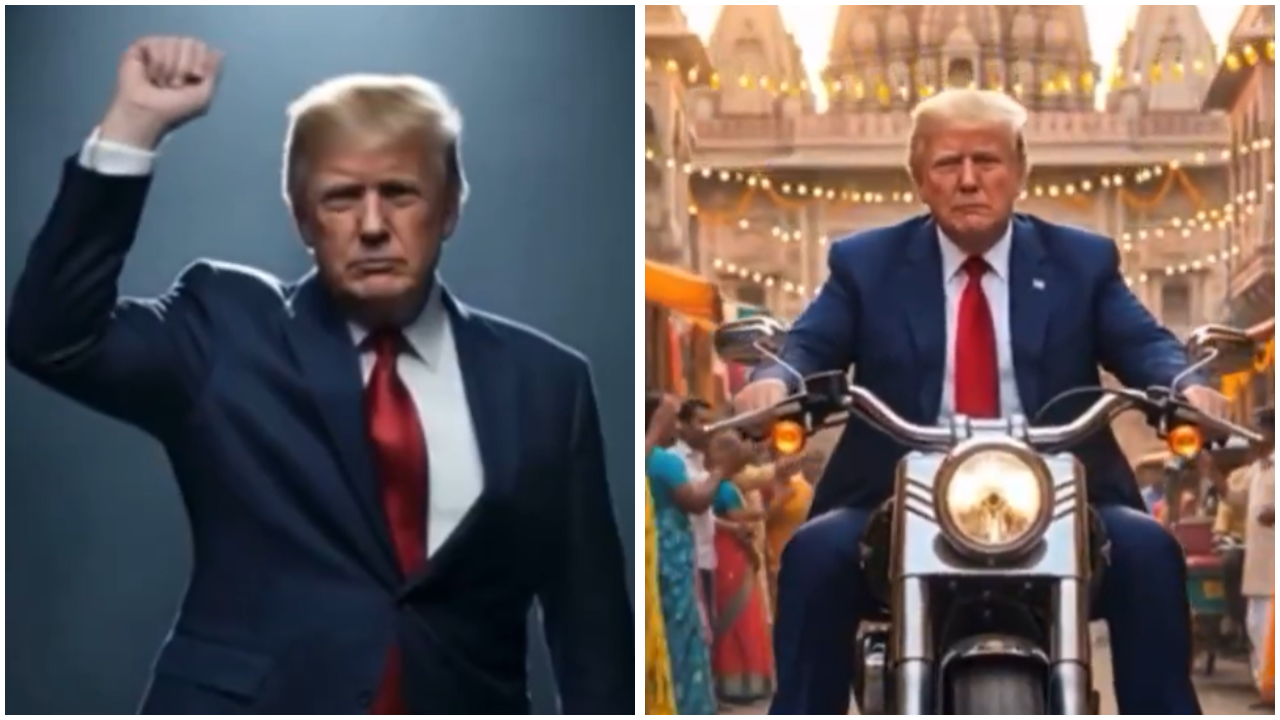
Donald Trump recently amplified an artificial intelligence-generated music video across his Truth Social platform, a track that loops his own name dozens of times while declaring a global, borderless infatuation with his presidency. The minute-long anthem, engineered by New York congressional candidate Anthony Constantino, positions Trump in a series of bizarre, hyper-inflated synthetic realities—riding lions, standing on the Moon, and paragliding across international skies. While mainstream commentators have dismissed the post as a routine exercise in standard political vanity, the reality runs far deeper. This is not just a president sharing a silly video. It represents a fundamental shift in political communication, marking the moment where synthetic flattery transitioned from an online novelty into an active instrument of executive image-making.
By analyzing the mechanics of this self-praise anthem, we can look past the surface-level absurdity to examine a deliberate strategy. The modern political ecosystem no longer relies purely on traditional media validation or even real-world crowds. Instead, it has entered a phase where political figures can manufacture an entirely artificial consensus, validate it via social algorithms, and feed it directly to a loyal base hungry for uncritical celebration.
The Mechanics of Manufactured Validation
The track itself operates on a simple, hypnotic loop. Fictional lyrics claim that populations from Mexico and Italy to China and India harbor a deep adoration for Trump. Visually, the video abandons any tether to physical reality. Viewers watch a digital likeness of the American president traveling through an Indian street on a motorcycle, posing near the Leaning Tower of Pisa, and consuming a pizza stamped with his own face.
It is easy to laugh at the camp aesthetic. However, the production technique reveals a more calculated utility. Traditional campaign ads require directors, film crews, permits, and massive expenditures. Synthetic media allows a single political operative to generate an international tour of flattering, albeit fictional, imagery in a matter of minutes.
For Constantino, the creator of the track, the payoff was immediate. Trump reposted his commentary, effectively granting an official presidential endorsement to a primary candidate via the amplification of a song written about the president himself. This creates a closed-loop system of political transaction. A candidate feeds the executive's appetite for public adulation, and the executive rewards the candidate with invaluable digital real-world real estate.
The Death of the Satire Barrier
For decades, political caricature was the exclusive weapon of the opposition. Satirists used exaggerated drawings and ridiculous premises to deflate the egos of those in power.
This video upends that historical norm.
By actively embracing and distributing imagery of himself riding a apex predator or walking on lunar dust, Trump neutralizes mockery by adopting it as a badge of honor. When a political figure parodies themselves more aggressively than their opponents can, conventional political satire loses its edge. The exaggerations are not seen by his base as humiliating fabrications, but rather as symbolic expressions of an underlying perceived truth. To his supporters, the lion represents strength; the moon represents boundless ambition. The literal falsehood of the video is entirely secondary to its emotional resonance.
The Algorithmic Safe Space
The decision to host and elevate this media on Truth Social is highly deliberate. On mainstream platforms, public figures are subjected to immediate counter-narratives, community notes, and critical commentary. Inside an ecosystem specifically designed to filter out dissenting voices, the synthetic anthem functions as intended. It builds a digital hall of mirrors where the feedback is exclusively positive.
This environment alters how leadership perceives global standing. When an executive is insulated by algorithms that only surface adoration—even when that adoration is generated by a prompt box and an AI algorithm—the distinction between authentic global popularity and synthetic praise begins to blur.
The danger is not that the public believes Donald Trump actually rode a lion past the Leaning Tower of Pisa. The danger is the normalization of a political reality where facts are completely divorced from messaging, and where a leader's personal narrative is sustained by an automated choir of digital praise. It signals a future where political campaigns no longer need to convince the public of their achievements; they can simply generate a simulation of success and broadcast it to an audience that has agreed to believe the illusion.
An illustrative look at how political figures utilize digital platforms to project manufactured narratives can be seen in Trump Praises Himself and Claims Perfect Numbers, which showcases the broader pattern of self-reinforcing rhetoric in modern political media.