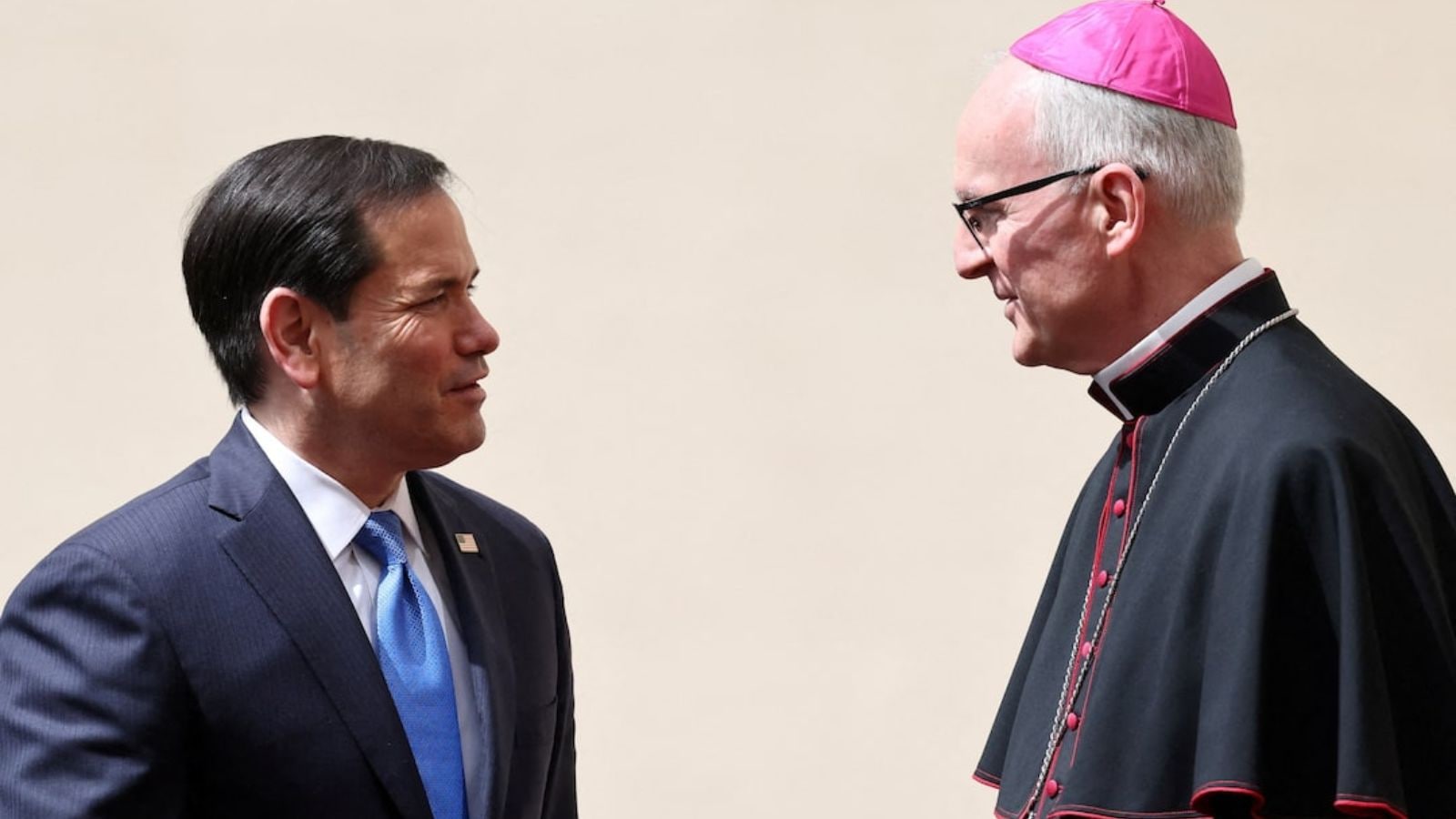
The appointment of Marco Rubio as a diplomatic envoy to the Holy See represents more than a standard personnel shift; it is a calculated attempt to reconcile a structural divergence between American populist-nationalist foreign policy and the globalist humanitarianism of the contemporary Papacy. The tension originates from a fundamental disagreement on the definition of state sovereignty and the moral obligations of wealth-exporting nations. To navigate this, the administration must move beyond the rhetorical volatility of previous cycles—specifically the documented friction regarding Pope Leo’s critiques of market fundamentalism—and engage in a transactional diplomacy that prioritizes shared security interests over theological alignment.
The Triad of Diplomatic Friction
The relationship between the current administration and the Vatican is currently defined by three distinct friction points that impede standard bilateral cooperation. Understanding these pillars is essential for any envoy attempting to stabilize the relationship.
- The Sovereignty Paradox: The administration views the nation-state as the primary unit of moral and legal authority. Conversely, the Vatican under Pope Leo emphasizes a "universal brotherhood" that often views national borders as secondary to human migration rights. This creates a zero-sum logic in policy discussions regarding border security and refugee quotas.
- Economic Moralism vs. Market Realism: Pope Leo has frequently critiqued "trickle-down" economics and the "autonomy of markets," labeling them as inherently exclusionary. The administration’s platform is built on the opposite premise: that deregulated market vigor is the only mechanism capable of generating the capital required for global stability.
- The Secular-Religious Convergence Gap: While both entities claim to protect religious freedom, their definitions differ. The administration focuses on the protection of religious institutions from state overreach within the West, while the Vatican prioritizes the safety of Christian minorities in the Global South, often through quiet diplomacy that the U.S. interprets as passivity toward authoritarian regimes.
The Mechanics of the Rubio Strategy
Marco Rubio’s mission is not to achieve ideological synthesis—which is a logical impossibility given the current theological direction of the Holy See—but to establish a "Functional Neutrality." This strategy involves de-escalating the "Frank" nature of past communications and replacing them with a data-centric approach to regional stability.
Categorizing the Vatican’s Influence Assets
The envoy must treat the Vatican as a non-state actor with a unique intelligence and soft-power network. The Vatican possesses:
- Hyper-Local Intelligence: A presence in nearly every conflict zone through the network of Catholic charities and dioceses, often outlasting formal embassy presence.
- Moral Arbitrage: The ability to grant or withhold moral legitimacy to international agreements, which influences the voting blocks of Catholic-majority nations in the UN and EU.
- The "Leo Effect": A specific rhetorical style used by the current Pope that resonates with the disenfranchised in the Global South, directly counteracting U.S. influence in South America and Sub-Saharan Africa.
The cost function of failing to mend these ties is high. If the Vatican continues to publicly align its moral weight against U.S. trade or migration policy, it provides a "moral shield" for adversarial leaders to justify their own anti-U.S. stances under the guise of humanitarian concern.
Causality and Conflict The Venezuela-China Nexus
The most significant missed opportunity in previous diplomatic efforts was the failure to recognize the cause-and-effect relationship between Vatican neutrality and U.S. sanctions efficacy.
In Venezuela, the Vatican’s insistence on "dialogue" has historically provided the Maduro regime with the time necessary to consolidate power during periods of domestic unrest. Rubio’s task is to provide the Holy See with a "Stability Framework" that proves how rapid democratization—rather than prolonged mediation—serves the Church’s goal of stopping the mass exodus of its parishioners.
The China-Vatican provisional agreement on the appointment of bishops represents a secondary bottleneck. The U.S. views this as a concession to a totalitarian state; the Vatican views it as a survival mechanism for the underground church. Rubio’s approach shifts the argument from "Religious Liberty" (a moral argument) to "Information Integrity" (a security argument). By highlighting how the Chinese state uses the agreement to harvest data on religious practitioners, the U.S. can appeal to the Vatican’s own interest in institutional self-preservation.
Navigating the Legacy of "Explosive Attacks"
The "frank" nature of the mission refers to the baggage of previous verbal skirmishes. When Pope Leo questioned the Christian credentials of those who build walls, it triggered a defensive feedback loop within the administration. To break this, the envoy must apply a "rhetorical decoupling" technique. This involves:
- Segmenting Audiences: Distinguishing between the Pope’s role as a global moralist and his role as the Head of State of the Vatican City. The U.S. can disagree with the former while maintaining a professional partnership with the latter.
- Interest-Based Negotiation: Moving away from "values-based" language, which is subjective and prone to conflict, toward "interest-based" language. For example, instead of debating the morality of migration, the envoy focuses on the joint disruption of human trafficking cartels—a goal where the Church’s parochial networks and the U.S. Department of State find common ground.
The Institutional Bottleneck of the Curia
Diplomacy with the Vatican is frequently slowed by the internal bureaucracy of the Roman Curia. Unlike a standard foreign ministry, the Secretariat of State at the Vatican operates on a "Longue Durée" (long-term) perspective, often ignoring the four-year or eight-year cycles of U.S. administrations.
This creates a temporal misalignment. The U.S. seeks immediate tactical wins (e.g., a statement on a specific conflict), while the Vatican seeks to preserve its multi-century neutrality. Rubio must overcome this by identifying "Pivot Points" within the Curia—specific officials who manage the intersection of finance and diplomacy—rather than focusing solely on the Papal office.
Risk Assessment of the "Frank" Mission
The primary risk of Rubio’s mission is the "Echo Chamber Effect." If the envoy uses his platform to lecture the Vatican on conservative Western values, the mission will collapse into a PR exercise that further alienates the Holy See.
The secondary risk is "Theological Encroachment." If the administration attempts to use American Catholic leaders as a lever against the Pope, it risks triggering a "sovereignty reflex" in the Vatican, causing them to harden their stance against U.S. policy out of a need to prove their independence from American political influence.
Strategic Realignment through the Mediterranean and Africa
The most effective path to mending ties lies in the Mediterranean and the African continent. Both the U.S. and the Vatican are concerned with the expansion of extremist ideologies in the Sahel.
The Vatican’s "Community of Sant'Egidio" has a proven track record in peace mediation. By funneling U.S. developmental aid through these established Catholic networks, the administration can achieve its stabilization goals while providing the Vatican with the resources to fulfill its humanitarian mission. This creates a "Mutually Assured Success" model.
This partnership requires the U.S. to accept that the Vatican will not endorse its specific border policies. However, by securing the Vatican’s cooperation in stabilizing the "source countries" of migration, the U.S. effectively achieves its policy outcome without requiring the Pope’s explicit rhetorical approval.
Operational Conclusion for the Envoy
Success for Marco Rubio will not be defined by a joint communiqué or a public photograph of agreement. Success is defined by the cessation of public hostilities and the establishment of a "Quiet Channel" for intelligence sharing.
The administration must realize that the Vatican is the only global entity with a footprint that rivals the U.S. military-intelligence complex, yet it operates on a completely different set of incentives. The envoy’s final play should be the proposal of a "Permanent Working Group on Transnational Crimes." This allows both parties to collaborate on anti-trafficking and anti-money laundering—areas where their interests are 100% aligned—thereby creating the "intertia of cooperation" necessary to survive the inevitable disagreements on climate change and economic theory.
The envoy should immediately deprioritize the "Leo attacks" and instead offer a formal partnership on the "Stability of the Global South," using the Vatican's network as a delivery mechanism for humanitarian aid that coincidentally serves U.S. regional security interests. This shifts the relationship from a collision of worldviews to a partnership of necessity.