Silence in a suburban neighborhood is usually a comfort. It means the lawnmowers have stopped, the school buses have finished their morning routes, and the world has settled into a predictable, manageable hum. But there is a very specific kind of silence that makes the hairs on the back of your neck stand up. It is the silence of routine broken. It is the closed front door that stays closed past noon, the uncollected newspaper dissolving in the morning dew, the absence of a familiar shuffle across hardwood floors.
Most of us walk right past that kind of silence. We are too busy rushing to our own destinations, headphones clamped over our ears, earbuds sealing us inside our own private audiobooks and phone calls. We assume someone else is looking. We assume the rhythm of modern life has a safety net built into its margins.
Dogs do not make that assumption.
To a dog, a human life is not a sequence of independent appointments. It is a shared ecosystem of breath, scent, footfalls, and unspoken loyalty. When that ecosystem fractures, a dog does not shrug and wait for tomorrow.
Consider what happened on an ordinary afternoon when a homeowner—let us call him Michael, because this story belongs to thousands of Michaels living behind unassuming beige siding across the country—stepped out onto his property to handle a routine chore. Maybe he was reaching for a rogue tree branch after a storm. Maybe he was checking the guttering before the first heavy frost.
We know the bare mechanics of the disaster because emergency responders later pieced it together. A fall. A bad angle on concrete or wet grass. A sudden, violent collision with the earth that leaves a person broken, immobilized, and utterly invisible to the passing world.
Hours bleed away when you are lying flat on your back, staring up at a indifferent sky, whispering for help that cannot cross the threshold of your own backyard. The sun moves. The shadows lengthen. The temperature drops. Panic, cold and sharp, settles into the chest long before the physical pain dulls into numbness.
And then there is the animal.
He was a loyal dog, the kind of mixed-breed rescue whose exact lineage is a mystery solved entirely by his devotion. When Michael did not return through the back door, the dog did not panic in the human sense. He investigated. He trotted out to the perimeter of the garden, caught the wrong scent in the wind, and found his person lying crumpled in the grass.
What follows in these moments is a masterclass in mammalian communication. Dogs do not have verbs or nouns, but they possess a vocabulary of urgency that transcends human language. They have the frantic pawing, the low, vibrating whine that rattles in the back of the throat, the desperate nudge of a wet nose against a hand that will not close in response.
Michael was stranded, fading in and out of consciousness, trapped by a severe injury that rendered him unable to shout. Every passing car on the distant street sounded like salvation, and every passing car meant nothing. The world rolled on, completely unaware that a life was quietly unraveling in the grass twenty yards away.
Except for the dog.
Dogs understand boundaries, but they also understand desperation. When barking at the empty air failed to conjure help, the dog shifted tactics. This is where instinct hardens into strategy. Instead of cowering beside the fallen homeowner—which is what fear would dictate—the animal stationed himself near the property line.
He became a sentinel of distress.
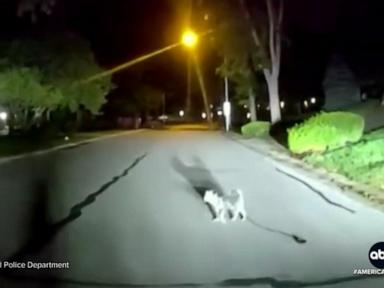
Imagine walking your own dog down that suburban street. You see a strange dog sitting rigidly by a neighbor’s fence line. He is not sniffing a fire hydrant. He is not chasing a squirrel. He is staring straight at you with eyes wide, unblinking, holding a silent vigil. When you slow your pace, the dog takes two sharp steps toward you, then looks back over his shoulder toward the house, then looks back at you.
It is a pantomime as old as time. Look at me. Follow me. Something is wrong.
Most people ignore stray or loose dogs, muttering about irresponsible owners. But this dog’s posture—the rigid spine, the intense, laser-focused gaze, the absence of tail-wagging relief—communicated an emergency long before any human voice could articulate it.
When a neighbor finally stopped, pulled off their headphones, and followed the frantic, backtracking animal toward the side of the house, they found Michael. They found the grim reality of a man who had been lying on the cold ground for hours, saved from total catastrophe only by the stubborn, unyielding refusal of a four-legged friend to accept the unacceptable.
We love to tell stories about animal heroism as if it were magic. We talk about Lassie tropes and Hollywood scripts, as if loyalty were a script written by screenwriters to make us feel warm on a rainy Sunday. But that is a profound misunderstanding of what is actually happening.
Loyalty is not magic. It is biology shaped by ten thousand years of co-evolution.
When wolves first crept toward human campfires millennia ago, they were trading independence for survival. Over generations, that trade morphed into something stranger and deeper: an absolute neural synchronization between two entirely different species. Brain imaging studies have shown that dogs process human vocalizations and emotional states in the same specialized regions of the brain that humans use. When you are terrified, your dog smells the adrenaline shift in your sweat. When you are in pain, your dog hears the micro-tremors in your voice.
They do not need David Muir on the evening news to tell them that something is wrong. They already know.
The modern world has engineered almost every obstacle out of our daily existence. We have smart thermostats, automated grocery deliveries, security cameras that beam alerts directly to our wrists, and emergency buttons we can press with a twitch of a thumb. We have built an extraordinarily comfortable, frictionless life designed to insulate us from vulnerability.
Yet, every single day, people fall in their backyards. People suffer sudden cardiac events while walking down basement stairs. People slip on ice and lie freezing in empty driveways.
Technology is brilliant until it fails. Batteries die. Wi-Fi drops. Signal bars vanish. In the quiet gaps between our digital safety nets, we are remarkably fragile creatures.
That is the hidden truth of the loyal dog's mission. It is a humbling reminder that our most advanced infrastructure is still entirely dependent on ancient bonds. We are kept safe not just by algorithms and emergency services, but by the watchful eyes of creatures who do not care about our status, our bank accounts, or our busy schedules. They care only about the person holding the leash.
When the ambulance finally arrived that afternoon, its red lights painting flashing crimson patterns across the neighborhood brickwork, the paramedics moved with practiced, efficient urgency. They lifted Michael onto a gurney, sliding straps across his chest, rushing him toward the sterile sanctuary of the hospital.
In the chaos of flashing lights and shouting medics, the dog did not jump into the back of the ambulance. He did what sentinel animals always do. He sat right on the edge of the driveway, watching the taillights fade down the street, keeping watch over the empty space where his person had just been.
He knew the job wasn't finished until everyone was home.
We live our lives racing against clocks, trying to optimize every minute, chasing productivity and connection through glowing glass screens. We forget how thin the ice really is beneath our feet. We forget that underneath the concrete and the asphalt and the noise of civilization, we are still just mammals living in a dangerous world, relying on each other—and on the animals who chose to walk beside us—to make it through the dark.
The next time you walk past a house with a closed door and a dog sitting quietly by the window, watching the street with an intensity that seems almost human, don't just look away. Pay attention to the silence.
Sometimes, the world is speaking to you. You just have to be willing to stop and listen.