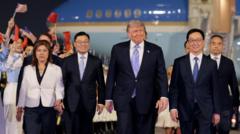
Air Force One touched down in Beijing with a heavy, metallic thud that echoed across the tarmac of the Middle Kingdom. On the surface, the scene was a carefully choreographed ballet of red carpets, honor guards, and the sharp, rhythmic clicking of cameras. But beneath the polished veneer of diplomatic protocol, two men were preparing to sit across from one another to settle a debt of history and a future of uncertainty.
Donald Trump stepped off the plane into a city that breathes the weight of five thousand years. Xi Jinping waited for him, not just as a head of state, but as the architect of a "Chinese Dream" that was increasingly colliding with the American reality. This wasn't just a meeting about trade deficits or regional security. It was a collision of two distinct worlds. If you liked this piece, you might want to read: this related article.
The Ledger of Broken Things
Think of a small-town manufacturer in Ohio. Let’s call him Jim. For decades, Jim’s family business forged the steel that built American bridges. But lately, Jim’s shop has gone quiet. The orders have dried up, moved across the Pacific where labor is cheap and environmental regulations are a distant suggestion. To Jim, "Trade Deficit" isn't a line item on a spreadsheet in D.C. It’s the sound of silence in his factory. It’s the $347 billion gap that feels like a hole in his pocket.
Trump arrived in Beijing carrying Jim’s frustration. He brought a ledger of grievances that went beyond simple math. He was there to talk about the forced transfer of technology—the invisible tax American companies pay to play in the Chinese market. It’s the price of admission that often costs a company its soul, handing over the very intellectual property that made them successful in the first place. For another look on this event, refer to the latest update from Al Jazeera.
Across the table, Xi Jinping looked at the same numbers and saw a different story. To him, China isn't "stealing" the future; it is reclaiming its rightful place at the center of the world. After a century of humiliation, China views its economic rise as an act of cosmic correction. Every factory opened in Shenzhen is a brick in the wall of their new empire.
The tension in the room was thick enough to touch. On one side, the American demand for "fairness" and "reciprocity." On the other, the Chinese insistence on "sovereignty" and "development." They were speaking two different languages, even with the best interpreters in the world.
The Shadow of the Persian Gulf
While the trade war simmered, a more immediate, more volatile ghost haunted the banquet halls: Iran.
Earlier that year, the Trump administration had signaled a hard pivot away from the nuclear deal, seeking to squeeze Tehran through "maximum pressure." But China is the primary lifeline for Iranian oil. For Xi, Iran isn't just a geopolitical partner; it’s a gas station.
Imagine a massive tanker drifting through the Strait of Hormuz. It carries the lifeblood of Chinese industry. If Trump succeeds in cutting off that flow, the lights in those Shenzhen factories start to flicker. Xi knows this. He also knows that Iran is a crucial piece of his "Belt and Road" initiative—a modern-day Silk Road designed to ensure that all paths lead to Beijing.
Trump’s mission was to convince Xi that a nuclear-armed Iran was a greater threat to global stability than a temporary disruption in oil prices. But in the grand strategy of the Forbidden City, stability is defined by the endurance of the Communist Party. Anything that threatens energy security threatens that stability. The two leaders were playing a high-stakes game of chicken with the world’s energy supply as the stakes.
A Line in the Water
Then there is Taiwan.
To the average American, Taiwan is a distant island that produces the chips inside their smartphones. To the Chinese Communist Party, it is the "unfinished business" of the revolution. It is a sacred cause.
During the meetings, the air grew noticeably colder when the subject shifted to the South China Sea and the Taiwan Strait. Trump’s "America First" policy created a strange paradox. While he questioned the value of old alliances, he also increased arms sales to Taipei. To Xi, this was more than a policy disagreement. It was a violation of the "One China" principle, a direct challenge to the territorial integrity of his nation.
Consider the perspective of a young software engineer in Taipei. She spends her days coding for a global tech giant, but she sleeps with an ear turned toward the sea, wondering if the status quo will hold for another year. She is the human face of a "strategic ambiguity" that is becoming less ambiguous by the day.
Trump used Taiwan as a lever. Xi viewed it as a non-negotiable. When these two forces meet, the friction doesn't just create heat; it risks a fire that could consume the entire Pacific.
The Forbidden City and the Twitter Feed
The optics were grand. Xi took Trump on a private tour of the Forbidden City, a gesture of "state visit-plus" treatment rarely afforded to foreign leaders. They walked through the Hall of Supreme Harmony, where emperors once sat on the Dragon Throne.
It was a brilliant piece of theater. Xi was showing Trump the scale of Chinese history, subtly reminding him that while American presidents come and go every four or eight years, the Chinese state endures for millennia.
Trump, ever the performer, responded with his own brand of digital diplomacy. He praised the hospitality, he marveled at the sights, but he never let go of the "America First" rhetoric that got him elected. He was the salesman trying to close the biggest deal of his life in a room filled with people who invented the art of the long game.
But the real work happened behind closed doors, away from the gold-leafed ceilings. It happened in the grueling sessions between commerce secretaries and trade representatives. It happened in the whispered sidebars about North Korea’s missile tests.
China holds the keys to the North Korean problem. Trump needed Xi to tighten the noose on Kim Jong-un. Xi, in turn, wanted a guarantee that a collapsed North Korea wouldn't result in a unified, pro-American peninsula on his doorstep. It was a trade of nightmares.
The Invisible Cost of Silence
What the official communiqués don't tell you is the psychological toll of this rivalry.
Businesses on both sides of the ocean began to hold their breath. Investment slowed. Supply chains, once thought to be permanent, began to fray as companies looked for "anywhere but China" solutions. The era of hyper-globalization, where everyone assumed the world would just keep getting flatter, was dying in real-time in the Great Hall of the People.
The human element of this shift is profound. It’s the researcher who suddenly finds their visa revoked. It’s the farmer in Iowa watching the price of soybeans plummet because of retaliatory tariffs. It’s the sense that the two most powerful engines of the global economy are no longer pulling in the same direction, but are instead trying to tear the hitch apart.
The talks ended with a flurry of signed "memorandums of understanding"—a phrase that in the world of diplomacy often means "we agree to keep talking so we don't start fighting." There were deals announced for Boeing planes and American beef, totaling billions of dollars. They were the "spoils" that Trump could take home to his base as proof that his approach was working.
But those deals were the low-hanging fruit. The core issues—the structural imbalances, the cyber-espionage, the maritime disputes—remained as jagged and dangerous as ever.
The Long Shadow
As Air Force One climbed back into the gray Beijing sky, the world looked much the same as it had forty-eight hours earlier. Yet, everything had changed.
The "State Visit-Plus" was over. The theater had concluded. What remained was the cold, hard reality of two superpowers locked in a struggle for the 21st century.
There was no "Game-Changer" moment. There was no "Holistic Synergy." There was only the uncomfortable realization that the gap between Washington and Beijing is not a distance of miles, but of fundamental values.
The steelworker in Ohio and the engineer in Taipei are still waiting. They are the ones living in the spaces between the headlines, watching as the two most powerful men on earth try to navigate a relationship that is too big to fail and too complex to fix.
The sun set over the yellow-tiled roofs of the Forbidden City, casting long, distorted shadows across the courtyards. The emperors are gone, but the throne remains. And as the world watched the two leaders depart, it became clear that the real high-stakes talks aren't the ones that happen in front of cameras. They are the ones that happen in the quiet moments of realization, when both sides understand that the only thing more expensive than a bad deal is no deal at all.
The ink on the agreements was dry before the plane cleared Chinese airspace, but the story of this rivalry was only beginning its most turbulent chapter.