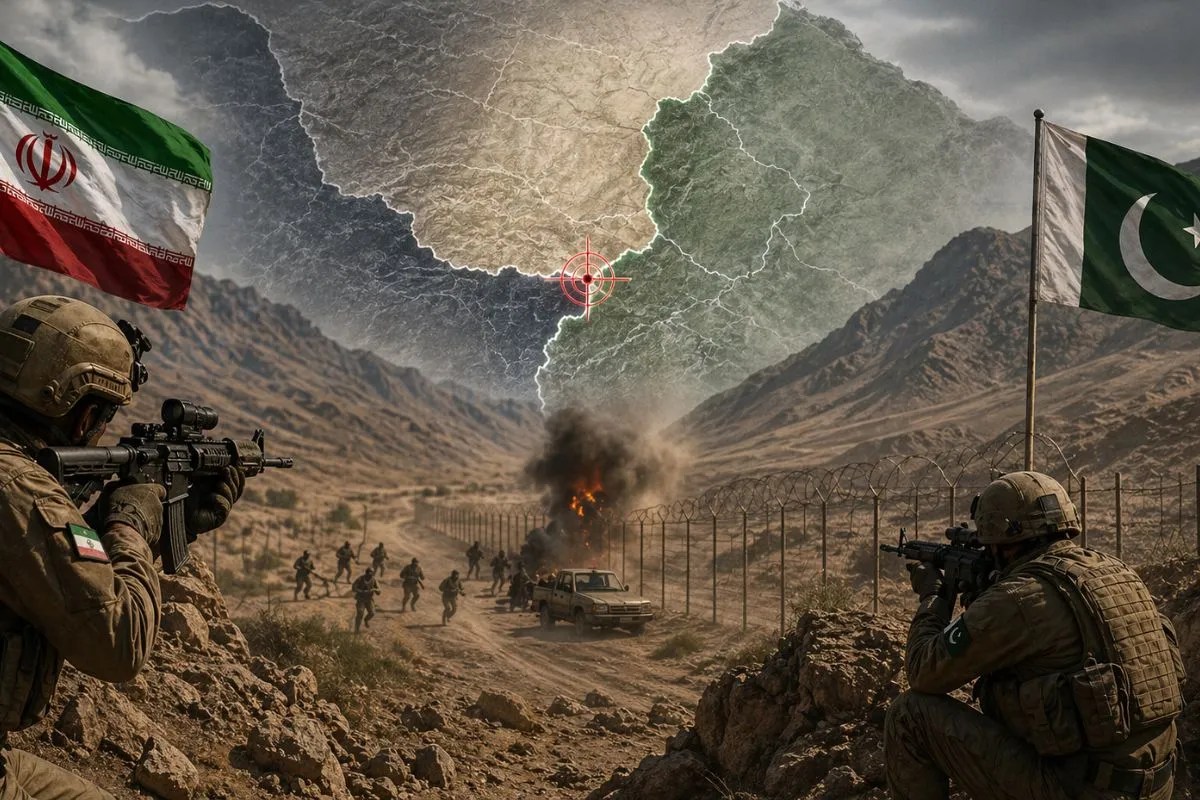
The air in the Sistan-Baluchestan province doesn't just sit; it heavy-handedly weighs on your lungs, thick with the scent of dry earth and the metallic tang of old tension. This is a land where the horizon is a jagged line of scorched mountains and the silence is rarely peaceful. It is a frontier where two nations, Iran and Pakistan, share a border that is often less a line on a map and more a scar across the desert.
Recently, that scar ripped open again.
In the early hours, when the light was still a bruised purple against the Iranian sky, the quiet was shattered. This wasn't the sound of the wind. It was the rhythmic, violent staccato of a military operation. Iranian security forces, specifically the Islamic Revolutionary Guard Corps (IRGC), moved with a cold, calculated precision against a group of militants who had crossed over from Pakistani soil. By the time the sun had fully cleared the peaks, dozens of these insurgents lay dead in the dust.
The official reports are sterile. They speak of "neutralized threats" and "border integrity." But to understand the weight of these bullets, you have to look at the invisible stakes that govern this stretch of No Man's Land.
The Shadow in the Ravine
Imagine a young man named Jalal. He isn't a high-ranking commander or a political theorist. He is a hypothetical local living in a village near Saravan, a place where the infrastructure is as brittle as the parched ground. For Jalal, the border isn't a geopolitical concept. It is a source of constant, low-thrumming anxiety. When he hears the thunder of mortars, he doesn't think about international law. He thinks about whether his children should sleep under their beds tonight.
The men who crossed the border that night weren't there for a skirmish. They were there for a message. These groups—often labeled as Jaish al-Adl or similar separatist factions—operate in the vacuum left by poverty and rugged geography. They move through the ravines like ghosts, using the porous nature of the Pakistan-Iran divide to strike and then vanish back into the safety of the Balochistan hills.
But this time, the ghosts hit a wall.
Iran’s response was not a frantic scramble; it was an ambush. Intelligence had been simmering for days. The IRGC had been tracking movement, watching thermal signatures dance across monitors in darkened command centers. When the militants moved into a designated "kill zone" near the border, the trap snapped shut.
A Marriage of Necessity and Spite
Why does this keep happening? To find the answer, we have to look past the smoke.
The relationship between Tehran and Islamabad is a strange, strained dance. They call each other "brotherly nations" in press releases while eyeing each other with deep-seated suspicion over tea. Iran feels that Pakistan isn't doing enough to police its side of the wilderness. Tehran suspects that these militants find safe harbor, perhaps even tacit support, within the labyrinth of Pakistani intelligence circles.
Conversely, Pakistan feels the sting of Iranian influence and the occasional "hot pursuit" where Iranian drones or shells cross the line without an invitation. It is a cycle of blame that has been spinning for decades.
But the recent escalation feels different. It feels personal.
The militants killed in this latest operation weren't just low-level foot soldiers. Intelligence sources suggest they were part of a coordinated effort to destabilize the Sistan region ahead of significant regional developments. When dozens of fighters are eliminated in a single sweep, it isn't just a tactical victory. It is a decapitation. It is a warning to those sitting in the shadows across the line: We are no longer waiting for you to come to us.
The Cost of the Buffer Zone
There is a specific kind of exhaustion that comes with living in a buffer zone.
In the tea shops of Zahedan, the talk isn't about the glory of the state. It’s about the price of eggs and the fear that the "spillover" will finally reach the city gates. The human element of this conflict is often buried under the headlines of "Terrorists Killed." We forget that every bullet fired at the border echoes in the economy of the region.
Investment doesn't flow into places where the night is owned by insurgents. Schools don't flourish when the teachers are afraid of kidnappings. The real tragedy of the Sistan border isn't just the blood spilled in the dirt; it's the potential that has been strangled by forty years of intermittent warfare.
Consider the reality of a border guard. These are often young men far from home, staring into the pitch-black night with night-vision goggles that turn the world a ghostly, glowing green. Every rustle of a lizard, every shift of a stone, could be a suicide vest or a sniper’s breath. They are the human tripwires of a grander game they didn't choose to play.
The Mechanics of the Strike
The operation itself was a masterclass in modern asymmetric warfare. It wasn't a blind charge. It involved the synchronization of drone surveillance, signal intercepts, and ground-based elite units.
- Detection: Long-range acoustic sensors picked up the movement of vehicles in a dry riverbed.
- Identification: Drones equipped with infrared cameras confirmed the presence of heavy weaponry—items not carried by simple smugglers.
- Engagement: Instead of a frontal assault, the Iranian forces utilized "shaping fires," using artillery to push the militants into a bottleneck.
The militants, caught in a topographical vice, had nowhere to go. The rugged terrain that usually acted as their shield became their tomb. The sheer number of casualties—dozens in a single night—suggests that the insurgent group was moving in a large, confident formation, perhaps expecting the usual cat-and-mouse game rather than a full-scale hammer blow.
The Silence After the Storm
The morning after such an event is always the strangest time. The smoke clears, the bodies are recovered, and the official statements are drafted in polished offices hundreds of miles away in Tehran.
"The borders of the Islamic Republic are a red line," the generals say.
But for the people on the ground, the red line is literal. It is the blood on the sand. It is the color of the dust kicked up by the retreating humvees.
There is no easy "conclusion" to a story that has been written in blood for generations. Pakistan will likely protest the "unilateral action." Iran will likely demand more "cooperation." They will continue to share a 900-kilometer border that refuses to be tamed.
As the sun sets over Sistan today, the mountains look the same as they did yesterday. They are indifferent to the men who died in their shadows. The wind will eventually blow the scent of cordite away, leaving only the smell of dry earth and the lingering, uncomfortable knowledge that the silence is only temporary.
Somewhere in the darkness across the line, someone is already planning the next crossing. And somewhere in a bunker, a finger is hovering over a screen, waiting for a heat signature to move.
The border remains. The fire is just waiting for more fuel.


