The rain did not fall. It fell like a weight.
For three days, the sky over north Edmonton had been the color of a bruised iron skillet. When the thunderstorms finally broke over the weekend, they did not arrive with the usual rolling majesty of a prairie storm. Instead, they brought a violent, relentless deluge that turned residential streets into rushing canals. It was the kind of rain that makes you double-check the sump pump in the basement. The kind that makes you stare out the window, watching the gutters choke on dead leaves and plastic wrappers. Meanwhile, you can find other developments here: The Cost of the Chokepoint.
Marcus stood at his kitchen window in north Edmonton, holding a mug of black coffee that had gone cold.
Outside, the storm was performing its final, frantic crescendo. The sky was dark, but the streetlights were already flickering, cast in a strange, watery halo. To Marcus, and to thousands of other Edmontonians trying to dry out their basements, the storm seemed like a temporary nuisance. A headache. A reason to cancel Sunday plans. To understand the bigger picture, we recommend the recent report by Associated Press.
They had no idea that beneath the asphalt, a quiet, invisible catastrophe was already unfolding.
The water had found a weakness. Far below the surface of the road, where the city’s aging storm drains and sewer pipes snake through the dark soil, a tiny crack had yielded to the pressure. When hundreds of millimeters of rain fell in a matter of hours, that crack became a torrent. Soil washed away in the dark. Sand and gravel flowed into the broken pipe, carried off by the subterranean flood.
Up on the surface, everything looked perfectly normal. The grey tarmac of the quiet northern avenue remained flat, solid, and dependable.
Until it wasn't.
The Collapse
It happened in a fraction of a second.
There was no dramatic explosion. There was only a wet, heavy thud that rattled the windows of the nearby bungalows, followed by a sound like a long, deep sigh.
Marcus ran to his front door, throwing it open to the damp air. The smell of ozone and wet earth hit him first. Then came the smell of raw, stagnant mud. When he looked down the street, his brain struggled to process what his eyes were seeing.
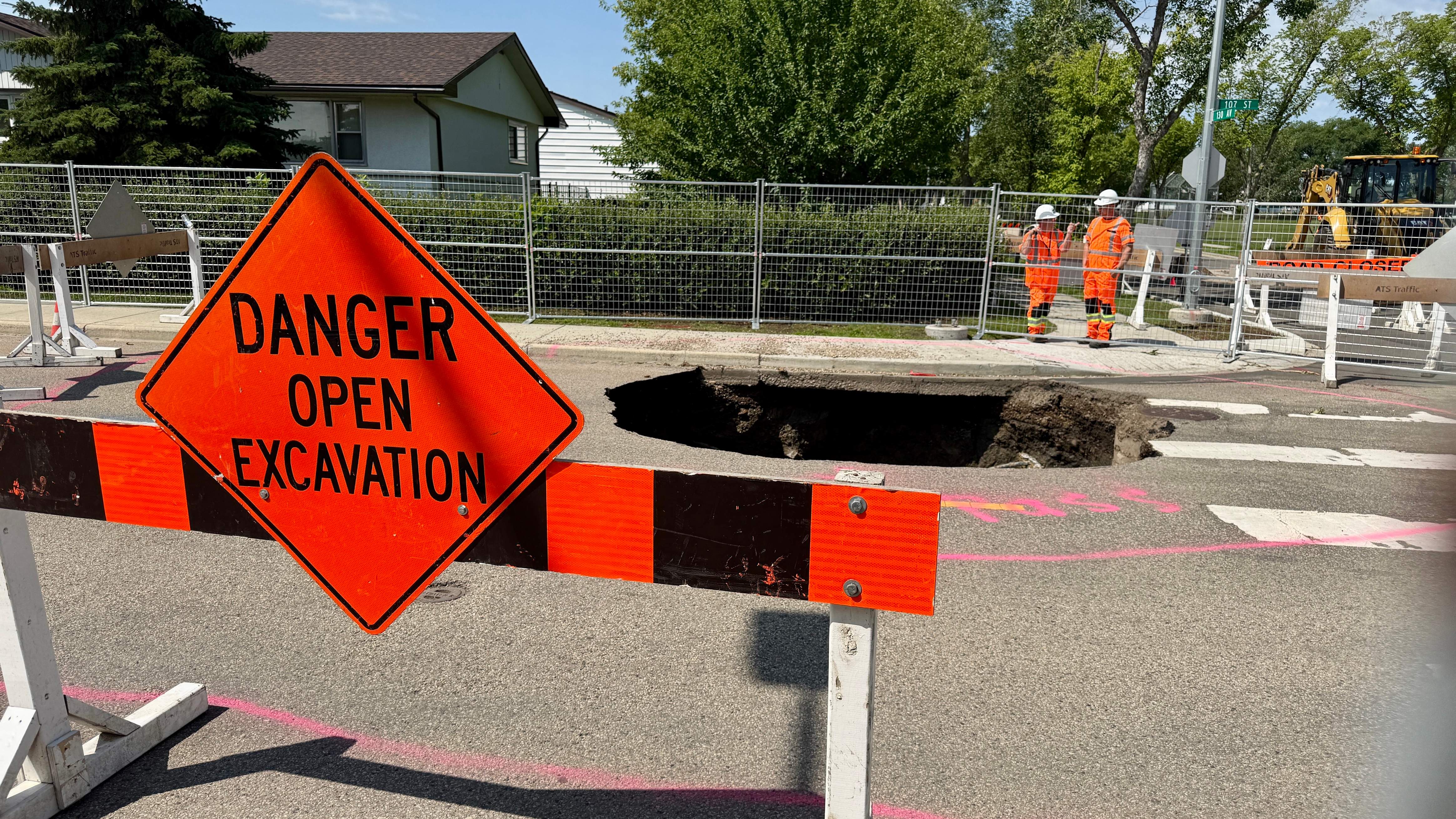
A massive, jagged circle had been punched directly into the middle of the road.
Where solid municipal engineering had existed moments before, there was now only a yawning, black void. The edges of the asphalt were suspended in mid-air, jagged and crumbling like stale cookies. Beneath them, a cavernous drop plummeted into the dark.
A sinkhole.
In the immediate aftermath of a disaster, even a localized one, there is a distinct kind of silence. It is the silence of disbelief. Marcus walked to the edge of his driveway, his boots squelching in the grass, keeping a healthy distance from the rim. He could hear the sound of rushing water echoing from deep within the hole, a hollow, metallic gurgle that sounded entirely out of place in a quiet residential neighborhood.
This was not a mere pothole. This was an abyss. It was wide enough to swallow an SUV whole and deep enough to hide a city bus.
Within thirty minutes, the quiet street was alive with the harsh, rhythmic flashing of amber and blue lights. Yellow caution tape fluttered violently in the damp wind, strung between trees and street lamps. Men and women in high-visibility vests stood at the edge of the void, their faces illuminated by the glare of their flashlights as they peered into the darkness.
They looked small against the scale of the collapse.
The Illusion of Solidity
We live our lives under a comforting illusion.
We walk, drive, and build our homes on the assumption that the ground beneath our feet is solid. We trust the concrete. We trust the tarmac. We treat the earth as an unyielding, permanent platform.
But the truth is far more fragile. Beneath the thin crust of our roads lies a complex, delicate ecosystem of pipes, wires, and shifting soils. In cities like Edmonton, where extreme temperature swings stretch and compress the earth every single year, this infrastructure is constantly under siege. Winter freezes it. Spring thaws it.
And summer storms test it to its absolute limits.
Consider what happens when a storm of this magnitude hits. The sheer volume of water searching for a way down is staggering. If the underground network has even a single point of failure—a rusted joint, a shifted pipe, a tiny crack from a winter frost heave—the water will find it. Once the water gets behind the pipe, it begins to carry the surrounding earth away.
It is a process called piping. It is slow. It is silent.
For weeks, or even months, a hollow chamber can grow beneath a busy road. Hundreds of cars drive over it every day, entirely unaware that they are hovering over a vacuum. The only thing holding them up is a thin, brittle bridge of asphalt. Then, a massive weekend storm provides the final, crushing weight of water, and the bridge gives way.
The sinkhole in north Edmonton was not an anomaly. It was a symptom.
The Human Toll of a Hole in the Ground
When we read the headlines about infrastructure failures, we usually see them expressed in numbers. We read about the diameter of the hole, the estimated cost of repairs, and the expected delay in traffic.
But the real impact of a sinkhole is measured in human disruption.
For the residents of the affected north Edmonton block, the opening of the sinkhole felt like an immediate eviction from normalcy. Water services had to be shut off as engineers scrambled to assess the damage to the water mains. Gas lines had to be checked for leaks, leaving families huddled in their homes without heat or the ability to cook a warm meal.
For elderly residents on the block, the sudden closure of the road meant their daily routines were instantly severed. Delivery vans could not reach their doors. Home care workers had to park blocks away and trek through the mud and rain to reach their patients.
Then there was the fear.
"Every time I hear a heavy vehicle drive by on the next street over, I jump," Marcus admitted, looking out at the barricades. "You start wondering where else the ground is empty. Is my driveway safe? Is my basement foundation about to drop into a hole?"
This psychological toll is rarely captured in the city's press releases. When the ground beneath you literally gives way, it shakes your sense of basic safety. The home that felt like a sanctuary suddenly feels like a raft floating on an unstable sea.
The city crews worked through the night. Under the harsh glare of portable floodlights, the excavator claws tore at the broken asphalt, digging deeper to find the source of the wash-out. The sound of heavy diesel engines rumbled through the neighborhood, a constant reminder of the battle being waged against the subterranean elements.
The True Cost of What We Ignore
It is easy to blame the city when things like this happen. We want to point fingers at municipal budgets, delayed maintenance, or slow response times.
But the reality is far more complex, and far more difficult to face.
Most of our modern cities are built on infrastructure that was laid down decades ago, during periods of rapid post-war expansion. These pipes and sewers were designed for a different era. They were built for a time when storms were less intense, and when urban populations were much smaller.
Today, we are asking these aging systems to do more than they were ever designed to do. We pave over green spaces that used to absorb rainwater, forcing millions of additional gallons into concrete channels that are already crumbling from age.
Repairing these hidden networks is not glamorous work. It does not win elections. It is incredibly expensive, disruptive, and entirely invisible to the public until something goes wrong. We happily celebrate a new park or a shiny recreation center, but we rarely clamor for millions of dollars to be spent on replacing sewer pipes three meters underground.
Until the street swallows a car.
By Tuesday morning, the rain had finally stopped, replaced by a pale, watery sunshine that did little to warm the damp air. The sinkhole was now surrounded by chain-link fencing and heavy equipment. The initial shock had worn off, replaced by the grim, dusty reality of a long-term construction project.
Marcus stood by the fence, watching a worker dump a massive load of coarse gravel into the pit. The sound of the rocks hitting the bottom was dull and heavy.
The hole would be filled. The pipes would be patched. The asphalt would eventually be repoured, looking shiny and seamless once more. People would drive over this exact spot again, their minds occupied by grocery lists, work deadlines, and weekend plans. They would forget that the earth had ever opened up here.
But Marcus knew he would never look at the street the same way again.
He looked down at the solid pavement beneath his boots, then out at the construction crew working in the mud. He knew the truth now. The ground we walk on is only as strong as the care we put into the things we cannot see.