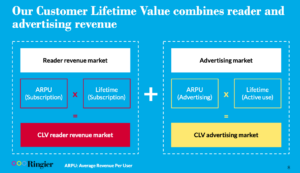
The deprecation of third-party cookies and the tightening of mobile operating system privacy frameworks have forced digital media conglomerates to confront a fundamental valuation problem. Anonymous traffic is a depreciating asset. When a publisher cannot reliably resolve a user's identity across sessions and devices, the economic yield of an impression collapses into commodity programmatic pricing. Swiss media group Ringier’s ongoing data initiative provides an empirical case study in reversing this value destruction. By shifting its operational focus toward user authentication—converting anonymous readers into logged-in subscribers and registered users—Ringier demonstrates that authenticated users generate substantially higher unit economics than their anonymous counterparts.
Understanding why logged-in users command a valuation premium requires decomposing the mechanics of digital advertising and subscription funnels. The value differential is not merely a byproduct of having an email address on file; it is the result of deterministic identity resolution, longitudinal behavioral tracking, reduced customer acquisition costs, and higher propensity to convert.
The Three Pillars of Authenticated User Value
To quantify the gap between anonymous and authenticated cohorts, media operators must isolate the structural mechanisms that drive revenue per user. In Ringier’s ecosystem—which spans news portals, marketplaces, and digital media brands—the value creation of a logged-in state rests on three distinct economic pillars.
Deterministic Identity Resolution and Yield Expansion
Anonymous browsing relies on probabilistic matching—inferring identity through IP addresses, browser fingerprinting, and transient cookies. Probabilistic models suffer from signal decay, especially in environments like Apple’s Safari (Intelligent Tracking Prevention) and Firefox, where third-party cookies are blocked by default and first-party storage is capped. When a user logs in via a unified single sign-on (SSO) infrastructure, the publisher establishes a deterministic identifier. This persistent ID allows the publisher to stitch together cross-device behavior (mobile web, native app, desktop) into a single unified profile. For advertisers, deterministic reach eliminates wasted ad spend on frequency capping failures and unverified demographics. In programmatic auctions and direct-sold campaigns, inventory tied to deterministic first-party segments clears at significantly higher CPMs (cost per mille) because the buyer can verify audience composition without relying on third-party data brokers.Signal Density and Behavioral Propensity Modeling
A single pageview provides minimal predictive power. Value emerges from longitudinal data—observing how a user’s content consumption evolves over weeks and months. Logged-in states allow data science teams to capture high-frequency behavioral signals without interruption. By analyzing article completion rates, scroll depth, topic affinity, time-of-day engagement, and referral pathways over an extended time horizon, publishers can build propensity models. These machine learning models score users on their likelihood to churn, their sensitivity to paywalls, and their affinity for specific commercial verticals (such as automotive, finance, or real estate). Instead of deploying static, blunt-force paywalls that alienate casual readers or leave money on the table with power users, the system dynamically adjusts friction—serving registration walls to mid-funnel readers and hard subscription offers to high-propensity cohorts.Ecosystem Cross-Pollination and CAC Amortization
For a diversified media group like Ringier, a centralized login architecture (such as OneID or similar group-wide SSO solutions) transforms isolated properties into a networked ecosystem. Acquiring a user on a high-volume, top-of-funnel news portal is relatively inexpensive compared to acquiring a customer for a specialized digital marketplace or a niche financial publication. Once the user authenticates on Property A, the media group can introduce them to Property B with zero incremental customer acquisition cost (CAC). The shared identity layer allows the group to observe cross-domain intent. A user reading real estate news on a general portal can be segmented and retargeted with mortgage comparison tools or property listings on a sister marketplace, capturing value across multiple stages of the consumer lifecycle.
The Mechanics of the Identity Conversion Funnel
Establishing that logged-in users are more valuable does not solve the operational challenge of getting them to authenticate. Consumers exhibit high friction sensitivity; every mandatory form field degrades conversion rates. Executing a data initiative like Ringier’s requires engineering a friction-adjusted value exchange.
The conversion from anonymous visitor to authenticated user follows a strict causal sequence:
- Initial Exposure and Trust Establishment: The user arrives via search, social, or direct navigation. At this stage, any hard barrier causes immediate bounce. The system must deliver immediate editorial or utility value to establish baseline trust.
- Progressive Profiling: Rather than demanding a full demographic profile upfront, sophisticated data architectures rely on progressive profiling. The initial registration gate asks only for the minimum viable identifier—typically an email address or a federated social/Apple login—lowering the cognitive and time cost of authentication.
- Contextual Value Triggers: Registration prompts are triggered by specific high-intent actions rather than arbitrary pageview counts. Examples include saving an article, commenting in a community forum, customizing a news feed, entering a sweepstake, or accessing a specialized data tool. The user trades identity for immediate functional utility.
- Attribute Enrichment: Once authenticated, the publisher enriches the profile passively through behavioral observation and actively through micro-surveys or preference centers. Over time, the sparse initial record becomes a dense matrix of explicit and implicit attributes.
Direct Monetization vs. Indirect Yield: The Dual Revenue Engine
A common strategic error in digital publishing is viewing user registration solely as a stepping stone to paid subscriptions. While authenticated users do convert to paid subscribers at multiples higher than anonymous visitors—largely because habitual engagement is a prerequisite for payment—the advertising yield from non-paying registered users is equally vital to the business model.
In an ad-supported tier, logged-in users generate superior Average Revenue Per User (ARPU) through three operational mechanisms:
- Addressability in Cookie-Restricted Environments: As browsers restrict third-party tracking, up to 40% to 50% of a publisher's traffic becomes unaddressable via traditional programmatic pipes. Logged-in users bypass this limitation entirely. By passing hashed, encrypted identifiers (such as Unified ID 2.0 or RampID) into the bidstream, the publisher restores addressability, allowing demand-side platforms (DSPs) to bid aggressively on inventory that would otherwise be blind.
- Custom First-Party Audience Packaging: Publishers can bundle logged-in behavioral cohorts into high-margin private marketplace (PMP) deals. Instead of selling generic "run-of-site" impressions, sales teams sell verified segments—such as "In-Market Auto Buyers" or "C-Suite Tech Decision Makers"—built directly from first-party consumption data. This shifts the publisher from competing on volume against ad networks to competing on precision against walled gardens.
- Reduced Ad Load and Superior User Experience: Because authenticated impressions command higher CPMs, the publisher requires fewer ad units per page to achieve the same revenue target. Reducing ad clutter improves page load speeds, lowers bounce rates, and increases session duration. This creates a compounding flywheel: better user experience drives higher engagement, which generates more first-party data, which further inflates CPMs.
The Operational Bottlenecks and Structural Limitations
While the economic thesis for first-party data initiatives is sound, execution introduces severe technical, regulatory, and organizational friction. Media executives frequently underestimate the operational overhead required to maintain an authenticated ecosystem.
The Authentication Ceiling
No matter how optimized the registration funnel is, a substantial percentage of traffic will never log in. Casual readers arriving from search engines or social aggregators have low brand affinity and high resistance to authentication prompts. Over-indexing on registration walls can choke top-of-funnel reach, starving the ecosystem of the new visitors needed to replenish churned users. Publishers must constantly balance reach against addressability, running continuous A/B tests to determine the exact threshold where registration friction begins to destroy total programmatic revenue.
Data Decay and Hygiene Costs
First-party data is not static. User interests shift, jobs change, and email addresses go dormant. An unmaintained customer data platform (CDP) rapidly accumulates stale attributes, leading to degraded targeting accuracy and declining advertiser trust. Maintaining high signal fidelity requires continuous data hygiene, decay algorithms that weight recent behavior more heavily than historical actions, and automated re-engagement workflows to purge inactive profiles.
Regulatory Compliance and Privacy Overhead
Operating a centralized identity graph across multiple brands exposes the organization to strict regulatory scrutiny under frameworks like the GDPR in Europe and CCPA/CPRA in the United States. Explicit consent management is non-negotiable. If a user revokes consent on one property, the identity architecture must propagate that opt-out across the entire ecosystem in real time. Failure to synchronize consent states across data lakes, ad servers, and third-party clean rooms creates catastrophic legal and reputational liability.
Organizational Silos
The greatest barrier to replicating Ringier’s success is rarely technological; it is structural. Legacy media companies often operate individual titles as autonomous fiefdoms with competing P&Ls. Editorial teams resist registration gates out of fear of declining traffic metrics, while individual brand managers hoard user data rather than contributing to a shared group-wide CDP. Without executive mandate to align incentives around group-level lifetime value (LTV) rather than brand-level pageviews, centralized data initiatives stall in internal politics.
Strategic Execution: Building the Authenticated Moat
For publishers and digital platforms seeking to capture the valuation premium of logged-in audiences, piecemeal tactics will fail. Success requires an integrated architecture that aligns product, engineering, editorial, and commercial teams around deterministic identity.
Deploy a Unified Identity Layer Before Monetization
Implement a group-wide single sign-on infrastructure that decouples user identity from individual brands. Ensure the schema supports both explicit data (registration fields, preferences) and implicit telemetry (clickstream, dwell time) unified under a single persistent user ID.Engineer Dynamic, Propensity-Driven Friction
Replace static rules-based registration walls with machine learning models that evaluate user intent in real time. Serve frictionless access to low-propensity visitors to maximize SEO and social reach, while deploying targeted value exchanges to high-frequency readers at the exact moment of peak engagement.Establish Data Clean Rooms for Commercial Activation
To monetize first-party data without exposing raw personally identifiable information (PII) to advertisers, deploy data clean room infrastructure. This allows enterprise advertisers to match their own CRM records against the publisher’s authenticated audience in a privacy-compliant environment, unlocking high-margin, closed-loop attribution campaigns that justify premium pricing.Realign Editorial and Product KPIs
Eliminate raw pageviews and unique anonymous visitors as primary performance indicators. Anchor product and editorial incentives to authenticated active users (AAU), registration conversion rates, and cohort retention. When editorial teams see that specific investigative formats or utility features drive high authentication rates, content strategy naturally evolves toward high-LTV journalism and tools.
The structural shift in digital media is irreversible. As third-party signals vanish, the valuation gap between authenticated ecosystems and anonymous traffic farms will continue to widen. Media organizations that treat user identity as a core infrastructure asset—rather than a marketing afterthought—will capture disproportionate market share, commanding the pricing power and customer retention required to survive the post-cookie era.