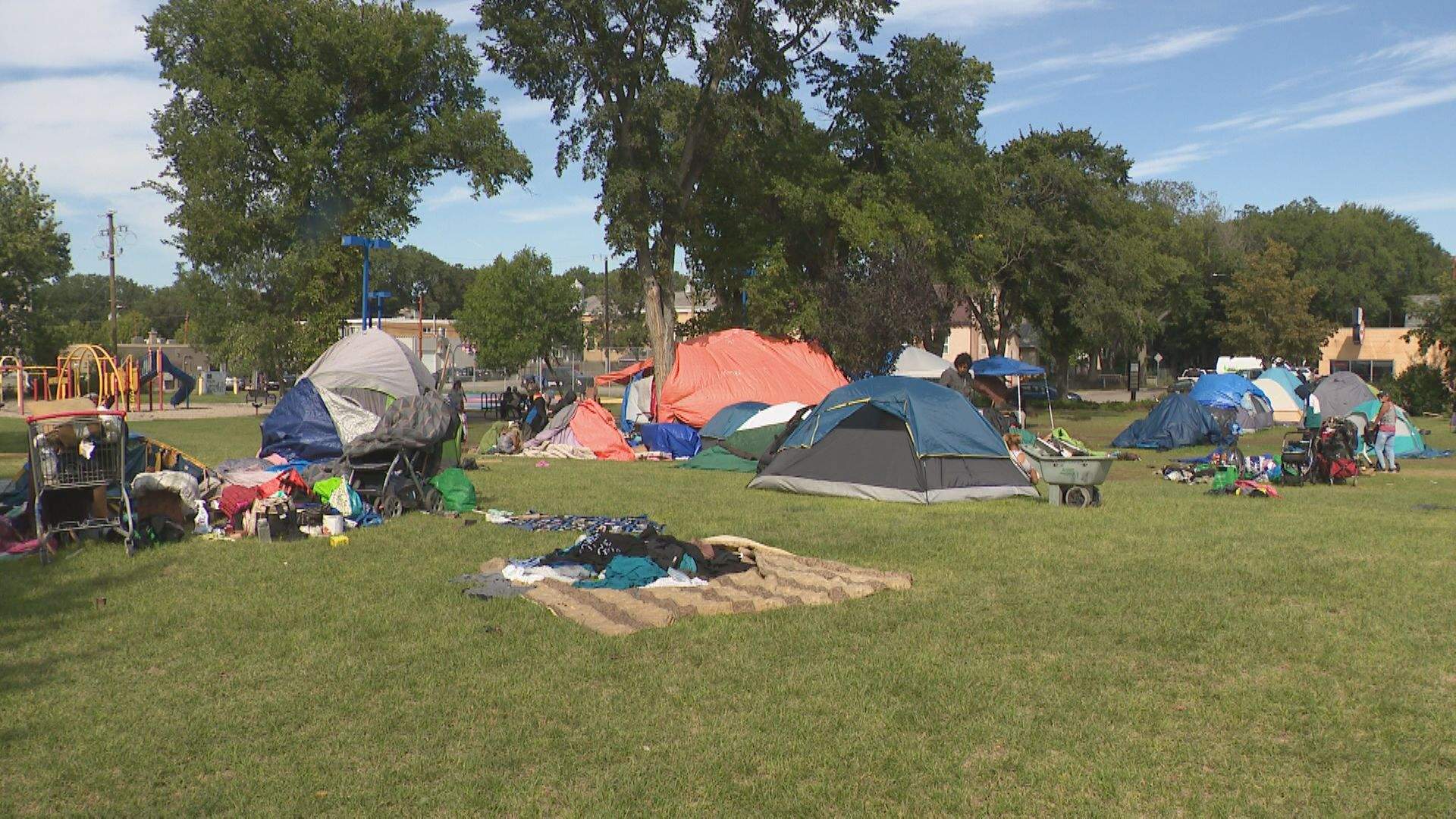
Urban encampments represent a high-friction intersection between systemic housing market failures, municipal resource constraints, and localized neighborhood externalities. When informal settlements stabilize past a sixty-day threshold—such as the Pepsi Park encampment in Regina, housing roughly one hundred and fifty individuals across seventy tents—they transition from transient anomalies into permanent parallel administrative units. Analyzing this environment requires moving past political rhetoric to evaluate the explicit cost functions, logistics, and operational bottlenecks that dictate municipal survival.
The Operational Infrastructure Deficit
The primary challenge of any sustained encampment is the absence of base-layer infrastructure. While municipal response teams and fire departments can deploy temporary sanitation measures like portable toilets, the baseline utility curve flatlines rapidly without permanent access to water, waste management, and electrical grids.
- Power Generation Constraints: Without grid ties, populations rely on hazardous combustion methods or improvised wiring for thermal regulation and device charging, amplifying fire risks. Mutual aid groups attempting to deploy micro-scale solar arrays face high capital expenditure hurdles relative to decentralized fundraising yields.
- Sanitation and Storage Bottlenecks: Portable sanitation handles baseline waste disposal but fails to account for hygiene maintenance or personal asset protection. The lack of secure storage forces residents to carry or risk losing essential identification, survival gear, and medication.
- Thermal Vulnerability: As seasonal temperatures drop, the energetic cost of survival rises exponentially. Uninsulated soft-shelled shelters create a severe heating deficit, shifting the operational focus from community organization to acute winterization logistics.
The Multi-Tiered Stakeholder Cost Function
Urban encampments impose distinct economic and social costs across four primary stakeholder groups, each operating under divergent constraints and incentives.
- Encampment Residents: Face high mortality risks, psychological attrition from chronic instability, and physical insecurity. Their primary optimization variable is immediate physical safety coupled with a transition to permanent low-barrier housing.
- Local Municipalities: Caught between legal obligations, public health mandates, and taxpayer pressure. Municipalities incur high recurring costs for policing, emergency response, and localized environmental remediation, yet lack the capital reserves to solve upstream housing deficits independently.
- Surrounding Neighborhoods and Businesses: Experience concentrated negative externalities, including perceived or actual increases in property crime, retail disruption, and restricted access to public amenities. Their optimization metric is the preservation of local property values and neighborhood safety.
- Provincial and Federal Jurisdictions: Control the fiscal levers necessary for systemic interventions—such as housing construction grants and rent control legislation—but often practice regulatory displacement, shifting financial burdens downward to municipal tax bases.
The Failure Modes of Mutual Aid Interventions
Grassroots mutual aid organizations serve as essential stopgap triage units, yet their operational model possesses inherent structural ceilings. Donations fluctuate based on media visibility, creating volatile revenue streams that cannot reliably fund long-term infrastructure like off-grid solar micro-grids or professional health navigation.
Furthermore, decentralized volunteer networks lack enforcement mechanisms to manage internal community disputes or large-scale waste processing. When mutual aid groups attempt to substitute for state welfare apparatuses, they mask systemic policy failures, inadvertently creating a moral hazard where upper levels of government delay structural funding under the assumption that volunteer networks will absorb the humanitarian deficit.
Strategic Municipal Allocation Priorities
Resolving the friction points of sustained urban encampments requires replacing reactive clearance cycles with predictable capital allocation models. Municipalities shifting toward supportive management strategies must transition from ad-hoc provisions to standardized public-private resource pipelines.
Priority must be given to establishing centralized sanitation hubs and climate-controlled interim transition centers before the onset of extreme weather events. Concurrently, regional housing authorities must decouple social support services from sobriety mandates to lower the barrier of entry for chronic unhoused populations.
Capital must be directed toward permanent supportive housing rather than perpetual emergency management. Until systemic structural deficits in housing supply and income security are met with legislative market corrections, urban parks will continue to bear the physical weight of macroeconomic policy failures.