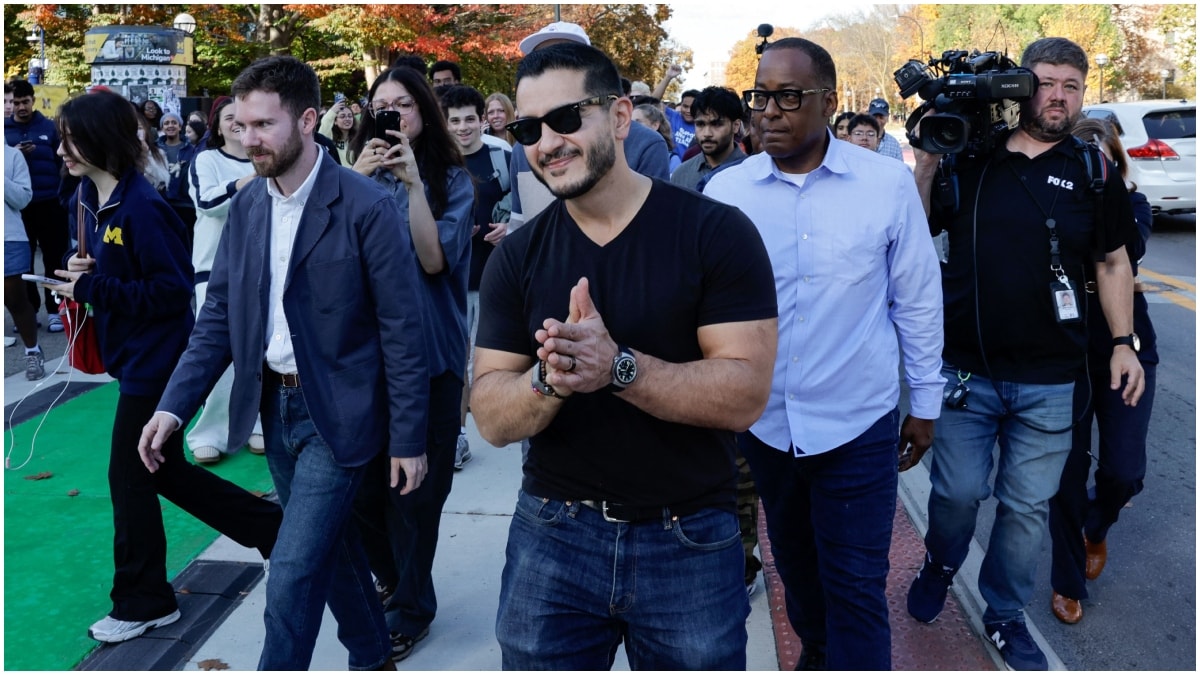
Evaluating Abdul El-Sayed’s viability in the 2026 Michigan United States Senate race requires stripping away biographical novelty and examining electoral mechanics. Standard political coverage focuses on identity milestones—specifically the prospect of El-Sayed becoming the first Muslim American elected to the upper chamber. While demographic representation carries symbolic weight, Senate campaigns are won through structural coalition building, primary turnout modeling, and resource allocation across disparate geographic media markets. The open seat created by Senator Gary Peters’ retirement presents a distinct strategic environment where a progressive outsider must convert ideological enthusiasm into durable general election margins in a state decided by razor-thin pluralities.
To understand El-Sayed’s trajectory, analysts must treat his candidacy not as a personality profile, but as a political enterprise operating within Michigan’s specific partisan constraints. His career—spanning academic epidemiology, municipal public health administration, progressive advocacy, and statewide campaigning—provides a unique operational toolkit. However, translating that background into a statewide victory demands solving the primary-to-general election pivot that historically stalls populist insurgencies in Rust Belt battlegrounds. Discover more on a similar issue: this related article.
The Structural Foundations of the Candidacy
A candidate’s biography only matters to the extent that it insulates them from opposition attacks or unlocks specific voter blocs. El-Sayed’s profile rests on three functional pillars that dictate how his campaign acquires voters and defends against standard political vulnerabilities.
Institutional Credentials vs. Outsider Positioning
Most progressive challengers suffer from an experience deficit, allowing moderate opponents to frame them as unqualified for federal governance. El-Sayed’s background disrupts this standard attack vector. Trained as a physician and holding a doctorate in public health as a Rhodes Scholar, he possesses traditional elite credentials. Crucially, his tenure as Executive Director of the Detroit Health Department—where he rebuilt municipal public health infrastructure post-bankruptcy—provides executive management metrics. More analysis by The New York Times explores comparable views on this issue.
In campaign operations, this creates an asymmetric advantage. He can deploy anti-establishment rhetoric targeting corporate lobbying and healthcare profiteering while simultaneously citing executive budget management and crisis response during the Flint water crisis. Voters skeptical of pure activists often accept progressive policy prescriptions when delivered by a technocrat who has managed a government agency.
The 2018 Gubernatorial Baseline
El-Sayed’s 2018 Democratic gubernatorial primary campaign against Gretchen Whitmer serves as the foundational dataset for his 2026 run. In 2018, he secured over 340,000 votes, finishing second with roughly 30 percent of the electorate.
Campaign strategists view a prior statewide run not as a loss, but as sunk-cost infrastructure acquisition. The 2018 cycle forced El-Sayed to build name recognition across Michigan’s 83 counties, establish donor networks, and stress-test his messaging in rural and suburban markets outside Southeast Michigan. Unlike a first-time statewide candidate who must spend the first six months of a primary cycle introducing themselves to voters, El-Sayed enters the 2026 contest with an established floor of progressive support and pre-existing volunteer lists.
Demographic Mobilization and Coalition Friction
Michigan’s Democratic coalition relies on a delicate equilibrium between three distinct groups: Black voters in urban centers like Detroit, organized labor in industrial corridors, and college-educated progressive voters in university towns and inner-ring suburbs. Layered onto this is Michigan’s substantial Arab American and Muslim population, concentrated heavily in Wayne, Oakland, and Washtenaw counties.
In recent election cycles, foreign policy—specifically U.S. policy in the Middle East—has introduced severe friction into this coalition, depressing turnout among Arab American and younger progressive voters. El-Sayed’s candidacy directly addresses this fracture. By offering descriptive representation alongside an anti-interventionist foreign policy platform, his campaign possesses the capacity to re-engage alienated voters in Dearborn, Hamtramck, and Ann Arbor. The strategic challenge lies in ensuring that the mobilization of this bloc does not alienate moderate suburban voters in Oakland and Macomb counties, where national security and traditional Democratic foreign policy alignments carry different weight.
The Primary Mechanism and Vote-Splitting Dynamics
Winning a contested Democratic primary in Michigan requires navigating a fragmented field. Because Senator Peters’ retirement opened a rare seat without an incumbent, multiple ambitious Democrats—ranging from sitting U.S. Representatives to state-level executive officials—are incentivized to enter the race.
In a multi-candidate primary, victory rarely requires capturing 51 percent of the electorate. Instead, the race becomes a plurality contest where a cohesive base of 32 to 38 percent can secure the nomination if the establishment vote splits among two or three moderate contenders. El-Sayed’s strategic positioning is optimized for this exact scenario.
- Ideological Consolidation: While moderate candidates compete for the same pool of institutional endorsements, chamber-of-commerce-friendly donors, and suburban primary voters, El-Sayed occupies a distinct ideological lane. His platform—centered on single-payer healthcare, aggressive antitrust enforcement, and climate infrastructure—allows him to consolidate the progressive wing without direct competition from a similarly positioned rival.
- Turnout Differential: Primary electorates are significantly smaller and more ideologically motivated than general electorates. El-Sayed’s organizational strength lies in high-propensity progressive volunteers and small-dollar fundraising networks. Through his leadership of Southpaw Michigan, a political action committee dedicated to electing progressive candidates across the state, he has spent the intervening years since 2018 cultivating local organizers. This grassroots infrastructure lowers voter acquisition costs during a summer primary when low-information voters stay home.
- The Endorsement Calculus: Institutional labor unions, particularly the United Auto Workers (UAW), play a decisive role in Michigan primaries. Under recent leadership shifts, the UAW has adopted a more aggressive, populist posture that aligns more closely with El-Sayed’s economic messaging than with traditional corporate-aligned Democrats. Securing major labor endorsements neutralizes the argument that a progressive candidate cannot win blue-collar votes in industrial counties like Genesee, Saginaw, and Bay.
Economic Populism as a General Election Bridge
The central vulnerability for any progressive candidate in a swing state is the general election pivot. Republican opposition research inevitably attempts to paint progressive nominees as cultural extremists out of step with Midwestern values. To survive a general election in Michigan, a candidate must neutralize social wedge issues by anchoring the campaign entirely in economic materialism.
El-Sayed’s communication strategy relies on framing healthcare, environmental regulation, and corporate consolidation as pocketbook issues rather than ideological abstractions. Having written extensively on health equity and hosted a prominent public health podcast, his rhetorical approach translates systemic policy into direct household math.
Consider the mechanics of healthcare messaging in Michigan. Rather than debating the administrative architecture of Medicare for All in abstract terms, an effective populist framing focuses on employer-sponsored insurance deductions, medical debt, and prescription drug pricing—issues that directly impact non-college-educated voters in Macomb County and rural northern Michigan. By identifying insurance conglomerates and pharmaceutical corporations as the primary antagonists, the messaging bypasses partisan cultural triggers and taps into a shared anti-corporate sentiment that crosses party lines.
This approach aligns with the economic realities of Michigan’s industrial base. Voters in manufacturing-heavy counties respond to arguments centered on supply chain resilience, domestic production, and protecting workers from corporate restructuring. When El-Sayed connects public health outcomes to environmental degradation—such as industrial air pollution in Southwest Detroit or PFAS contamination in rural waterways—he bridges the gap between urban progressive priorities and rural conservationist instincts.
Operational Vulnerabilities and Opposition Vectors
No political strategy operates without counter-measures. Should El-Sayed advance through the primary, or face well-funded opposition within it, his campaign will confront three distinct structural vulnerabilities that adversaries will aggressively exploit.
The Regulatory and Taxation Attack Surface
A platform built on expanding public healthcare infrastructure and accelerating green energy transitions requires substantial federal expenditure. Republican strategists in Michigan routinely deploy fiscal conservatism to peel away independent voters in suburban Grand Rapids (Kent County) and the Detroit suburbs. Opposition advertising will inevitably isolate specific policy proposals—such as the elimination of private health insurance or aggressive carbon taxes—and translate them into projected household tax increases or job losses in Michigan’s automotive sector.
To counter this, El-Sayed cannot rely on defensive explanations of macroeconomic policy. Political communications research consistently demonstrates that explaining complex tax offsets in 30-second television spots fails. The counter-strategy requires offensive framing: immediately pivoting any question about government spending toward corporate subsidies, stock buybacks, and the cost of inaction on healthcare inflation.
Geographic Asymmetry in Campaign Infrastructure
Michigan’s media markets are expensive and fragmented, spanning Detroit, Grand Rapids-Kalamazoo, Flint-Saginaw, Lansing, Traverse City, and the Upper Peninsula. Progressive campaigns historically over-index in the Detroit and Ann Arbor media markets while under-investing in Western and Northern Michigan.
In 2018, El-Sayed’s vote share dropped precipitously outside of Southeast Michigan and college towns. To win a general election, a Democrat does not need to win rural counties like Ottawa or Wexford, but they must lose them by manageable margins—typically keeping Republican vote shares below 65 percent. Achieving this requires sustained physical presence and localized economic messaging in agricultural and tourism-dependent regions, demanding discipline in campaign scheduling and media buying that resists the gravitational pull of friendly urban rallies.
Identity Politics and Asymmetric Scrutiny
Running as the first Muslim American with a realistic path to the U.S. Senate introduces a distinct set of asymmetric pressures. On one hand, it generates national media attention and out-of-state small-dollar fundraising, allowing the campaign to compete financially with establishment-backed rivals without relying on corporate PACs. On the other hand, it subjects the candidate to bad-faith smear campaigns and dog-whistle tactics aimed at culturally conservative swing voters.
Past election cycles demonstrate that addressing identity-based attacks directly often amplifies them, keeping the campaign off-message. The optimal operational response is strict message discipline: refusing to litigate cultural or religious identity on the opponent’s terms, while utilizing trusted local validators—such as labor leaders, local mayors, and veterans—to vouch for the candidate’s commitment to Michigan’s working class.
Strategic Imperatives for the 2026 Cycle
The outcome of Abdul El-Sayed’s Senate bid will not be determined by the historical novelty of his candidacy, nor by national media narratives surrounding progressive politics. It will be decided by execution across specific operational benchmarks over the next eighteen months.
First, the campaign must lock down institutional labor support early in the primary cycle. Without the organizational muscle and working-class validation of major unions like the UAW, a progressive candidate remains trapped in an ideological silo that cannot scale to 2.5 million general election votes.
Second, campaign leadership must allocate at least 35 percent of field organizing resources to Western Michigan and the Tri-Cities region prior to the primary. Building name recognition and local validator networks in Kent, Muskegon, and Saginaw counties early prevents the geographic collapse that doomed previous progressive statewide bids.
Third, messaging must remain relentlessly anchored in healthcare costs and corporate accountability. Every policy position—from climate transition to foreign policy—must be articulated through its direct financial impact on a Michigan household’s balance sheet. If El-Sayed maintains this discipline, he converts an identity milestone into a viable governing coalition; if he allows the race to become a referendum on ideological purity, the structural math of Michigan politics will favor a conventional opponent.