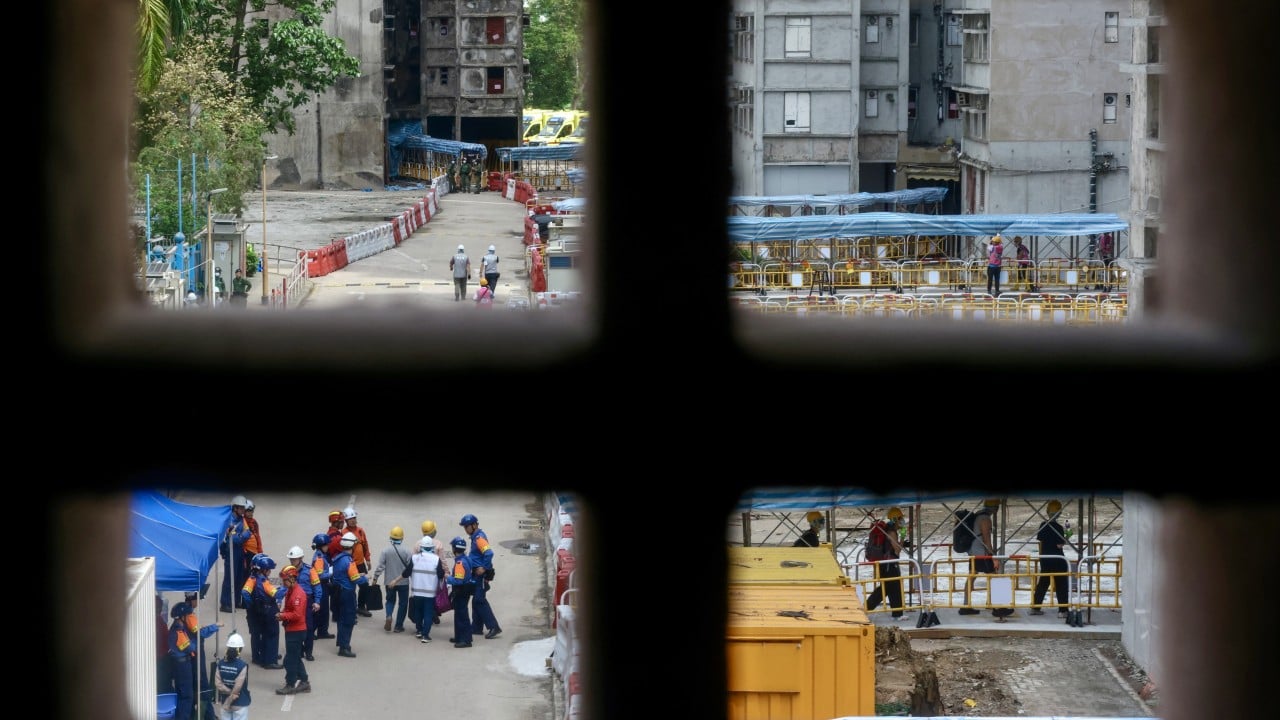
Ash does not wash out of memory the way it washes out of concrete.
You can scrub a stairwell until your knuckles bleed, repaint the blistered hallway walls in a sterile shade of municipal eggshell, and replace the melted intercom panel by the front door. Yet the smell stays. It hides inside the mortar, settles behind the fuse boxes, and waits for a humid afternoon in the New Territories to rise back into the air. Anyone who has ever stood outside a gutted Hong Kong tenement block after the fire trucks have packed up their hoses knows that the emergency does not end when the flames die. That is merely when the long, quiet suffocation begins.
For the residents of Tai Po who survived a devastating residential blaze—and waited nearly a full year for an official acknowledgment of accountability—the trauma was never just the fire itself. It was the 330 days of institutional silence that followed. When an apology finally arrived eleven months after the smoke cleared, it landed not as a balm, but as an insult wrapped in formal stationery.
Why does an apology lose its power when it arrives on a bureaucratic timetable? Because grief moves at the speed of a heartbeat, while institutions move at the speed of liability mitigation.
The Architecture of Waiting
To understand why eleven months feels like a lifetime to a displaced survivor, picture a composite resident—let’s call her Mrs. Chan, a hypothetical retiree modeled on the dozens of elderly tenants who populate Tai Po’s older walk-ups and mid-rise estates.
On the night of the fire, Mrs. Chan leaves with nothing but her slippers, her house keys, and the cardigan buttoned over her pajamas. The keys are useless by midnight; the door they fit is charred off its hinges. For the first forty-eight hours, adrenaline carries her. Community centers hum with volunteers handing out bottled water, foil-wrapped rice boxes, and donated blankets. Reporters ask how she feels. Officials appear in crisp windbreakers, nodding gravely beside cordoned-off tape, promising thorough investigations and swift support.
Then the cameras pack up. Day three arrives. Then week four. Then month six.
This is the invisible phase of disaster recovery that rarely makes headlines. While committees convene behind closed doors to parse fire-safety ordinances, subdivided unit regulations, or contractor negligence, real human lives are suspended in amber. Think of a residential fire like a stone thrown into a deep well: the splash at the surface is loud and brief, visible to everyone standing at the rim, while the ripples at the bottom keep slamming against the dark stone walls long after the crowd has walked away.
In those eleven months, Mrs. Chan sleeps on a borrowed folding cot in a cramped relative’s flat in Fanling, or navigates the labyrinth of transitional housing applications while trying to replace lost identity cards, medical records, and decades of irreplaceable photographs. Every morning she wakes up with the same unanswered question pressing against her ribs: Who let this happen, and why is nobody saying they are sorry?
When Bureaucracy Mistake Silence for Prudence
In dense urban districts like Tai Po—where aging private buildings, tangled renovation scaffolding, and cramped living quarters frequently intersect—residential fires carry a heavy weight of public anxiety. Survivors rarely view a severe blaze as a random act of fate. They look at blocked fire exits, unmaintained alarm systems, or lax oversight, and they see human choices.
When an institution, a property management firm, or a public body delays an apology for eleven months, the delay itself becomes a second injury.
From a legal and administrative standpoint, the hesitation is predictable. Organizations are trained to treat the words I am sorry as a loaded weapon—an admission of fault that could trigger compensation claims, disciplinary hearings, or political fallout. Every comma in a public statement is vetted by legal counsel. Every timeline is stretched until an inquiry concludes, a report is printed, and every possible escape hatch has been inspected.
But human beings do not live inside legal briefs. To a survivor standing in front of a blackened building facade, silence reads as indifference. Worse, it reads as erasure. Psychologists who study disaster recovery have long observed that institutional betrayal—the failure of trusted systems to respond with speed and empathy after a crisis—compounds post-traumatic stress far more severely than the physical loss of property. People can rebuild a kitchen. They can buy a new mattress. What fractures them is the realization that their suffering was treated as an administrative file waiting at the bottom of an inbox.
By the time the eleventh month rolls around, an apology ceases to be an act of contrition. It becomes a box-checking exercise. It arrives after the hardest winter has already been endured, after loans have been taken out to cover rent deposits, and after elderly neighbors have had to disperse across different districts, severing the tight-knit social fabric that kept them afloat.
The Anatomy of a Too-Late Apology
Consider what happens when an official expression of regret is finally delivered nearly a year after the fact.
First, there is the question of audience. Who is the apology actually for? When a statement comes eleven months late, it often feels designed to close a chapter for the institution rather than open a path of healing for the victims. It allows officials or managers to point to a timestamp and say, We have addressed the matter. We have apologized. Now let us move forward.
Second, there is the absence of immediate agency. An apology offered in the first week says, We failed you, and we are bleeding alongside you to make this right today. An apology offered in the eleventh month says, Our review process has concluded, and we are now permitted to express regret. One is a human reflex; the other is a calendar event.
I have sat across from people who waited months for a single word of accountability after an avoidable tragedy, and the look in their eyes is always the same. It is not even rage anymore. Rage requires energy, and eleven months of chasing paperwork drains you dry. What remains is a cold, hollowed-out clarity. You realize that the people in charge were never waiting to understand your pain—they were only waiting until it was safe for them to acknowledge it.
What Accountability Actually Demands
If an eleven-month delay is the wrong way to answer a community in crisis, what does genuine accountability look like in the aftermath of a fire like Tai Po’s?
It begins with separating human empathy from legal finality. You do not need a 400-page forensic engineering report to look a displaced family in the eye during the first forty-eight hours and say, You should have been safe in your own home, and we are deeply sorry that you are standing out here in the cold. Acknowledging suffering does not obstruct an investigation; it proves that the investigators remember whom they serve.
Real accountability also requires visibility that outlasts the news cycle. Support cannot peak in week one and evaporate by month two. Survivors need dedicated caseworkers who do not rotate out every six weeks, transparent timelines for safety inspections, and clear, jargon-free updates on what is being fixed so the same sparks do not catch in the building next door.
Most of all, it requires speed. In crisis management, time is not neutral. Every week that passes without a direct, unvarnished acknowledgment multiplies the resentment tenfold. By month eleven, even the most carefully crafted words sound hollow against the echo of all the days nothing was said at all.
The Smell That Remains
Walk past a restored building in Tai Po a year after a fire, and to a stranger’s eye, everything looks orderly again. The scaffolding is down. The fresh paint gleams under the streetlights. The notices taped to the lobby glass are crisp and laminated.
The people who lived there know better. They know which stairwell went dark first, which neighbor pounded on doors through the thick black smoke, and exactly how many nights they spent staring at someone else’s ceiling waiting for a phone call that took eleven months to come. You can sign a statement of regret and file it away in an archive, but a piece of paper cannot unburn a home, and it cannot give back a year of a life spent waiting in the dark.