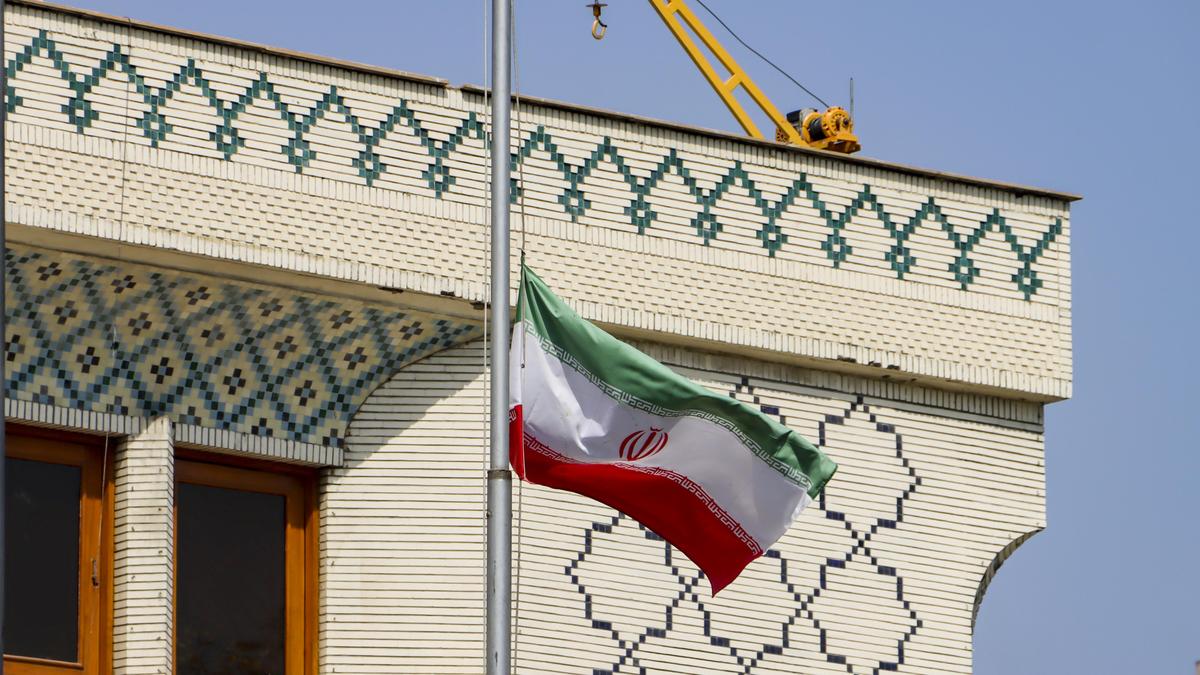
The ink on the official stationery was barely dry when the doors of the Iranian Embassy in New Delhi swung open, not to welcome a delegation, but to issue a cry for help.
Outside, the humid air of the Indian capital buzzed with the usual chaos—auto-rickshaws weaving through traffic, street vendors shouting over the roar of engines, and the steady, indifferent rhythm of a city that never stops. But inside the high walls of the embassy, the air was heavy. It was the weight of a void. Ali Khamenei, the man who had occupied the center of the Iranian universe for decades, was dead.
History has a way of turning individuals into monuments, and monuments into mere facts. When a leader of such magnitude passes, the world tends to look at maps. They look at oil prices. They look at nuclear enrichment levels. They look at the "big picture." But the big picture is composed of millions of tiny, fractured lives, and right now, the Iranian diplomatic mission in India isn't looking at a map. They are looking at the people.
The Silence That Screams
Silence is rarely empty. In diplomacy, silence is a weapon, a shield, or a death knell. The Iranian Embassy’s recent plea—"Do not remain silent"—wasn't just a press release. It was an admission of vulnerability.
Imagine a family whose patriarch has suddenly vanished. For thirty-five years, every decision, every prayer, and every law flowed from a single source. Now, that source has dried up. The embassy’s message to the Indian public and the global community is a desperate attempt to bridge the gap between a grieving state and a skeptical world. They are asking for a moment of recognition, a pause in the geopolitical machinery to acknowledge the tectonic shift occurring beneath their feet.
India and Iran share more than just trade routes; they share a soul that stretches back to the Silk Road. You can smell it in the saffron sold in Old Delhi and hear it in the Persian loanwords that salt the Urdu language. When the embassy calls for India not to remain silent, they are invoking this ancient brotherhood. They are asking their oldest neighbor to help them hold the floor while the room spins.
The Invisible Stakes of a Succession
The facts are cold: succession in a theocratic state is a labyrinth. There is no simple ballot box to solve the problem of "What happens next?"
The Assembly of Experts—a body of eighty-eight clerics—now faces a task that feels less like politics and more like trying to catch lightning in a bottle. They must find a successor who can satisfy the hardliners, appease the restless youth, and maintain the delicate balance of the "Axis of Resistance."
But consider the person standing on a street corner in Tehran or a student from Mashhad currently studying in Pune. For them, this isn't about the Assembly. It’s about the price of bread. It’s about whether the social contracts they’ve lived under will tighten like a noose or finally begin to fray.
The embassy’s plea for "non-silence" is a strategic move to ensure that during this period of internal fragility, the world doesn't see an opening for intervention. It is a request for stability through visibility. They know that in the darkness of a power vacuum, the worst instincts of international politics often come out to play.
A Tale of Two Cities
To understand the emotional core of this plea, you have to look at the people who inhabit the space between these two nations.
Think of a carpet merchant in Srinagar. His father dealt with Isfahan; his grandfather traveled to Shiraz. To him, the Supreme Leader’s death isn't a headline about "Regional Instability." It’s a tremor in his heritage. He watches the news not for the politics, but for the vibe of the bazaar. If the bazaar stays quiet, he can breathe. If the embassy is pleading for voices of support, he knows the bazaar is terrified.
Then there is the diplomat. A man or woman stationed in New Delhi, thousands of miles from home, watching their country’s future being debated on news tickers. They are the ones who had to draft that statement. They had to find a way to ask for empathy without sounding weak. It is a grueling tightrope walk. They are representing a government that is often painted as a monolith, but in this moment, they are just human beings mourning a leader and fearing a chaotic transition.
The Weight of the Crown
The role of the Supreme Leader is not just a political office. It is the Velayat-e Faqih—the Guardianship of the Jurist. It is a position that claims a direct line to the divine. When that line is cut, the psychological impact on the loyalist population is profound.
We often talk about Iran in terms of "the regime" versus "the people," but that binary is too simple. There are millions for whom Khamenei was a symbol of resistance against Western hegemony, a steady hand in a region that has seen Iraq, Syria, and Afghanistan crumble. To those people, his death feels like the roof has been torn off their house.
The embassy’s communication is directed at this anxiety. By asking India to speak up, they are trying to validate the importance of the fallen leader and, by extension, the legitimacy of the system he left behind. They are trying to prove that Iran is not alone.
Beyond the Headlines
The standard news reports will tell you about the official mourning period. They will list the dignitaries who sent condolences. They will speculate on the rise of Mojtaba Khamenei or the potential for a more pragmatic successor.
What they won't tell you is the feeling of the 3:00 AM phone call. The call where an Iranian expatriate in Delhi asks their mother in Tehran, "Is it safe to go out tomorrow?"
What they won't tell you is the way the tea stays cold on the desk of an embassy staffer because they are too busy monitoring a dozen different telegram channels, trying to gauge if the mourning will turn into protest or if the grief is genuine enough to hold the status quo.
The "invisible stakes" are the lives of the millions of Iranians who are currently holding their breath. If the transition is smooth, the world moves on. If it isn't, the ripple effects will wash over the borders of Iraq, Lebanon, and Yemen, eventually reaching the shores of India.
The Mirror of History
India’s response has been one of practiced, dignified caution. A day of national mourning was declared. Flags were flown at half-mast. This isn't just protocol; it is an acknowledgement of the gravity of the moment. India understands that a destabilized Iran is a nightmare for the entire Global South.
The infrastructure of the future—the ports, the railways, the energy pipelines—all rely on an Iran that is functional. When the embassy asks the Indian public to "not remain silent," they are reminding us that our fates are intertwined. The silence they fear is the silence of indifference. Indifference is what allows regional tensions to boil over into a conflict that no one can afford.
The Sound of the Future
In the coming weeks, the mourning posters in Tehran will begin to peel. The flowers at the embassy in New Delhi will wilt. The "facts" of the succession will be codified into history books.
But the plea remains. It hangs in the air like the scent of rain before a storm.
We are living through one of those rare moments where the curtain of history is pulled back, revealing the gears of power in their most raw, grinding state. The Iranian Embassy in India isn't just asking for words of comfort. They are asking the world to look at them—really look at them—and see a nation at a crossroads, trying to find its way in the dark.
The tragedy of power is that it often leaves a vacuum that nature, and politics, abhors. As the sun sets over the Yamuna River in Delhi and the minarets in Tehran, the silence is finally broken. It is broken by the sound of a country trying to remember how to breathe without its heart.
A chair sits empty in a high office in Tehran. The world watches. The world waits. And for now, the only thing louder than the grief is the sound of the world deciding what to say next.
Would you like me to look into the specific trade agreements between India and Iran that might be impacted by this transition?


