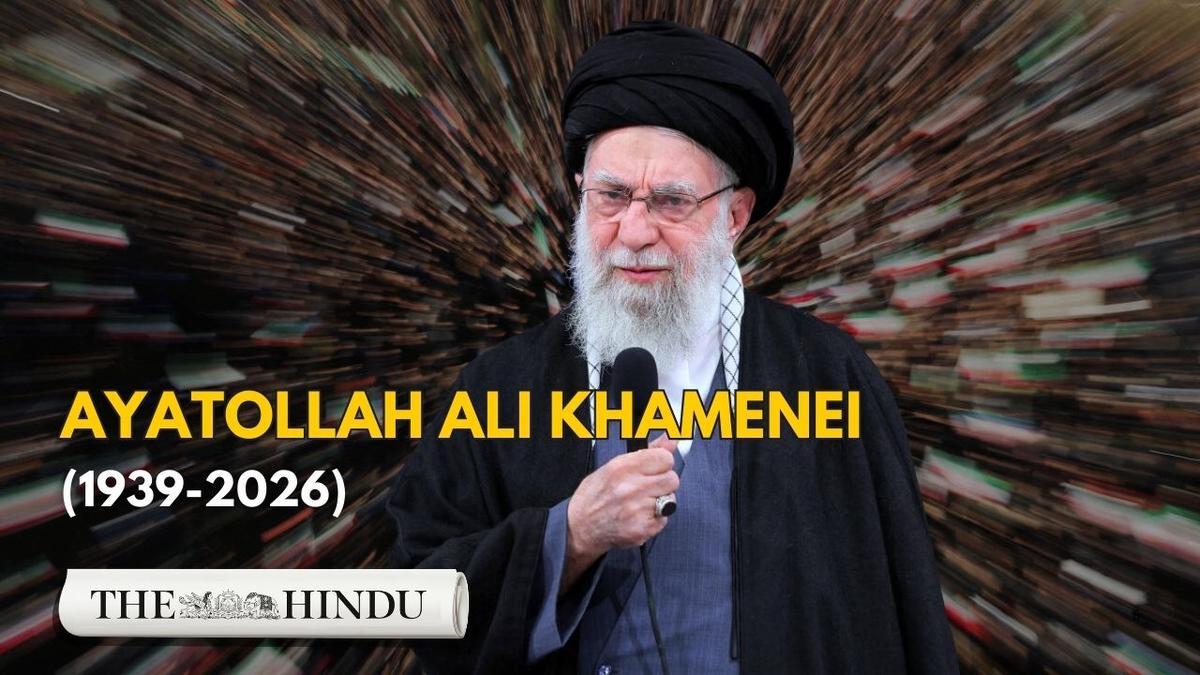
The air in Tehran does not move like it does in other cities. It is heavy, seasoned with the scent of diesel, toasted saffron, and a persistent, invisible tension that lives in the back of your throat. For decades, if you walked through the Grand Bazaar or sat in a taxi snaking through the gridlock of Vali- عصر (Valiasr) Street, there was one constant. It wasn’t just the smog or the call to prayer. It was the face.
Ali Khamenei looked down from every government wall, his gaze filtered through thick spectacles, his beard a silver landscape of frozen authority. To an outsider, he was a headline. To a resident, he was the climate. He was the weather you couldn't change. In related news, we also covered: The Sabotage of the Sultans.
But the weather has broken.
The news of his passing did not arrive with a sudden thunderclap. It leaked. It seeped through encrypted messaging apps and whispered conversations in the bread lines. For thirty-five years, this man was the "Ultimate Authority," a title that sounds more like a theological absolute than a political office. Now, that absolute has met the one thing it couldn't command: biology. NPR has also covered this critical issue in extensive detail.
The Architect of a Silent House
To understand the weight of this vacuum, you have to understand how Khamenei built his world. He was not the charismatic firebrand that his predecessor, Khomeini, had been. He was a librarian of power. He was a man of the shadows who stepped into the light in 1989 and spent the next three decades ensuring that the light only shone where he permitted.
Think of the Iranian state as an intricate, ancient clock. Most leaders are content to be the hands on the face, showing the world the time. Khamenei was the oil between the gears. He controlled the Revolutionary Guard (IRGC), the judiciary, and the clerics who decided who could even run for office. He created a system where he was the only bridge between the divine and the terrestrial.
When a bridge collapses, the travelers on both sides find themselves staring at an abyss.
Consider a hypothetical shopkeeper in Isfahan, let’s call him Omid. Omid doesn't care about the intricacies of the Assembly of Experts or the nuances of Shiite jurisprudence. He cares about the price of eggs, which has climbed higher than the Alborz mountains. He cares about his daughter, who wants to walk to university without a van of morality police waiting at the corner. For Omid, Khamenei’s "fall" isn't a political transition. It is the removal of a lid from a boiling pot.
The Illusion of Continuity
The state media will tell you there is a plan. They will point to the Constitution, to the 88 clerics who comprise the Assembly of Experts, and talk about a "seamless transition." They want you to believe that the system is a machine that can simply swap out a damaged part.
It is a lie.
Power in Iran is not institutional; it is deeply, dangerously personal. Khamenei spent his life hollowing out institutions to ensure no rival could ever challenge him. He turned the presidency into a lightning rod for public anger while he kept the lightning. By making himself the "Ultimate Authority," he made himself the single point of failure.
The IRGC, the sprawling military-industrial complex that owns everything from telecommunications to construction firms, now looks at that empty chair and sees something other than a spiritual void. They see an opportunity. Or a threat.
In the tea houses, the talk isn't about who is next. It’s about what is next. If the clerics choose a weak successor, the generals might decide they no longer need a turbaned figurehead. If they choose a hardliner, the streets—already scarred by the "Woman, Life, Freedom" protests—might finally decide they have nothing left to lose.
The Ghost in the Machine
The tragedy of Khamenei’s long reign is that he mistook silence for stability. He looked out over a country where the internet was throttled and the dissidents were jailed and saw a nation in harmony.
But the silence was pressurized.
I remember talking to a student in North Tehran a few years ago. She pointed to a mural of the Supreme Leader and said, "He lives in a century that doesn't exist anymore."
That is the core of the fall. It wasn't just a heart stopping or a lung failing. It was the final expiration of a vision that tried to freeze a vibrant, young, and hyper-connected population in a 1979 snapshot. More than 60 percent of Iranians are under the age of 30. They don't remember the revolution. they only know the isolation. To them, the "Ultimate Authority" was a grandfather who spent their inheritance on foreign wars and ideological purity while their currency turned to ash.
Statistics tell a cold story: the rial has lost over 90 percent of its value in a decade. Inflation lingers near 40 percent. These aren't just numbers on a spreadsheet; they are the reason a young man in Mashhad can’t get married, or why a grandmother in Tabriz skips her heart medication.
The Stakes of the Vacuum
What happens when the shadow vanishes?
There is a terrifying fragility to this moment. In the West, we often talk about "regime change" as if it’s a menu option at a restaurant. But for the people living in the shadow of the Zagros mountains, change is a gamble with their lives.
There are those who fear a Syrian-style collapse, where the factions within the state turn their guns on each other. There are those who hope for a "Beijing Spring" that actually succeeds, a sudden lurch toward the world. And there are those—perhaps the majority—who just want to breathe.
The "fall" described in the headlines isn't just the end of a man. It’s the end of a specific type of certainty. For thirty-five years, Iranians knew exactly who to blame and exactly who to fear. That clarity is gone. In its place is a jagged, electric uncertainty.
The elite are currently scurrying behind the high walls of the Beit Rahbari, the leader's compound. They are trading favors, making threats, and trying to divine who among them can hold the leash of the IRGC. They are looking for a new "Ultimate Authority."
But they are looking in the wrong place.
They are looking at each other, while the real power is shifting in the alleys of South Tehran and the dormitories of Shiraz. The people are no longer waiting for a new leader to be chosen for them. They are watching the chair, not with reverence, but with the cold, calculated gaze of someone who has waited a very long time for the theater to end.
The Last Portrait
The transition will not be a single event. It will be a series of fractures.
First, the mourning periods, choreographed and mandatory. Then, the frantic attempts to project strength to the outside world, particularly to rivals in Riyadh and Washington. Finally, the internal reckoning.
We are witnessing the death of a system that tried to outrun time. Khamenei’s rise was built on the idea that one man’s interpretation of God’s will could govern a modern nation-state. His fall is the physical proof that it cannot.
As the sun sets over the Milad Tower, casting long, spindly shadows across the capital, the posters of the Supreme Leader are still there. But they look different now. The paper is peeling at the edges. The colors are faded by the harsh Persian sun.
In a small apartment in downtown Tehran, a young man watches the flickering screen of his phone. He sees the black-bordered announcements. He hears the chanting from the mosque. He looks at his hands, then at his suitcase, then at the window.
The man who claimed to hold the keys to heaven and earth is gone.
The young man reaches out and turns off the light, leaving the room in a darkness that feels, for the first time in his life, like a beginning.
The heavy, unmoving air of Tehran is finally starting to stir.
Would you like me to research the current geopolitical responses from neighboring Gulf states to further explore how this power vacuum is shifting regional alliances?


