Three words. That is all it takes to make a heavy steel door swing shut across a continent.
No money left.
Say them out loud in a crowded room, and watch what happens. Shoulders slump. Eyes drop to the floor. It is the ultimate conversation stopper, a phrase dressed up in the respectable, buttoned-down uniform of household common sense. When a family runs out of cash at the end of the month, you cancel the streaming subscriptions, you skip the restaurant, and you stop lending money to the neighbor down the street whose roof just caved in during a storm.
Simple. Logical. Undeniable.
Except nations are not households, and a collapsing border four hundred miles to the east is not a leaky roof.
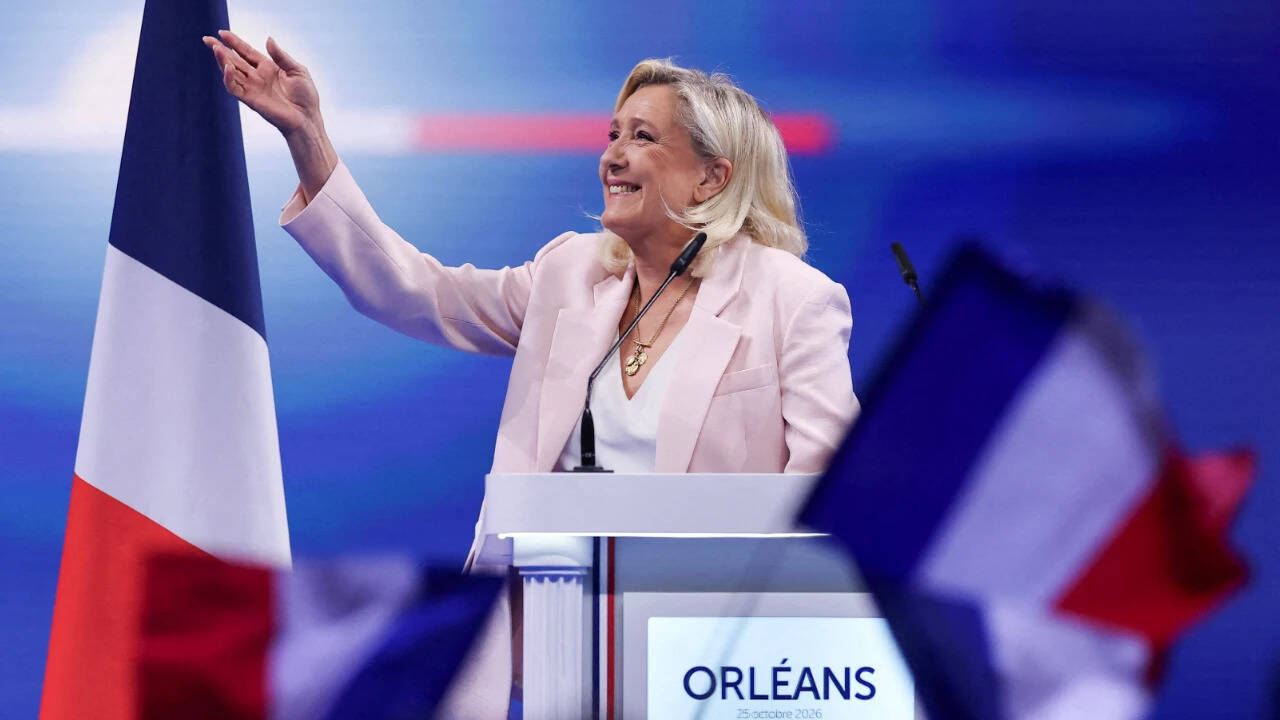
Yet this exact phrase has become the sharpest weapon in the arsenal of France’s far-right leadership. As the race for the Élysée Palace heats up, the message echoing from campaign stages in northern industrial towns and southern coastal cities is blunt: if the National Rally wins the presidency, French financial and military aid to Ukraine stops. Cold. The justification is wrapped in that seductive, three-word package. France is broke, the argument goes, drowning in debt, squeezed by inflation, and left with nothing in the coffers to spare for Kyiv.
I remember the first time I stood in a town square in northern France and heard a voter repeat that line back to me, almost word for word. It was a damp Tuesday in November, the kind of gray afternoon where the chill settles straight into your marrow. Outside a shuttered bakery, a retired metalworker named Jean-Luc—a composite, let us be clear, of a dozen men I have spoken with across the Pas-de-Calais, though his worn wool coat and calloused knuckles are entirely real—pulled a crumpled grocery receipt from his pocket. He pointed to the price of butter. He pointed to his heating bill. Then he looked up, his eyes tired rather than angry, and asked why his tax euros were buying artillery shells for a war he could not see while his own town felt like it was slowly hollowing out.
You cannot dismiss Jean-Luc. If you try to lecture him about geopolitical architecture or rules-based international order while he is calculating whether to turn the radiator up two degrees, you have already lost him. His pain is immediate, tactile, and entirely legitimate.
The tragedy is not that Jean-Luc is asking the question. The tragedy is that the answer he is being sold is an illusion—one that will ultimately cost him far more than the price of butter.
The Ledger Behind the Slogan
To understand what happens when a major European power abruptly pulls the plug on an ally, you have to look past the campaign podium and open the actual ledger. Political rhetoric thrives in fog; accounting requires daylight.
Since the full-scale invasion began in February 2022, France has committed billions of euros in bilateral military, financial, and humanitarian assistance to Ukraine, alongside its substantial share of European Union support packages. On a television chyron, those numbers look staggering. They are designed to make you gasp. Ten figures is a lot of zeros when you are staring at an overdraft notice.
Here is what the chyron leaves out.
Much of what we call "sending money to Ukraine" does not involve loading pallets of crisp euro banknotes onto cargo planes bound for Kyiv. When France sends a CAESAR self-propelled howitzer, a batch of SCALP cruise missiles, or anti-aircraft defense systems, the money does not vanish into the Ukrainian soil. It goes directly into French factories. It pays the salaries of engineers in Bourges, welders in Roanne, and electronics technicians in the suburbs of Paris. It revitalizes domestic manufacturing lines that had been gathering dust since the end of the Cold War.
In pure economic terms, a massive portion of military aid is an industrial stimulus package wearing camouflage.
Even the financial loans—the actual cash transfers meant to keep Ukrainian hospitals running, pensions paid, and power grids patched together—are largely structured through joint European Union instruments backed by long-term borrowing, and increasingly funded by the windfall profits generated from frozen Russian central bank assets sitting in European clearinghouses. The notion that cutting off Kyiv would magically free up a pile of cash to drop directly into Jean-Luc’s pension fund is, to put it plainly, a fiscal mirage.
Numbers, however, rarely win arguments against fear. Fear feels like survival. Spreadsheets just feel like homework.
The Dominoes You Do Not See
Imagine, for a moment, a hypothetical scenario. Let us walk five years down the road that the far-right platform maps out.
A new French president takes the oath of office in Paris and immediately fulfills the campaign promise. The shipments stop. The training programs for Ukrainian soldiers on French soil are disbanded. In Brussels, France uses its veto power—or simply its immense diplomatic weight—to fracture the European consensus on sanctions and funding. Without one of the continent’s two primary engines, the European defense effort stalls. Sensing the sudden vacuum, isolationist voices in other capitals grow louder.
What happens next?
Kyiv does not fall overnight; Ukrainians have proven their capacity to endure far worse than political abandonment. Instead, the front lines slowly buckle under the sheer weight of unopposed artillery and glide bombs. Without air defense interceptors, Ukrainian cities go dark through the winter. Millions more people—mothers, children, elderly grandparents carrying whatever fits in two suitcases—begin walking west toward the borders of Poland, Slovakia, and Romania.
Think about what a fresh wave of five or ten million desperate refugees does to the European economy. Think about the strain on housing, healthcare, and social safety nets from Warsaw to Paris. Suddenly, the domestic budget crisis that the "no money left" doctrine promised to solve explodes to ten times its previous size.
Now look at the borders. If Russia succeeds in subjugating Ukraine because the West lost its nerve, Moscow learns a permanent, intoxicating lesson: nuclear blackmail works, patience pays off, and democratic alliances are paper tigers that fold the moment grocery prices rise.
Does anyone genuinely believe the ambition stops at the Dnipro River?
Within months, NATO’s eastern flank—Estonia, Latvia, Lithuania, Poland—becomes an active, hair-trigger flashpoint. France, as a nuclear-armed founding member of the Atlantic Alliance, cannot simply opt out of the neighborhood. To deter an emboldened adversary now sitting directly on the borders of the European Union, Paris would be forced to triple its own defense spending, deploy tens of thousands of French troops permanently to Eastern Europe, and live under a constant, suffocating shadow of military mobilization.
Paying to help Ukraine defend itself now is like buying a fire extinguisher while smoke is still coming from the kitchen. Refusing to buy the extinguisher because you want to save fifty euros, only to watch the entire apartment building burn down, is not fiscal conservatism. It is arson by neglect.
The Architecture of Abandonment
We have seen this exact movie before, and the ending was written in blood across the fields of Flanders and the beaches of Normandy.
In the late 1930s, a wave of exhaustion swept through France and Britain. The Great Depression had battered working families; the memory of the First World War’s trenches was still raw; the national treasuries were strained. When authoritarian aggression began redrawing the map of Central Europe, an entire class of politicians rose to prominence preaching the gospel of prudent self-interest. Why bleed for Prague? Why empty the treasury for Danzig? Surely, if we simply tend to our own gardens and let the strong take what they want from the weak far away, peace and prosperity will reign at home.
History has a merciless way of grading that kind of realism. Every concession purchased only a brief, feverish pause before the bill came due with compound interest.
I admit, there is something deeply unsettling about watching that old script get dusted off and recited for a modern audience. When I sit down to read the transcripts of these speeches, I feel a cold knot in my stomach—not because I lack sympathy for the working families struggling across France, and not because I have all the answers to Europe's economic stagnation. The challenges facing the French middle and working classes are real, structural, and infuriatingly slow to fix. Anyone who pretends otherwise is lying to you.
The fear comes from watching legitimate economic frustration get hijacked and steered toward a cliff.
Because the people promising to close the door on Ukraine are not offering a serious plan to fix the French pension system, revitalize rural healthcare, or make energy permanently cheap. They are offering a scapegoat. It is infinitely easier to point at a foreign flag flying outside a town hall and blame it for your empty wallet than it is to untangle decades of stagnant productivity, global supply chain shifts, and housing shortages.
What Actually Happens When the Lights Go Out
Last winter, I spent time with a family in a mid-sized Ukrainian city roughly sixty miles from the front line. Let us call the mother Olena. She was a high school math teacher before the invasion; now she spent her mornings coordinating generator fuel deliveries for a local clinic and her evenings grading papers by the glow of a battery-powered camping lantern.
During an air raid alert, we sat in the narrow hallway of her apartment—away from the windows, listening to the distant, rhythmic thud of air defense batteries working in the dark. Every few seconds, the floor vibrated slightly beneath our boots. Olena did not flinch. She just kept pouring tea from a thermos, her hands remarkably steady.
She asked me about France. She had visited Lyon once, years ago, on a teacher exchange program, and still kept a faded postcard of the Rhône River taped to her refrigerator. She had seen the news clips of French politicians arguing that Europe could no longer afford to stand with her country.
She did not get angry. She did not launch into a lecture about democracy or international law. She simply looked at the camping lantern sitting between us on the linoleum floor and said something I have not been able to shake since.
"When people say they have no money left to help us," she said quietly, "what they really mean is they still have the luxury of believing the dark cannot reach their house."
Outside, another interceptor roared into the freezing sky, a brief streak of white fire tearing through the clouds to knock a drone out of its path before it could hit a substation three blocks away. That missile—or the radar guiding it, or the artillery shell keeping the front line ten miles further east—was paid for by an alliance of nations that decided, however imperfectly and however grudgingly, that some lines cannot be crossed without all of us paying the price.
The heavy steel door has not swung shut yet. The debate in France is far from settled, and the ballot box remains an unpredictable instrument. Every voter walking into a polling booth carries their own private ledger of anxieties, bills, and hopes for their children.
Before anyone decides that closing the door is the cheapest option available, they ought to look closely at what is standing on the other side of it—and remember that walls built to keep the storm out have a funny way of trapping you inside when the roof finally gives way.