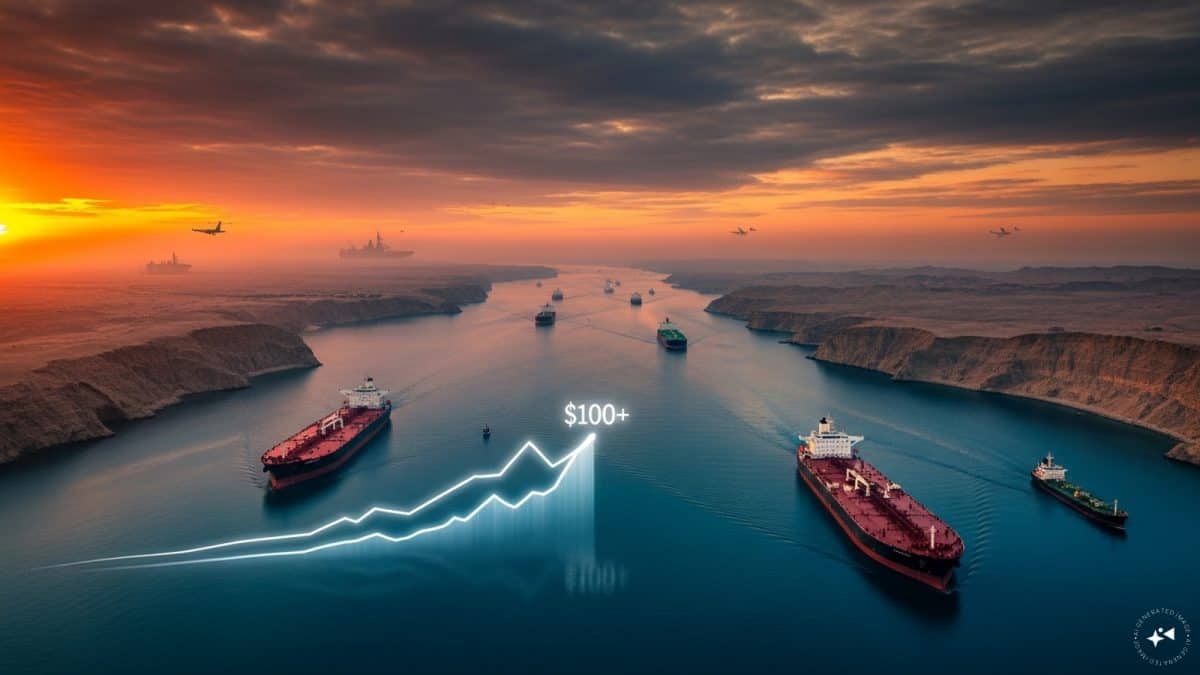
The 10% surge in global crude prices following US-Israeli kinetic operations and the subsequent threat to the Strait of Hormuz is not a localized pricing anomaly; it is the manifestation of a fundamental breakdown in the global energy arbitrage system. When a primary maritime chokepoint—responsible for the transit of approximately 21 million barrels per day (bpd)—faces closure, the market stops pricing based on supply-demand equilibrium and begins pricing based on the total failure of the delivery mechanism. This shift represents a transition from "just-in-time" logistics to "just-in-case" hoarding, where the risk premium is no longer a marginal cost but the primary driver of the asset's value.
Understanding the current volatility requires deconstructing the crisis into three distinct operational layers: the kinetic disruption of production assets, the logistical paralysis of maritime corridors, and the psychological contagion within the paper trading markets. Read more on a connected subject: this related article.
The Triad of Volatility: Production, Transit, and Speculation
The immediate 10% price appreciation is the aggregate result of three compounding pressures that traditional energy reporting often conflates.
1. The Kinetic Impact on Upstream Infrastructure
Military strikes on energy-related infrastructure or command centers in the Middle East introduce an "irrecoverability" factor into the supply chain. Unlike a labor strike or a temporary technical failure, kinetic damage to refineries, pumping stations, or export terminals requires long-lead-time capital expenditures (CapEx) for repair. The market is currently discounting the possibility that a portion of the global spare capacity—largely held by OPEC+ members in the Gulf—could be physically neutralized. This creates a floor for prices because even a ceasefire does not immediately restore destroyed flow capacity. More journalism by Associated Press delves into similar views on the subject.
2. The Chokepoint Paradox of the Strait of Hormuz
The Strait of Hormuz is a geographic bottleneck where the cost of security exceeds the value of the cargo for most private insurers. If the Strait is closed or even contested, the impact is non-linear.
- Volume Displacement: Roughly 20% of global petroleum liquids consumption passes through this 21-mile-wide waterway.
- The LNG Link: Beyond crude, the Strait is the primary exit point for nearly 20% of the world’s Liquefied Natural Gas (LNG). A closure triggers a cross-commodity shock, forcing power utilities to switch back to oil-fired generation, further tightening the crude market.
- Insurance Ejection: Once a zone is declared "unnavigable" by maritime underwriters, the effective supply drops to zero regardless of physical availability. Ships cannot move without P&I (Protection and Indemnity) insurance, and the "war risk" premiums currently being applied act as a shadow tax on every barrel.
3. Derivative Cascades and the Margin Call Loop
On the Intercontinental Exchange (ICE) and the NYMEX, the 10% price move triggers automated liquidation of short positions. This is the "gamma squeeze" of the commodities world. As prices rise, entities that were hedged against lower prices are forced to buy back contracts to cover their losses, creating a self-reinforcing upward spiral that has little to do with the physical movement of oil and everything to do with liquidity in the financial markets.
The Cost Function of Regional Escalation
To quantify the current crisis, one must look at the Risk-Adjusted Barrel Price (RABP). This is not a formal ticker but a conceptual framework used by consultants to explain why oil can jump $10 in a single session without a single well being capped.
The RABP is calculated as:
$$RABP = P_{base} + P_{ins} + P_{geo}$$
Where:
- $P_{base}$ is the cost based on global inventory levels.
- $P_{ins}$ is the surge in maritime insurance and freight rates.
- $P_{geo}$ is the geopolitical premium, which represents the probability of a "Total Supply Failure" multiplied by the expected duration of that failure.
The current 10% jump indicates that the market has shifted its $P_{geo}$ from a negligible variable to a dominant one. In a standard market, the global inventory (measured in days of forward cover) dictates the price. In an escalation scenario, the inventory is irrelevant if it cannot reach the consumer.
Structural Bottlenecks in Global Redirection
A common fallacy in energy analysis is the belief that global supply is fungible. The assumption is that if the Strait of Hormuz closes, crude from the US Permian Basin or the North Sea can simply fill the gap. This ignores the "Quality and Complexity" constraint.
The Heavy-Sweet Disparity
Refineries are calibrated for specific grades of crude. Most Asian refineries, particularly in China and India, are optimized for the Medium-Sour grades produced in the Persian Gulf. If this supply is cut, these refineries cannot easily switch to the Light-Sweet crude produced by US shale without significant efficiency losses or physical damage to the refinery units over time. This creates a "localized shortage" even if global production numbers remain high.
Pipeline Throughput Limits
While Saudi Arabia and the UAE maintain pipelines that can bypass the Strait of Hormuz (such as the East-West Pipeline to the Red Sea), these systems have a combined capacity of approximately 6.5 to 7 million bpd. This leaves a deficit of over 14 million bpd that has no alternative route to market. The infrastructure is a relief valve, not a replacement.
Strategic Petroleum Reserve (SPR) Limitations
The traditional tool for mitigating price shocks is the release of Strategic Petroleum Reserves by IEA member nations. However, the efficacy of the SPR is currently at a multi-decade low for two reasons.
The first limitation is the physical volume. After significant drawdowns in 2022-2023 to combat post-pandemic inflation, the US SPR sits at levels that offer less of a cushion than in previous Middle Eastern crises. The "psychological bazooka" of an SPR release is weakened because the market knows the tank is half-empty.
The second limitation is the discharge rate. An SPR is limited by the maximum flow rate of its pumps and the proximity to refineries. You cannot dump 300 million barrels into the market overnight; it is a slow bleed that cannot compensate for the sudden loss of 20 million bpd from the Gulf.
The Macroeconomic Transmission Mechanism
High oil prices act as a regressive tax on global consumption, but the current shock is particularly dangerous because it coincides with a period of "sticky" core inflation.
- The Transportation Surcharge: Because diesel is the lifeblood of global logistics, the surge in oil prices translates directly into higher shipping and trucking costs. This creates a "second-wave" inflation effect where the price of food and consumer goods rises weeks after the initial oil spike.
- The Dollar Strength Feedback Loop: Oil is priced in USD. As the crisis deepens, investors flock to the US Dollar as a safe haven. This makes oil even more expensive for emerging markets whose currencies are devaluing against the dollar, leading to "energy poverty" and potential civil unrest in non-OECD nations.
- Central Bank Paralysis: Normally, a supply-side shock would lead central banks to hold interest rates steady to avoid crushing growth. However, if the oil surge reignites inflation expectations, they may be forced to raise rates into a recession—a "stagflationary trap" that hasn't been seen at this scale since the 1970s.
Real-Time Indicators of Escalation
To determine if the 10% surge is a peak or a midpoint, analysts must monitor three specific metrics:
- VLCC (Very Large Crude Carrier) Charter Rates: If the cost to charter a tanker jumps by more than 50% in 48 hours, it indicates that shipowners are refusing to enter the Gulf, signaling a de facto blockade.
- The Brent-WTI Spread: A widening spread suggests the disruption is localized to the Atlantic or Middle East, while a narrowing spread suggests the US is being pulled into the global price vacuum as an exporter of last resort.
- Time Spreads (Backwardation): If the price for immediate delivery (spot) is significantly higher than the price for delivery in six months, it indicates extreme physical scarcity. Deep backwardation is a signal that the market is "scrambling" for every available molecule.
Tactical Positioning for a Fractured Energy Market
The 10% move is a warning shot regarding the fragility of the "Global Commons"—the idea that the world’s oceans and chokepoints are permanently open for business. We are entering an era of "Geopolitical Energy Pricing" where the military capability of a state to protect or transit a waterway is as important as the geology of its oil fields.
The immediate strategic priority for industrial energy consumers is the transition from spot-market exposure to long-term bilateral supply contracts that bypass vulnerable maritime routes. For sovereign states, the priority must shift from "Just-in-Time" inventory management to a "Fortress Energy" model, prioritizing the physical domestic storage of finished fuels (diesel and gasoline) rather than just raw crude.
The next phase of this crisis will be defined by the "Duration of Disruption." A 72-hour closure of the Strait of Hormuz is a manageable volatility event; a 30-day closure is a global systemic collapse. Diversification of supply is no longer a corporate social responsibility goal; it is a baseline requirement for institutional survival. Organizations must immediately audit their Tier 2 and Tier 3 supply chains for energy-intensive dependencies, specifically in plastics, fertilizers, and logistics, where the 10% crude spike will manifest as a 25-30% increase in input costs by the next fiscal quarter.