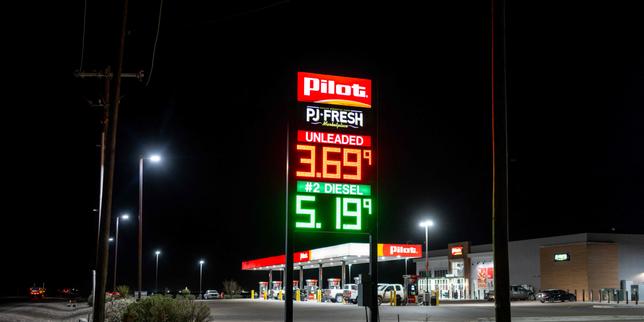
The latest Consumer Price Index data confirms what every American feels at the pump and the checkout counter. Inflation hit 3.3% in March, a figure that effectively slams the door on the Federal Reserve’s hopes for a quiet spring. While economists spent months predicting a smooth glide path toward the 2% target, the reality on the ground is far more jagged. Gasoline prices alone accounted for over half of the monthly increase, proving once again that the American economy remains a hostage to global oil volatility and the escalating friction in the Middle East.
This isn't just a statistical blip. It is a structural failure. Don't forget to check out our previous post on this related article.
The narrative often focuses on "sticky" services or housing costs, but the March surge highlights a much more volatile driver. When energy prices spike, the entire supply chain feels the heat. It costs more to transport goods, more to run factories, and more for the average commuter to show up for work. By the time the Department of Labor compiles these numbers, the damage to the American consumer’s purchasing power is already done. We are seeing a collision between domestic monetary policy and geopolitical reality, and right now, the geopolitics are winning.
The Middle East Premium and the Logistics of Misery
The immediate culprit for the 3.3% print is the tightening grip of the energy market. For decades, the U.S. has attempted to insulate itself from Middle Eastern instability through domestic fracking and strategic reserves. It hasn't worked. Oil is a fungible global commodity, and as tensions escalate between regional powers in the Levant and the Persian Gulf, the "war premium" is priced in instantly. To read more about the context of this, Business Insider offers an excellent summary.
When a tanker faces a threat in the Red Sea or a refinery in the Gulf of Africa feels the ripples of a broader conflict, the price of West Texas Intermediate (WTI) climbs. In March, this translated to a massive jump in the energy index. For the working class, this is a regressive tax. A billionaire doesn't notice when gas hits $4.00 a gallon. A delivery driver or a nurse with a thirty-mile commute loses a week’s worth of groceries every month.
The ripple effect is where the real investigative story lies. We are seeing "second-round effects" where businesses, weary of thin margins, are no longer absorbing these costs. They are passing them on immediately. This creates a psychological feedback loop. When people see the numbers spinning faster on the gas pump, they expect inflation to stay high. They demand higher wages. Producers raise prices in anticipation of those wage demands. The cycle doesn't just continue; it accelerates.
The Federal Reserve’s Impossible Corner
Jerome Powell and the Board of Governors are staring at a set of tools that no longer fit the job. Raising interest rates is designed to cool an overheated economy by making borrowing expensive. It works well when inflation is driven by "excessive" consumer demand—too much money chasing too few PlayStations. But interest rates cannot stop a drone strike on a refinery or reopen a blocked shipping lane.
The Fed is essentially trying to perform surgery with a sledgehammer. If they keep rates high to fight the 3.3% inflation, they risk a hard landing—a recession that could wipe out the job gains of the last three years. If they cut rates, they risk letting inflation spiral into the 4% or 5% range, permanently eroding the value of the dollar.
The Shelter Myth
One of the most overlooked factors in the March report is the lag in housing data. The Bureau of Labor Statistics uses a metric called Owners' Equivalent Rent (OER). It is a slow-moving beast. While real-time data from private rental sites shows a cooling market, the official government data is still reflecting the massive rent hikes of eighteen months ago.
This creates a dangerous "data lag." The Fed might be making decisions based on "sticky" housing numbers that are actually phantom artifacts of the past, while ignoring the very real, very present surge in energy and insurance costs. This disconnect is how policy errors happen. If the Fed stays too tight for too long because of lagging shelter data, they will ignore the fact that the average American is already broke from the gas and grocery double-whammy.
Why the Supply Side is Failing
We were told that the supply chain issues of the post-pandemic era were over. That was a lie of convenience. The "Just-In-Time" delivery model that defined the last thirty years of global trade is fundamentally broken in a world of persistent regional conflict.
In March, we saw a significant uptick in the cost of used cars and apparel. These aren't just random fluctuations. They represent a "re-shoring" tax. As companies try to move manufacturing away from volatile regions, they incur massive capital expenditures. These costs are being baked into the price of every shirt and every sensor.
Consider the insurance industry. This is the hidden titan of inflation. The cost of insuring a home or a car has increased at double-digit rates in many states. This isn't just about "climate change" or "accidents." It’s about the cost of parts and labor—driven by energy and shipping—making it more expensive for insurers to settle claims. They are hiking premiums to stay solvent, and those premiums are a core part of the CPI. You can’t opt out of car insurance. You can’t opt out of a roof over your head. This is "non-discretionary" inflation, and it is the hardest kind to kill.
The Geopolitical Chessboard
The March 3.3% figure is a victory for those who wish to see the American economy destabilized. When the U.S. is forced to burn through its Strategic Petroleum Reserve to keep prices down during an election year, it leaves the nation vulnerable to the next big shock. We are currently at the lowest reserve levels in decades.
Foreign actors know this. By keeping oil supply tight—either through OPEC+ production cuts or by stoking regional fires—they exert direct control over the American domestic agenda. Every time the price of a barrel of crude moves up five dollars, it’s a political blow to Washington. It limits the ability of the U.S. to project power abroad because the domestic cost of "stability" becomes too high for the voters to bear.
The Productivity Gap
There is a final, darker component to this data. For inflation to come down without a recession, productivity must go up. Employees need to produce more per hour worked to justify their higher wages. But productivity has stalled.
Bureaucracy, aging infrastructure, and a workforce that is increasingly burnt out have created a ceiling. We are paying more for the same—or less—output. In the tech sector, the promise of automation hasn't yet hit the bottom line of the grocery store or the trucking company. Until that gap closes, 3.3% might not be a peak; it might be the new floor.
The High Cost of the Green Transition
We must also be honest about the "Green Premium." The transition to a cleaner economy is necessary, but it is inherently inflationary in the short term. We are dismantling a highly efficient (though dirty) fossil fuel infrastructure and replacing it with a supply chain for minerals like lithium, cobalt, and copper that is even more volatile and concentrated in hostile hands.
During March, the cost of electricity and utility gas also remained stubbornly high. This is partly due to the massive investments required to upgrade the grid. You cannot rebuild the energy foundation of the world’s largest economy without someone paying the bill. Currently, that someone is the American taxpayer, who is paying for the transition at the pump and in their monthly utility statement.
The 3.3% inflation rate in March is a signal that the easy wins are over. The "transitory" era was a fantasy. The "painless cooling" era was a hope. What remains is a gritty, long-term struggle against a world that has become more expensive to navigate, more dangerous to trade in, and more difficult to manage.
Investors shouldn't be looking for a rate cut in June. They should be looking at their hedges. The energy trap has snapped shut, and the only way out is through a period of significantly lower growth or a fundamental restructuring of how the U.S. secures its basic commodities. Neither option is pleasant, and neither will be quick.
Check your local gas station prices this evening. That is your real-time inflation report. If that number isn't moving down, the Fed’s spreadsheets don't matter. The American consumer is being squeezed by a global pincer movement, and the pressure is only beginning to mount.