Public art in a fading seaside town is rarely just about paint. It is about a desperate, clutching grip on identity. In Morecambe, a town that has spent decades trying to reconcile its glorious Victorian past with a gritty, post-industrial present, that identity is inextricably linked to a man who loved the place so much he took its name.
The unveiling of a massive new mural on the side of the former Hitchens Building this week marks the centenary of Eric Morecambe’s birth. Born John Eric Bartholomew on May 14, 1926, the comedian remains the patron saint of this Lancashire coast. But as the curtain drops on this latest tribute, we have to look past the nostalgia. This isn’t just a birthday celebration; it is a calculated effort by the Morecambe Business Improvement District (BID) to weaponize memory in the fight for the town’s economic survival.
The Mural as a Monument to Relevance
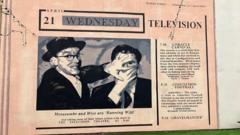
The artwork, designed by Jamie Jenkinson and brought to life by artists Molly Bland and Shane Johnstone, isn’t some abstract, avant-garde experiment. It is a faithful, towering reproduction of Eric and Ernie Wise in their prime, inspired by a vintage Radio Times cover. It leans heavily into the "sunshine" aesthetic that the duo trademarked.
For the locals, it is a point of pride. For the town’s planners, it is a strategic asset. The mural sits on Marine Road Central, a prime location for the influx of visitors expected as the town prepares for the transformative arrival of Eden Project Morecambe. By anchoring the seafront with high-visibility heritage art, the BID is trying to ensure that "Old Morecambe" isn't swallowed whole by the shiny, eco-conscious "New Morecambe."
Why Eric Still Matters
It is easy to dismiss this as mere sentimentality. However, the data of cultural impact suggests otherwise. Morecambe and Wise didn't just tell jokes; they created a shared national language. At their peak, 28 million people—half the British population—tuned in for their Christmas specials.
The enduring power of Eric’s image lies in his specific brand of vulnerability. He was the fool who knew he was being watched, the man who skipped when he should have walked. In an era of cynical, rapid-fire stand-up, that warmth is a rare commodity. The centenary celebrations, which include the "Follow the Sunshine" walking trail and performances of the West End hit Eric & Ern at the Winter Gardens, are tapping into a profound well of public affection that hasn't dried up forty years after his death.
The Mechanics of a Centenary
Executing a tribute of this scale requires more than just a few cans of spray paint. It is an exercise in local diplomacy. The project saw an unusual alignment of interests:
- Morecambe BID: Provided the vision and coordination as part of a wider "Eric Morecambe 100" program.
- The Family: Gary and Gail Morecambe, Eric’s children, have been deeply involved, ensuring the "brand" of their father remains authentic.
- The Private Sector: Brewers Decorator Centres donated the materials, a move that highlights how local business is forced to subsidize civic pride where council budgets fall short.
The mural stands near Eric's birthplace, a geographic reminder that he wasn't a product of London or the BBC—he was a product of the North.
The Counter-Argument: A Town Trapped in Time?
There is a risk here. Critics often argue that Morecambe is too obsessed with its favorite son. Walk the promenade and you’ll see the famous 1999 Graham Ibbeson statue, which has become a pilgrimage site. Now, with the new mural, the question arises: at what point does a tribute become a crutch?
A town cannot survive on ghosts alone. While the mural is a masterful piece of execution, it highlights a tension between the need for regeneration and the comfort of the rear-view mirror. The "Eric Morecambe 100" events are designed to drive footfall, but the real test is whether that footfall translates into a sustained revival of the local economy.
More Than Just Sunshine
The mural is bold. It uses the side of a building that had seen better days to project an image of a man who represented the best of British optimism. In the context of 2026, where seaside towns across the UK are struggling with the soaring costs of living and the decline of the traditional holiday, Eric Morecambe’s glasses and skip are more than just a memory. They are a brand.
The town is betting that by doubling down on Eric, they can maintain a unique selling point that no shiny new eco-dome can replicate. They are betting on the fact that even a century after his birth, people still want to go to the place that gave the world its greatest smile.
Whether this mural remains a vibrant landmark or becomes another fading relic of a bygone era depends entirely on the town’s ability to build something new alongside the old. For now, on the corner of Marine Road, the sunshine is back, even if it’s just made of paint.