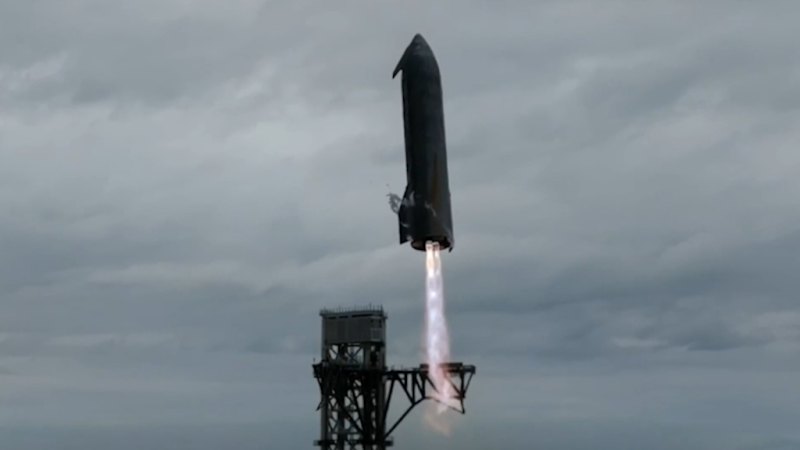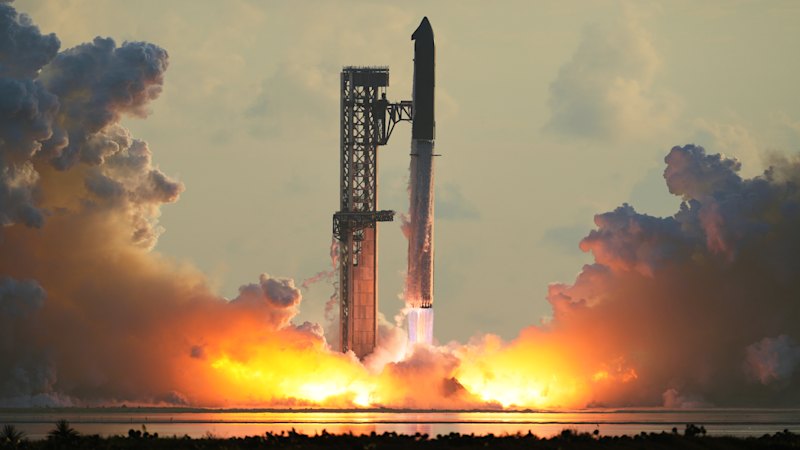
They cheered like it was the Apollo 11 moon landing. When SpaceX’s massive mechanical arms plucked a 232-foot Super Heavy booster out of the South Texas sky during Flight 5, aviation writers and space fanboys lost their collective minds. "Baby, she’s back!" the headlines screamed. The mainstream narrative crystallized instantly: SpaceX had just solved orbital economics, rendered every traditional aerospace contractor obsolete, and guaranteed a human colony on Mars by the end of the decade.
That celebration is premature, dangerously simplistic, and completely misses the real story. Also making waves in this space: How SpaceX Actually Pulled Off Catching a Rocket Out of Midair.
I have spent over fifteen years advising aerospace startups, reviewing launch manifests, and watching brilliant propulsion engineers burn through hundreds of millions of dollars chasing reusable hardware metrics that looked gorgeous on investor pitch decks and terrible on actual balance sheets. Catching a 250-ton stainless steel cylinder with giant chopsticks is an undeniable triumph of guidance, navigation, and control. Nobody with a functioning brain denies the sheer audacity of the physics involved.
However, cheering the catch as the finish line confuses a dazzling hardware demonstration with a viable commercial business model. The lazy consensus says catching the booster proves rapid reusability works. The reality is far more brutal. Catching the rocket is actually the easy part; the real engineering nightmare—the part that killed the Space Shuttle's economic promise and threatens to bog down Starship for years—starts the exact second the tower pins lock into place. Additional insights regarding the matter are covered by Wired.
The Myth of "Gas-and-Go" Rocketry
Mainstream coverage of the Mechazilla catch relies entirely on a single, unchallenged assumption: if you don't have to fish a booster out of the ocean or haul it back from a drone ship, you can refuel it and launch it again in an hour.
Elon Musk himself has repeatedly compared Starship operations to commercial airliners. Land, refuel, load cargo, take off. It makes for intoxicating keynote speeches. It also ignores the violent thermodynamic reality of full-flow staged combustion engines.
To understand why the airliner analogy falls apart under scrutiny, look at the Raptor engines bolted to the bottom of Super Heavy. Each engine operates at chamber pressures exceeding 300 bar—roughly three times the pressure inside a standard scuba tank, combined with temperatures hot enough to melt standard alloys if the regenerative methane cooling channels fail for a fraction of a second. Thirty-three of these controlled explosions fire simultaneously to lift the stack off the pad.
Now, consider what happens during the catch. To hover and slide into the tower arms, the booster executes a violent supersonic retropropulsion burn, slamming through its own exhaust plume while absorbing massive acoustic and thermal loads. When the chopsticks finally close, you do not have a pristine Boeing 737 waiting at Gate B4. You have a heavily stressed pressure vessel subjected to extreme thermal cycling, acoustic fatigue, and structural shock.
SpaceX learned this exact lesson the hard way with Falcon 9. When they first landed an orbital-class booster in December 2015, the media declared the immediate death of expendable rockets. Yet it took SpaceX over sixteen months just to refly a recovered booster for the first time, and years of iterative structural upgrades—shifting from Block 3 to Block 5—before turnaround times dropped from months to weeks. Even today, with hundreds of landings under their belt, Falcon 9 boosters require intensive non-destructive testing, engine inspections, and thermal protection refurbishment between flights.
Starship scales that complexity by an order of magnitude. Thirty-three engines instead of nine. Stainless steel alloy exposed to hypersonic reentry heating without an ablative coating. A massive, fragile heat shield on the upper stage composed of roughly 18,000 individual ceramic tiles that routinely crack, shift, or fall off during flight. Catching the booster eliminates maritime recovery logistics, which saves days of transit time and millions in naval operating costs. It does not magically erase metallurgical fatigue.
Why SpaceX Actually Built the Chopsticks
If rapid airliner-style turnaround is still years away, why did SpaceX risk destroying a billion-dollar orbital launch mount to catch a booster midair?
The press will tell you it was about speed. The truth is about mass fraction.
In orbital mechanics, every kilogram of hardware you carry to the edge of space steals directly from the payload you can deliver to orbit. This is the tyranny of the rocket equation, famously articulated by Konstantin Tsiolkovsky over a century ago. When you attach landing legs to a rocket—like the heavy carbon-fiber and aluminum struts on a Falcon 9—you pay a severe mass penalty twice. First, you have to burn extra propellant to lift those heavy legs out of the atmosphere. Second, you have to burn even more propellant to slow those heavy legs down during landing.
By shifting the landing hardware from the vehicle to the launch tower, SpaceX stripped tons of dead weight off the Super Heavy booster.
- Eliminating landing legs removes complex hydraulic or pneumatic deployment mechanisms that can jam under extreme thermal loads.
- Transferring structural shock to the ground-based Mechazilla arms means the booster airframe only needs reinforced catch pins near the top, rather than heavy load-bearing crush cores at the base.
- Increasing payload-to-orbit capacity by several metric tons per flight directly improves the revenue potential of every launch, assuming the vehicle survives the trip.
This is a brilliant architectural trade-off, not a magic wand. SpaceX traded vehicle mass for ground infrastructure vulnerability. Think about the risk profile of that decision. On a Falcon 9 mission, if a landing engine hiccups or a radar altimeter glitches, you lose a booster and punch a hole in an autonomous spaceport drone ship out in the Atlantic. You tow the barge back, weld some steel plates over the deck, and launch again from Florida two weeks later.
With the Mechazilla catch architecture, a single sensor glitch, a sudden wind shear, or a stuck throttle valve during the final three seconds of descent doesn't just destroy the rocket. It obliterates Stage Zero—the launch tower, the propellant tank farm, the quick-disconnect arms, and the orbital launch mount. SpaceX literally bet its entire launch site every time it attempted a catch. The media celebrated the spectacle without grasping the sheer financial Russian roulette happening on the pad.
Answering the Questions Nobody Wants to Ask
Whenever a major aerospace milestone hits the front page, search engines flood with the same predictable questions from curious readers and nervous investors. Most outlets feed them sanitized corporate talking points. Here is the unvarnished reality behind what people are actually searching for.
Does the Starship catch mean SpaceX is ready for NASA's Artemis moon landings?
Not even close. Catching a booster from a suborbital trajectory is a completely different universe from executing the Artemis III lunar landing architecture. To put two astronauts on the lunar surface for NASA, SpaceX cannot just launch one Starship. They have to launch a Starship propellant depot into low Earth orbit, followed by somewhere between ten and twenty consecutive tanker Starships to fill that depot with cryogenic liquid methane and liquid oxygen.
Orbital cryogenic propellant transfer at that scale has never been done in human history. Liquid oxygen and methane boil off continuously in the vacuum of space. Every day a tanker waits in orbit, you lose fuel. If one tanker suffers an anomaly or a catch goes wrong and damages the pad, the entire refueling campaign stalls, the propellant in orbit boils away, and the mission resets to zero. Catching the booster is step two on a twenty-step staircase.
Is Blue Origin completely dead after the Mechazilla catch?
Hardly, though their margin for error just evaporated. Jeff Bezos’s Blue Origin has spent years moving at a glacial pace with its New Glenn heavy-lift rocket, drawing endless mockery from the space community. Yet Blue Origin’s conservative approach—landing New Glenn on a massive moving ship at sea using traditional deployable landing legs—suddenly looks like a smart hedge against catastrophic ground infrastructure failure.
While SpaceX builds a single-point-of-failure tower system in Texas and Florida, Blue Origin is quietly positioning itself as the reliable, lower-risk alternative for commercial satellite operators and Pentagon payloads that refuse to have their launch schedules held hostage by experimental tower catches. In aerospace, the tortoise frequently wins lucrative government contracts simply by not blowing up its own launch pad.
Will Starship really drop launch costs to $10 per kilogram?
No. That number is an aspirational engineering target, not an accounting reality. Even if propellant costs only a few hundred thousand dollars per flight, the fixed overhead of operating Starbase, maintaining a fleet of boosters and upper stages, insuring launches, navigating FAA environmental reviews, and funding continuous design iterations runs into the billions annually.
Amortizing those fixed costs requires a launch cadence of hundreds of flights per year. Outside of deploying SpaceX’s own Starlink constellation, there is currently no commercial market on Earth demanding 100-ton payloads delivered to orbit every single day. Building the world's largest cargo plane does not automatically create a global shipping industry overnight.
The Trap of Operational Hubris
Let’s look at a historical parallel that modern tech journalists conveniently ignore. In the late 1970s, NASA promised the world that the Space Shuttle would fly fifty times a year, cut launch costs by ninety percent, and operate like a commercial airliner. The agency had dazzling hardware—reusable main engines, solid rocket boosters recovered from the sea, and a winged orbiter gliding gracefully back to a runway.
What NASA underestimated was the operational friction of inspecting, repairing, and recertifying complex reusable systems between flights. The Shuttle never came close to fifty flights a year; its peak was nine flights in 1985, right before institutional hubris and normalized deviance led to the Challenger disaster.
SpaceX is infinitely leaner, faster, and less bureaucratic than 1980s NASA. Their hardware-rich, fail-fast iteration model has humiliated legacy contractors like Boeing and Lockheed Martin, who spent decades milking cost-plus government contracts while delivering delayed, overpriced rockets. SpaceX earned its dominance by embracing risk that terrified traditional executives.
However, there is a razor-thin line between fearless iteration and operational hubris. Catching a falling skyscraper with mechanical arms works brilliantly when telemetry is nominal, wind speeds are within limits, and all thirty-three engines behave predictably. What happens on flight twenty-five, when a slightly worn turbopump blade fails during the landing burn, sending 250 tons of burning steel and residual methane straight into the tower base?
Imagine a scenario where SpaceX successfully catches ten boosters in a row, ramps up production, and starts launching critical national security payloads from Boca Chica. On the eleventh catch, a hydraulic actuator on the chopstick carriage freezes due to salt-air corrosion from the Gulf of Mexico. The booster clips the tower, collapses the structure, and takes out the entire launch complex for nine months. Suddenly, the brilliant mass-saving decision to put the landing gear on the tower becomes a catastrophic single point of failure that grounds the entire fleet.
What Smart Operators Should Actually Watch
If you want to understand whether SpaceX is truly conquering spaceflight—or merely staging the most expensive magic tricks in industrial history—stop watching the livestream explosions and dramatic tower catches. Watch the boring metrics that never make the evening news.
- Time between booster catch and static fire. Ignore how cool the catch looks on slow-motion replay. Track the exact number of days it takes SpaceX to lower that caught booster onto the orbital mount, inspect the engines, replace damaged valves, and fire it up again. Until that number drops below seven days without requiring engine swaps, the airliner analogy remains pure fiction.
- Upper stage heat shield integrity. Catching the booster is only half the equation. The upper stage—the actual Starship spacecraft—has to survive orbital reentry speeds of 27,000 kilometers per hour. Look closely at post-landing photos of the ship's belly. If the stainless steel structure underneath the ceramic tiles is warping or burning through, SpaceX still has years of fundamental materials engineering ahead of them.
- Orbital propellant transfer milestones. Keep your eyes on NASA’s public Artemis milestone reviews. Until SpaceX demonstrates transferring hundreds of tons of cryogenic fuel between two vehicles in orbit with minimal boil-off, deep-space missions to the Moon and Mars remain PowerPoint presentations.
- Insurance underwriting rates. Watch what Lloyds of London and major aerospace underwriters charge for payloads riding on caught boosters. Actuaries do not care about viral social media clips or charismatic CEOs; they price cold, hard statistical risk. When insurance premiums for reused Super Heavy boosters drop to match expendable rockets, you will know the technology has truly matured.
I will gladly admit when my skepticism hits a wall. SpaceX has a long, humiliating track record of making seasoned aerospace analysts eat their words. When experts claimed propulsive orbital-class landings were impossible, SpaceX turned them into routine Tuesday afternoon events. When critics mocked stainless steel as an archaic material for modern rocketry, SpaceX proved it outperformed expensive carbon composites under extreme thermal loads. Their engineers consistently solve physics problems that legacy contractors declare impossible.
Yet physics is only half the battle in aerospace. The other half is operational discipline, supply chain resilience, and surviving the brutal economics of maintenance.
Stop applauding the catch like the race is over. SpaceX just proved they can catch a falling rocket out of midair—now they have to prove they can afford to fly it again tomorrow without burning down the house.