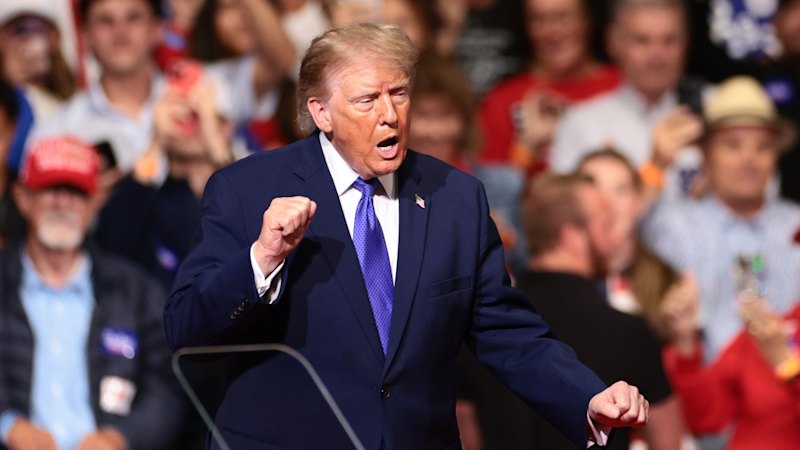
Political pundits love a simple psychological diagnosis because simple diagnoses sell clicks. When Donald Trump abruptly canceled late-October midterm rallies in Kansas and Iowa, snapped at a Reuters reporter who asked if he was "sick of traveling," and then put both events back on his schedule within 24 hours, cable news and digital outlets settled on a tidy, lazy consensus. According to mainstream coverage, the reversal was pure ego-driven damage control—a thin-skinned president lashing out over health rumors and scrambling to prove his stamina.
That reading misses the actual mechanics of modern campaign logistics, earned-media warfare, and what happens inside a political operation when internal polling starts flashing red in states that are supposed to be safe. Meanwhile, you can read related developments here: How the Clooney Foundation Mobile Legal Clinics Are Actually Reaching 9,000 Women and Children.
If you look closely at the timeline of the final week before the November 2026 midterm elections, the "he got mad about being called sick" narrative falls apart. What actually unfolded was a collision between two competing campaign strategies: a modern, data-driven attempt to trade expensive, low-margin tarmac spectacles for targeted tele-rallies, and an older, instinct-driven political reflex that treats physical crowd size as the ultimate metric of power.
The Lazy Consensus Versus the Real Tarmac Math
To understand why those rallies were cut in the first place, you have to stop viewing campaign schedules through the lens of personality and start viewing them through the lens of resource allocation. To explore the complete picture, check out the recent analysis by USA Today.
In the final stretch of any federal election cycle, a sitting president's time is the scarcest asset on the board. Every physical rally requires days of advance Secret Service sweeps, local law enforcement coordination, airlift logistics, and massive operational spend. In return, a rally in a deep-red state mostly preaches to the already converted. The people standing on an airport tarmac in Salina, Kansas, or Dubuque, Iowa, are not undecided swing voters. They are high-propensity base loyalists who were already going to vote.
Campaign strategists have known for years that when you are trying to defend vulnerable Senate seats across multiple time zones in the final 96 hours, flying Air Force One into a single mid-sized media market is often an inefficient use of bandwidth. By contrast, a "tele-rally"—essentially a massive, automated outbound conference call targeting tens of thousands of specific, low-propensity voters in targeted precincts—allows a principal to hit twenty congressional districts or Senate battlegrounds in a single afternoon without leaving the residence.
When the Republican National Committee initially scrubbed the Kansas and Iowa stops, aides framed the move as a pivot to accommodate roughly 20 tele-rallies across the closing weekend. In purely operational terms, that made complete sense. You trade two high-cost, localized media events for twenty surgical voter-turnout calls aimed directly at people who voted in 2024 but looked likely to sit out 2026.
The problem was not the strategy. The problem was the optics of executing that strategy in states where Republican incumbents were suddenly fighting for their political lives.
What the Health Narrative Completely Missed
When Reuters reporter Jacob Bogage approached Trump at Joint Base Andrews on October 29 and asked if he had canceled the Kansas trip to support Senator Roger Marshall because he was "sick of traveling," Trump erupted. He insulted Bogage’s physical appearance, insisted he felt "perfect," and claimed he was skipping Kansas only because Marshall was "doing very well".
Competitor articles treated that tarmac exchange as the smoking gun. In their telling, the phrase "sick of traveling" morphed in the public bloodstream into "physically sick," triggering an immediate panic inside the West Wing that forced Trump back onto the plane to prove his vitality.
Look at the actual numbers on the board that same week, and a very different picture emerges.
- The Kansas Warning Sign: Trump had carried Kansas by more than 16 percentage points in 2024. Yet on October 29—the exact day of the Joint Base Andrews outburst—a CNN/SSRS poll showed Democratic challenger Adam Hamilton leading Republican incumbent Roger Marshall 49% to 45%.
- The Broader Red-State Erosion: It wasn't just Kansas. Polling released that same week showed Democrats leading Senate contests in Maine, Michigan, and even Texas, where State Representative James Talarico held a 49% to 43% edge over Republican Ken Paxton.
- The Approval Drag: A Reuters/Ipsos poll put Trump’s approval rating at roughly 32%, creating a massive enthusiasm deficit for GOP candidates down the ballot.
When a president who won a state by 16 points pulls out of a rally there four days before Election Day, political operatives on both sides of the aisle do not read it as a health issue. They read it as triage. They read it as the White House writing off a seat as unwinnable—or worse, realizing that the president's presence might actually motivate Democratic turnout more than Republican turnout.
Democratic Representative Ted Lieu immediately capitalized on the cancellation by arguing on X that Trump was retreating to a "safe space" to avoid rally protesters. Meanwhile, television commentators like Joe Scarborough asserted that GOP operatives privately viewed the Kansas Senate race as "gone".
For a political brand built entirely on the projection of inevitability and dominance, having your own party's donors and local organizers conclude that you are abandoning a red-state incumbent is lethal. It freezes fundraising, depresses volunteer door-knocking, and signals to soft Republican voters that the fight is over before ballots are even cast.
The Structural Flaw in Modern Campaign Punditry
If you want to understand political news without getting played by the daily outrage cycle, you have to recognize how political journalism incentives distort coverage. Reporters traveling in a press pool are hyper-focused on physical access, interpersonal friction, and the immediate quote of the day. When a president yells at one of their colleagues on a tarmac, that confrontation becomes the center of the universe for the next news cycle.
I have watched political analysts and communications teams misread this exact dynamic across multiple cycles. They mistake the spark for the fuel.
Did Trump hate the implication that he was tired or slowing down after holding 26 campaign events in a single month? Undoubtedly. At 80 years old, any politician facing persistent scrutiny over stamina and age is going to bristle at the word "sick".
But ego alone rarely overrides a locked-in Secret Service travel manifest on 48 hours' notice. Reversing a presidential cancellation requires re-securing venues in Salina and Dubuque, re-deploying advance teams, and tearing up a weekend schedule that already included a Friday stop in Daytona Beach, Florida, plus twenty scheduled tele-rallies. You do not put a multi-agency logistical machine into reverse simply because a reporter annoyed you on a runway.
You put it into reverse because local stakeholders, donors, and nervous Senate allies picked up the phone and warned the White House that canceling those stops looked like surrender.
The Double-Edged Sword of the Reversal
Here is the nuance that both Trump’s critics and his defenders missed: reviving the rallies solved one political problem while actively worsening another.
In high-stakes political communications, there is an iron rule about tactical reversals. Once you announce a cancellation, you have already paid the reputational price for backing down. Reversing course 24 hours later does not erase the original headline; it compounds it by adding a second news cycle about internal chaos and indecisiveness.
Consider what the reversal actually accomplished in practice:
- It validated the panic: By rushing back into Kansas and Iowa after new polling dropped, the White House inadvertently confirmed that deep-red states were genuinely in danger. If Roger Marshall were truly "doing very well," as Trump claimed on the tarmac, there would have been zero reason to blow up the weekend schedule to rescue him.
- It sacrificed surgical turnout for broad noise: Every hour spent in transit to and from Salina and Dubuque was an hour taken away from targeted digital, fundraising, and tele-rally operations in tighter battlegrounds.
- It amplified the exact framing Trump wanted to bury: By staging a dramatic comeback weekend to prove he wasn't tired or retreating, Trump kept the "Trump health and stamina" keyword cluster trending right through the final weekend of the campaign.
As the eventual November 2026 midterm results demonstrated—with Democrats capturing control of both chambers of Congress and flipping key seats across the map—last-minute tarmac rallies could not override fundamental macro-level headwinds like voter dissatisfaction over healthcare, inflation, and foreign policy.
How to Actually Read Campaign Schedule Shifts
If you are trying to separate real political signals from cable-news noise in future election cycles, stop asking whether a candidate is "angry" or "scared." Start tracking three concrete indicators instead:
- Watch the travel radius, not the rhetoric: Compare a leader’s final-week travel map to their previous electoral map. In 2018, Trump barnstormed seven states in the final 72 hours. When a party’s top surrogate has to spend the final 48 hours defending states their party won by double digits two years earlier, the map has already broken against them.
- Follow the paid media, not the tarmac: A rally generates free local news coverage, which is great for base morale, but it rarely moves persuadable voters. Look at where party committees are placing late-stage television buys and field money. When ad buys get pulled from offensive targets to shore up defensive states, that is the real distress flare.
- Distinguish between base mobilization and persuasion: Tele-rallies, direct mail, and ground-game canvassing are persuasion and low-propensity turnout tools. Stadium rallies are base-affirmation rituals. Whenever a campaign trades the former for the latter in the closing days, it means leadership has decided to play to its base rather than expand the electorate.
The story of Trump’s revived midterm rallies was never a medical mystery, and it was never just a bruised ego on an airport runway. It was a textbook case of what happens when modern campaign math collides with old-school political instincts—and the instincts win the weekend, even when they cannot win the election.