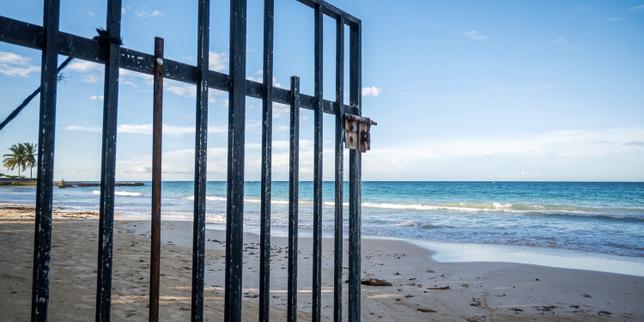
Locals versus resorts. Villagers versus developers. Foreigners lounging behind barbed wire while citizens get locked out of the sand.
That is the tidy moral postcard handed out whenever coverage centers on Jamaica's beach access crisis. It feels righteous. It feels complete. It is also lazy. Recently making headlines recently: When Paradise Catches Fire.
Calling this a simple clash between greedy hoteliers and aggrieved locals misses the real machinery grinding down coastline access across the island. When commentators treat every beachfront gate as an act of cartoonish villainy, they let the real culprits—fragmented title records, underfunded public spaces, weak enforcement, and a tourism model built on enclosure—skate past scrutiny.
The Lazy Consensus About Sand and Fences
Standard reporting frames beach access in Jamaica as a morality play. On one side stand big-money hospitality projects and private estate owners. On the other stand everyday Jamaicans fighting for a birthright along the Caribbean Sea. Further details regarding the matter are covered by Condé Nast Traveler.
Nobody denies the friction. Anyone who has spent time studying land use, coastal policy, or resort development in the Caribbean has seen how physical barriers and informal gatekeeping shape daily life. I have watched development proposals stall for years and seen millions burned on legal battles, environmental reviews, and public relations damage control because investors treated shoreline friction as a minor nuisance rather than a structural fault line.
Yet treating every locked gate as proof of an evil master plan confuses symptoms with causes.
In legal and policy terms, access is not a single word. Public access means the practical ability of ordinary people to reach and use a shoreline without intimidation or obstruction. Ownership refers to legal title or leasehold rights over land. Littoral rights relate to property bordering tidal waters, while statutory regulation governs how public authorities enforce rules on the ground.
People routinely lump those distinct concepts into one emotional bucket. They assume a wall automatically equals theft, or that tearing down a wall automatically creates a welcoming, safe, functional public beach.
Reality is messier. Many stretches of coastline in Jamaica sit inside overlapping claims, inherited family parcels without clear survey boundaries, historic Crown or state leases, and long-standing customary paths that never had formal protection. When an investor buys a parcel with murky historical boundaries or builds an all-inclusive compound designed to keep guests inside a controlled bubble, the conflict is not just ideological. It is institutional.
Why People Ask the Wrong Questions About Jamaica's Beaches
Search habits around this topic reveal a predictable set of assumptions. Readers ask why locals cannot go to the beach in Jamaica. They ask whether beaches in Jamaica are public or private. They ask how resorts get away with blocking the coast.
Those questions start from a flawed premise. They treat shoreline access like a light switch that is either on or off.
In practice, access fails through friction. A beach can sit on paper as accessible while remaining unreachable behind a gated perimeter, a security guard's stare, a lack of public parking, or a winding route that requires trespassing across private land. Conversely, a stretch of sand can be technically open while offering no restrooms, no shade, no waste collection, and no lifeguards—making it unusable for families on a weekend afternoon.
Ask "Why can't locals go to the beach?" and you get outrage. Ask "Which specific legal, spatial, and municipal failures turn a coastline into an exclusive zone?" and you get answers that actually fix things.
"Are Beaches in Jamaica Public or Private?"
That phrasing trips up visitors and locals alike because it flattens how coastal land works. Under general common-law traditions and Caribbean coastal frameworks, the foreshore and seabed are tied to public interest principles, yet dry land adjacent to the water can be privately held or leased.
If you cannot legally cross dry land to reach the water—or if practical entry points are fenced off, sold off, or policed aggressively—paper rights mean very little. A legal principle without physical corridors and enforcement is just ink.
"Why Do Resorts Block Access to the Coast?"
Blaming all-inclusive hotels is easy. It is also incomplete.
All-inclusive resorts built their business model on predictability, security, and contained spending. Keep guests inside the compound, feed them there, entertain them there, and capture every dollar on-site. Over time, that economic model encouraged isolated enclaves rather than integrated coastal towns where locals and visitors mix naturally.
Still, resorts are not the only actors shrinking public breathing room. Private villas, residential developments, commercial operations, and informal enclosures all shape who gets to stand near the water. When public agencies lack resources to patrol boundaries, maintain public beaches, or resolve land disputes quickly, private control fills the vacuum.
Imagine a scenario where a coastal parish designates three clean, well-lit public beach parks with free entry, bus stops, showers, and vendor stalls, while enforcing strict rules on unlawful perimeter blockades. That thought experiment exposes an uncomfortable truth: part of the frustration comes from the absence of decent public infrastructure, not solely from the presence of a hotel wall.
The Uncomfortable Trade-Offs Nobody Wants to Admit
Here is where the sharp edge cuts both ways. If you push for sweeping, unfiltered access without fixing governance, things can break fast.
Unregulated access without sanitation, policing, and environmental management leads to trash buildup, erosion, safety hazards, and conflict between users. Coastal ecosystems—mangroves, dunes, reefs, and beaches—do not care about slogans. Heavy, unmanaged foot traffic and waste degrade the exact natural assets people want to enjoy.
At the same time, fortress tourism carries its own heavy price. When locals feel alienated from their own coastline, resentment hardens. A tourism economy that treats surrounding communities as mere staff or spectators builds fragile long-term stability.
Coastal planners, urban designers, and policy researchers who study island economies point to the same tension: sustainable coasts require both clear public rights and real management capacity. Without enforcement and upkeep, "open access" can turn into neglect. Without guaranteed access and fair planning, "managed development" looks like exclusion.
I am not pretending my contrarian framing is cost-free. Focusing on governance, land titling, and municipal capacity sounds less dramatic than shouting at a gate. It can sound clinical when people feel pushed out of spaces tied to family memory and cultural identity. Worse, emphasizing institutional complexity can accidentally give bad actors cover if activists lose focus on concrete abuses.
That is a real risk. Nuance should sharpen accountability, never excuse obstruction.
What Actually Works Instead of Performative Outrage
If the goal is real, lasting beach access in Jamaica rather than another cycle of headlines and anger, stop fighting ghosts and target the levers that move real estate and policy.
- Audit specific parcels, not vibes. Stop treating every coastline dispute as identical. Map exact boundary lines, lease terms, easements, and physical entry points beach by beach. Vague outrage is easy to ignore; documented boundary violations and unfulfilled public obligations are harder to brush aside.
- Demand funded public beaches, not just unlocked gates. A strip of sand with no access road, no shade, and knee-deep garbage is a consolation prize. Push local authorities to invest in maintained public beaches with clear signage, transit links, lifeguards, and waste management.
- Tie coastal permits to verifiable access corridors. Future coastal development and renewals should face strict, enforceable conditions for public walkways, visual corridors, and environmental safeguards—backed by real penalties rather than toothless promises.
- Separate security from exclusion. Safety concerns are real in any crowded space, yet blanket intimidation at access points crosses a line. Clear rules on where public entry runs and how security personnel behave prevent everyday beachgoers from being treated like intruders.
- Fix land records and dispute resolution. Murky title histories and slow legal processes breed turf wars and speculative land grabs. Clearer land administration reduces gray areas where bad-faith enclosures thrive.
The Real Battle Beneath the Sand
Jamaica's beach access struggle is not a cartoon of good guys and bad guys. It is a stress test of law, land, economics, and public power along a finite shoreline.
Keep reducing it to a simple slogan, and the gates stay locked while the real bottlenecks stay hidden. Fix the rules, fund the public spaces, and force every stakeholder to play by enforceable standards—or keep arguing over the fence while the coastline slips further out of reach.