The glow of a smartphone screen in a darkened room is usually a portal to mindless scrolling, a late-night laugh, or a message from a loved one. But for thousands of young men and women across Asia, that exact glow became a digital leg-iron. They sat in concrete compounds guarded by men with automatic rifles, typing out scripts designed to steal life savings. If they failed to hit their targets, they were beaten. If they tried to run, they disappeared.
Behind this multibillion-dollar industry of forced cyber-scamming stood a handful of untouchable dynasties. Chief among them was the Wei family.
For years, they operated with absolute impunity in Kokang, a lawless, semi-autonomous region in northern Myanmar bordering China. They built an empire on a simple, brutal equation: human trafficking plus internet connectivity equals infinite wealth. But the digital empire has crashed. The recent trial of Wei San, also known as Wei Qingtao, along with his top lieutenants in a Chinese courtroom, marks the end of an era of digital feudalism. It is a stark reminder that even the most modern crimes eventually answer to the oldest forces of geopolitical gravity.
To understand how a family transformed a mountainous borderland into a high-tech horror show, look closely at Wei San himself.
Before his arrest, Wei was the definition of nouveau-riche arrogance. He was the "Golden Gatsby" of the Mekong. His TikTok and Douyin accounts were masterclasses in vulgar opulence. One video would show him drifting a supercar through the dusty streets of Laukkai, the capital of Kokang. The next would show him flaunting stacks of cash at a VIP baccarat table, or hosting lavish parties where champagne flowed like water. He presented himself as a legitimate, high-flying young tycoon, a beacon of modern luxury in a developing region.
It was a grotesque illusion.
While Wei was filming his lifestyle content, hundreds of captives were trapped in the basement complexes beneath his family’s properties. Consider a typical, composite victim of this machine—let us call him Chen. Chen was a twenty-four-year-old IT graduate from Hunan province. Unemployed, desperate to help his aging parents, he answered an online ad for a high-paying tech support job in Thailand.
The moment Chen crossed the border, the trap snapped shut. His passport was confiscated. He was bundled into a car, driven across dirt roads, and delivered to a heavily fortified compound in Kokang owned by the Wei family’s Fully Light Group.
Chen was handed a script and ten smartphones. His new job was "pig butchering"—a psychological scam where operators build romantic trust with victims online over weeks, only to convince them to invest in fraudulent cryptocurrency platforms. If Chen didn't dupe enough victims, he was denied food. When he tried to refuse to work, he was shocked with an electric cattle prod. The contrast was absolute: on the top floor, Wei San filmed videos celebrating his immense wealth; in the subterranean digital sweatshops, Chen bled to generate it.
The Wei family did not achieve this level of power overnight. They were part of the "Four Families" of Kokang, a oligarchy that took power after a volatile history of ethnic conflict and shifting alliances with Myanmar’s central military junta.
The patriarch, Wei Chaoren, was a former local commander who understood that physical territory could be monetized. As the internet penetrated the remote hills of Myanmar, the family realized that traditional smuggling routes were outdated. The real money was in the airwaves. They built massive commercial complexes that were, in reality, cyber-prisons. They leased these buildings to criminal syndicates, provided security through private militias, and took a massive cut of the profits.
They believed they were untouchable because they had built a perfect symbiotic relationship with local authorities. They had the guns. They had the money. They had the infrastructure.
What they failed to realize was that their digital dragnet had caught too many Chinese citizens. The scale of the scams became an existential embarrassment for Beijing. Hundreds of thousands of Chinese families were losing their life savings to operations running just across the southern border. The social fabric was fraying.
Beijing’s retaliation was slow to start, but devastating when it arrived. The turning point came late last year when a coordinated offensive by an alliance of ethnic armed groups, known as the Three Brotherhood Alliance, swept through Kokang. They launched their attacks under the explicit banner of eradicating the scam syndicates, a move that Beijing tacitly supported.
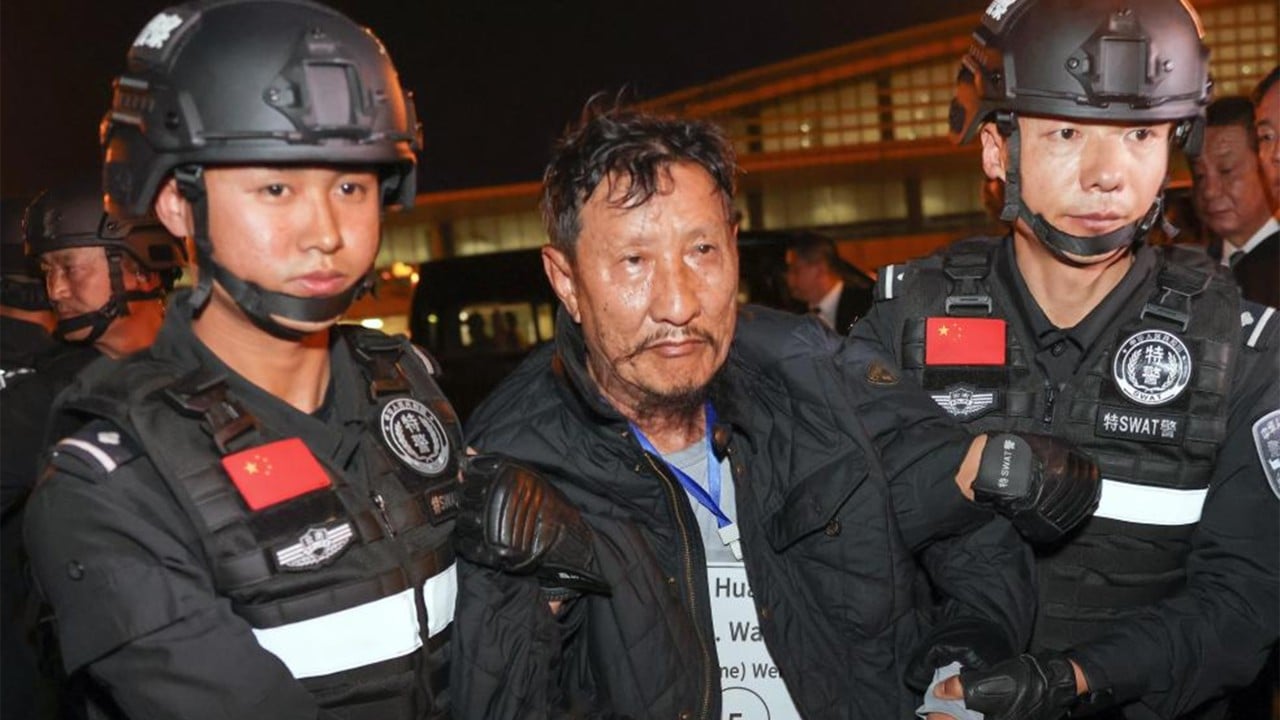
As the rebel forces advanced on Laukkai, the Wei family’s empire dissolved. Wei San was captured by Chinese authorities while traveling outside his stronghold. The man who once commanded millions via his smartphone was suddenly wearing a standard-issue prison jumpsuit, his head shaved, his eyes fixed on the floor of a Chinese courtroom.
The trial of Wei San and his co-defendants is being broadcast by Chinese state media as a total victory. The footage is carefully curated to project absolute control: a row of stern judges, meticulously organized files of digital evidence, and broken tycoons confessing to their crimes. The message to other syndicates operating in Southeast Asia is clear: the arm of the state is long, and no amount of wealth can buy permanent immunity.
But the reality on the ground is far more tangled and uncertain than the clean narrative of a courtroom trial suggests.
While the Wei family has been dismantled, the vacuum they left behind is already being contested. The physical infrastructure of the scam compounds—the high-speed fiber-optic lines, the reinforced concrete barracks, the biometric security systems—remains intact. Reports are already trickling out that the cyber-scam industry is not dying; it is simply migrating. Syndicates are packing up their servers and moving further south into the lawless pockets of Karen State, or across the borders into Laos and Cambodia.
The human cost remains incalculable. For every Wei San brought to justice, there are thousands of Chens who carry the psychological and physical scars of their captivity. There are thousands of families across the globe whose financial lives were destroyed by a voice on the other end of a WhatsApp message, a voice that was being forced to speak under the threat of violence.
The courtroom in China was quiet when the verdicts were read. The flashy suits and custom sports cars of the Kokang elite had been replaced by the dull drone of legal bureaucracy. Wei San listened to his fate without the benefit of a camera angle or a filter.
Outside the courthouse, the digital world kept spinning. Somewhere in a hidden compound along the Mekong River, a smartphone screen flickered to life in a dark room, waiting for its next victim.


