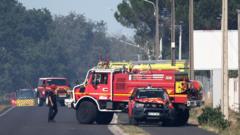
Two French firefighters lost their lives battling an aggressive wildland blaze near Bordeaux-Mérignac Airport, exposing systemic vulnerabilities in southern Europe’s emergency response apparatus. The incident, which disrupted regional air traffic and forced swift localized evacuations, initially appeared to be a standard containment scenario. However, operational breakdowns, delayed aerial support, and escalating urban-wildland interface risks turned a manageable containment line into a deadly trap. The loss highlights an uncomfortable reality across the continent. Emergency crews are running on empty while fighting fires fueled by unprecedented heat and outdated infrastructure.
The Mérignac Incident exposing systemic fractures
The fire began along a dry timber and brush belt bordering the perimeter of Bordeaux Airport, a critical transport hub in southwestern France. High winds coupled with prolonged dry spells caused the flames to jump established firebreaks within minutes. First responders from the Gironde departmental service deployed rapidly to protect critical aviation assets and neighboring residential properties.
Tragedy struck during the initial attack phase. Two veteran crew members were trapped when a sudden shift in wind direction directed a crown fire directly onto their position. Despite immediate rescue efforts by surrounding units, both crew members succumbed to severe thermal injuries and smoke inhalation on site.
Tragedies of this scale rarely stem from a single failure. They are the cumulative result of smaller operational friction points. In Gironde, ground crews confronted a lethal mix of volatile vegetation, dense smoke that grounded early thermal-imaging reconnaissance, and a communications dead zone near the airport runway corridors.
The tragedy near Bordeaux Airport is not an isolated disaster. It reflects a dangerous pattern visible from the pine forests of Portugal to the dry hillsides of Greece. Emergency management agencies face an evolving threat landscape, yet their operating models remain fixed in the late twentieth century.
The Lethal Chemistry of the Urban-Wildland Interface
The area surrounding Bordeaux-Mérignac represents a classic urban-wildland interface. Here, high-density infrastructure sits immediately adjacent to highly flammable pine plantations and neglected scrubland. Managing fires in these hybrid zones introduces severe complications that traditional rural firefighting teams are rarely equipped to handle.
Infrastructure gets in the way. Perimeter fences, security gates, fuel storage depots, and high-voltage power lines turn a standard containment zone into a maze. Ground crews must protect high-value commercial structures while simultaneously maneuvering heavy apparatus through narrow, unpaved service roads.
Standard wildfire tactics rely on controlled retreats and tactical backfires. In an interface zone like Bordeaux Airport, crews do not have the luxury of giving up ground. They are forced to make static stands to defend fuel depots, jetliners, and residential developments. This defensive posture drastically increases the risk profile for frontline personnel. When a fire turns, crew members surrounded by physical barriers have no viable escape route.
Public land management around major infrastructure has lagged behind climate reality. Landowners and municipal authorities frequently fail to enforce mandatory vegetation clearing around critical assets. Dry pine needles and underbrush stack up year after year, creating a powder keg right beside high-risk zones. When an ignition occurs, the resulting fire burns with an intensity that renders standard ground tactics ineffective.
The Equipment Deficit and the Myth of European Modernization
Political leaders regularly promise modernized firefighting fleets and state-of-the-art coordination centers after every major disaster. The operational reality on the ground tells a radically different story.
France’s national aerial firefighting fleet remains severely stretched. The heavy water-bomber fleet, composed primarily of aging Canadair aircraft, suffers from chronic maintenance delays and supply chain bottlenecks for spare parts. During peak summer months, regional fire services compete for limited air assets. Ground commanders often wait hours for tactical water drops that need to happen within minutes.
Aging assets and delayed air support
The delay in deploying heavy air tankers during the early stages of the Mérignac fire proved catastrophic. Regional air support was tied up on secondary incidents across the region, leaving local commanders without instant suppression options.
Suppression assets were missing when they were needed most. A single targeted drop during the initial thirty-minute window could have knocked down the head of the fire before it developed into a thermal column strong enough to trap ground units.
The communication breakdown in critical zones
Equipment issues extend far beyond aircraft. Interoperability between local fire departments, national civil protection units, and airport security teams remains fragmented. Radio communications regularly drop out near heavy infrastructure due to electromagnetic interference and structural shielding.
Ground crews in Mérignac experienced critical communication lags during the wind shift. Warnings issued by overhead command units failed to reach the frontline team in time to execute a tactical retreat. This failure exposes a persistent weakness in how emergency services share real-time spatial data across different administrative divisions.
The Human Cost of Strategic Neglect
The burden of these systemic failures falls directly on the personnel wearing the gear. Regional fire services across southern Europe face severe staffing shortages, driven by budget cuts, stagnant wages, and high turnover rates caused by physical and psychological exhaustion.
Volunteer networks, which form the backbone of rural fire departments in France, are collapsing. Younger generations are reluctant to take on the unpaid risk, leaving an aging pool of volunteers to handle increasingly volatile fire seasons. Professional units are routinely asked to work prolonged shifts with minimal rest cycles, compounding fatigue and impairing decision-making during life-or-death situations.
Safety protocols written two decades ago assume predictable fire behavior. They do not account for the rapid rate of spread, intense heat output, and erratic wind events that define modern wildfires. Expecting firefighters to compensate for structural and policy failures through sheer bravery is a strategy that guarantees more casualties.
Fixing a Broken System
Resolving this crisis requires moving beyond political speeches and implementing drastic operational changes across land management, equipment acquisition, and tactical doctrine.
First, buffer zones around critical infrastructure must be legally enforced, not merely recommended. Airports, industrial parks, and residential developments bordering wildlands must maintain cleared defense zones cleared of all volatile fuels. Municipalities that fail to enforce these clearings must face direct financial penalties and loss of state development funding.
Second, aerial procurement needs immediate overhaul. European nations cannot continue relying on a shared pool of legacy water-bombers that sit grounded for repairs during peak fire season. Direct investments into modernized, medium-capacity air fleets capable of rapid deployment from regional airfields must replace piecemeal leasing arrangements.
Third, communications infrastructure requires modernization. Emergency services need localized mesh networks and real-time satellite tracking systems that function reliably around major infrastructure, ensuring every ground commander has a clear view of fire movement and crew positions at all times.
The deaths near Bordeaux Airport were not an unavoidable act of nature. They were the direct consequence of putting frontline crews into modern fire environments equipped with outdated tools and broken support systems. Until European leaders treat wildfire management as a critical national security issue rather than an seasonal inconvenience, the cost will continue to be measured in human lives.