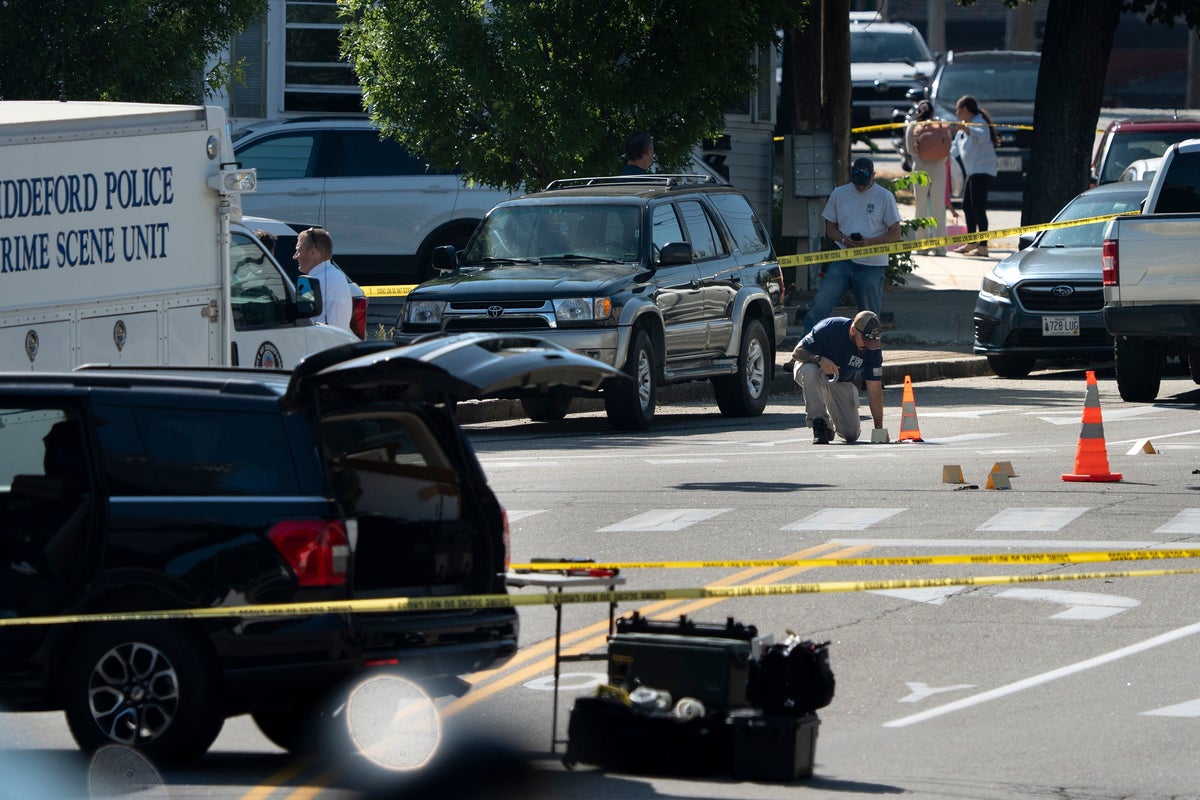
A white sedan slowly spun in circles on a quiet asphalt intersection in Biddeford, Maine, while federal agents chased it down. Inside the car, 26-year-old Johan Sebastián Durán Guerrero was dying. Minutes earlier, an immigration officer had opened fire on him through the glass.
Witnesses nearby didn't see an armed threat. They saw a young father. Daniel Boucher, looking out from his third-floor window after hearing gunshots, watched the SUV block the sedan. He heard the young driver's last words.
"I tried to stop."
Those four words lay bare the massive, terrifying gap between official agency statements and the reality on the ground. The Department of Homeland Security quickly claimed the officer fired because he was fearing for public safety after the vehicle attempted to flee. Yet, the victim was not even the target of the immigration sweep. He had a valid social security number and permission to work in the United States.
This is not a one-off tragedy. It is a systematic failure. Across the country, federal immigration officers are turning routine encounters on public roads into fatal battlegrounds.
The Broken Narrative of the Weaponized Vehicle
When federal agents pull the trigger on a driver, a predictable public relations machine starts humming. The script is almost always the same. They claim the driver weaponized the vehicle. They say the officer had no choice. They claim the officer's life was in danger.
Look at the numbers. Durán Guerrero is the ninth person killed during immigration enforcement operations since the current administration's mass deportation campaign kicked into high gear. At least four of those deaths occurred during vehicle encounters.
Just six days before the Maine shooting, an ICE agent in Houston shot and killed Lorenzo Salgado Araujo under nearly identical circumstances. The agency claimed Araujo tried to ram his car into an agent. But passengers in his van directly disputed that story. They said he did no such thing. He was simply driving to his construction job.
In March 2025, federal agents shot 23-year-old Ruben Ray Martinez in Texas. Again, the official line was that Martinez intentionally ran over an agent. It took nearly a year for details to emerge, but the pattern is impossible to ignore.
The defense is automatic. It is designed to shield officers from liability before any real investigation begins. But local police dashcams and bystander videos have repeatedly shown these claims of self-defense to be highly exaggerated, if not outright fabricated.
The Madness of Shooting Into Moving Cars
Ask any veteran metropolitan police chief about shooting at a moving vehicle. They will tell you it is a terrible idea. In fact, most major city police departments explicitly ban the practice.
The logic is simple. If you shoot a driver, you now have a two-ton unguided missile careening down a public street.
Shooting a driver = Unconscious driver = Out-of-control vehicle = Greater public danger
By firing into the windshield, the officer actually increases the danger to the public. If the goal is public safety, shooting the person behind the wheel achieves the exact opposite.
John Sandweg, who ran ICE during the Obama administration, raised this exact point after the Maine shooting. He questioned why federal officers are putting themselves in these dangerous, low-leverage positions in the first place. Traffic stops are notoriously unpredictable. They are dangerous for local police officers who have extensive training in highway safety. ICE agents do not have that same level of training, yet they are increasingly initiating high-risk vehicle blocks on suburban streets.
If a suspect flees in a vehicle, the standard police protocol is to let them go and track them later, unless they pose an immediate threat of mass violence. Fleeing arrest is not a capital offense. It does not justify a death sentence delivered through a windshield.
The Human Cost of Surveillance Mistakes
Johan Sebastián Durán Guerrero was not a fugitive. He was a neighbor. He lived down the street with his wife and young daughter.
Sadie Dilboy, who runs a local laundromat in Biddeford, remembered him as a kind, helpful man who regularly brought his daughter in and gave her quarters for candy.
On Monday morning, ICE agents were watching a nearby home. They were looking for someone else—someone with a final order of removal. When Durán Guerrero drove away from the area, agents decided to intercept his white sedan.
They made a massive mistake. Senator Angus King confirmed that Durán Guerrero was not the target of the operation. He was just a guy driving down his own street.
This is the nightmare scenario of unregulated federal policing. If you look vaguely like a target, or if you happen to walk out of a building under surveillance, you can find yourself boxed in by unmarked SUVs with guns pointed at your face.
Put yourself in that driver's seat. You are a young immigrant. You see men in vests jumping out of unmarked vehicles, shouting. Panic sets in. You try to steer away. The agents see your attempt to escape as a lethal threat. They shoot you in the head.
Your wife is left falling to her knees on the asphalt, staring at your body. Your daughter is left standing there in her pink school backpack, crying.
The Accountability Black Hole
There is a glaring reason why these shootings keep happening without consequence. Federal immigration officers do not operate under the same transparency standards as local police.
In the Biddeford shooting, the agents involved were not wearing body cameras. This is unacceptable. In 2026, there is zero excuse for any law enforcement officer to conduct field operations without an active camera recording the interaction.
Without video, the public is forced to rely on the word of the agency. And the agency has a proven track record of shading the truth.
Consider the case of Alex Pretti, a 37-year-old nurse shot and killed by a Border Patrol officer during a protest in Minneapolis. Authorities immediately labeled Pretti an armed threat. But bystander video told a completely different story. Pretti was on the ground, holding nothing but a cellphone.
When federal agencies operate in the dark, they protect bad actors and destroy public trust. The FBI is currently leading the investigation into Durán Guerrero’s death, alongside the Maine Attorney General’s office. The officer who fired the shots has been placed on leave. But history suggests we should not hold our breath for criminal charges. No federal immigration officers have been prosecuted in any of the recent fatal encounters during this deportation push.
Stopping the Carnage on Local Roads
The mounting death toll has finally forced some political pushback. Senator Susan Collins of Maine publicly urged DHS Secretary Markwayne Mullin to halt all non-urgent vehicle stops.
Sources indicate that federal officials have quietly told immigration officers to suspend most vehicle stops. But a temporary pause is not enough. We need systemic, permanent changes to how these agencies operate.
First, the Department of Homeland Security must ban the practice of shooting at or from moving vehicles, matching the standards used by progressive metropolitan police forces.
Second, body cameras must be mandatory for all field agents. If an agent does not have an active camera, they should not be allowed to participate in arrests or surveillance.
Third, we must end the practice of low-intelligence vehicle blocks. Chasing down cars based on loose visual similarities or because they left a watched address is sloppy, dangerous police work.
We cannot allow our local streets to be treated as combat zones. The people living in these communities deserve better than to watch their neighbors bleed out on the pavement because of a federal agency's reckless tactics. It is time to pull the plug on these dangerous highway ambushes before another family is torn apart.