The concrete does not remember the ocean.
For decades, the tank walls have absorbed the echoes of thousands of human voices, echoing laughter, the sharp blast of a plastic whistle, the dull thud of frozen herring hitting the water. But concrete has no memory of salt spray, of the endless, bruising pressure of deep arctic currents, of the way the light filters down through two hundred feet of living green water.
A beluga whale knows those things. Or, at least, its body remembers them, even when the mind is trapped in a sterile oval of blue-painted steel and glass.
Weeks ago, a transfer happened. A heavy flatbed truck, a specialized sling, a crane, a quiet roar of diesel engines cutting through the pre-dawn stillness. The destination was a U.S. aquarium, a facility that promised better medical oversight, a fresh start, a new chapter in a life already worn thin by captivity. The logic was clean, bureaucratic, and sanitized. Facilities trade animals like baseball cards to manage breeding programs, to refresh exhibits, to solve spatial equations on corporate spreadsheets.
Then came the silence.
Not the silence of the deep ocean, which is filled with the clicks, whistles, and low-frequency pulses of a pod conversing miles away. This was the silence of a medical chart flatlining. Just weeks after arriving in its new home, the whale was gone.
Stop. Look at the timeline. Weeks.
It takes longer than that for a human being to adjust to a new time zone without their bones aching. Imagine being lifted out of the only environment you have ever known—faulty as it was—drained of water, suspended in the air, loaded onto a rumbling machine, rushed across international borders, and dumped into a foreign tank with new water chemistry, new microbial flora, and a new acoustic signature bouncing off unfamiliar walls.
It is a wonder they survive the trip at all. Often, they don't.
We treat these animals as movable assets, as living statues that can be unbolted from one pedestal and bolted onto another. We look at them through thick acrylic windows and see a permanent, unblinking smile. That smile is a biological accident. The curve of the beluga jaw does not shift when it is terrified. It does not drop when it is grieving. It remains fixed, a cruel magic trick played by evolution, masking a fragile nervous system that is utterly unequipped for the modern logistics of entertainment and conservation.
Consider what happens inside the body of a cetacean under chronic stress.
(Note: To understand this invisible crisis, I often rely on a hypothetical baseline derived from veterinary pathology reports of marine mammals in transit.)
When a beluga experiences acute panic, its adrenal glands flood the bloodstream with cortisol. In the wild, this chemical surge is designed to fuel a high-speed escape from an orca or a sudden hazard, followed by physical exertion that burns the hormone away. In a transport sling, that physical outlet does not exist. The whale hangs motionless in the dark, breathing stale air, its heart hammering against ribs designed for buoyancy, not gravity. The cortisol stays. It accumulates. It suppresses the immune system, shreds the stomach lining, and turns the body against itself.
By the time the crane lowers the animal into its new enclosure, the clock is already ticking down to zero. The visible move is over, but the internal collapse has only just accelerated.
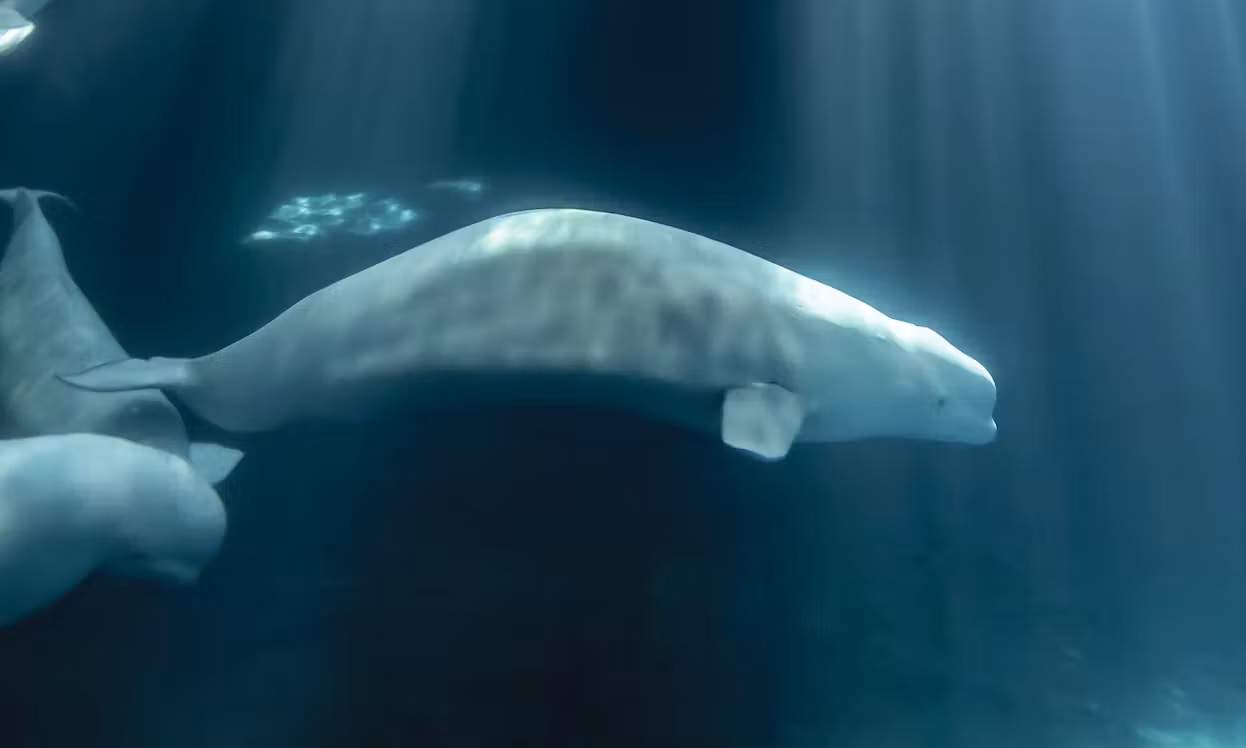
We have built an entire industry around the illusion of stewardship. We tell ourselves that these concrete enclosures are arks, saving species from a dying planet. We buy tickets for our children so they can look into the eye of an apex predator and feel a spark of ecological empathy. That spark is real. I felt it myself, years ago, standing before a massive glass pane as a white ghost glided past, exhaling a column of bubbles that danced toward the surface. It is intoxicating. It makes you want to protect the oceans, to save the whales, to care about the wild places of the world.
Yet the irony is staggering. We use the prison to teach the value of freedom.
And the cracks in that logic are widening. More facilities are facing public scrutiny, declining ticket sales, and mounting scientific evidence that cetaceans simply doth not thrive behind glass. Their brains are wired for complex social structures, immense territories, and acoustic navigation that spans entire coastlines. A concrete tank is not a habitat; it is a sensory deprivation chamber with a gift shop attached.
When the transfer was announced, public relations teams spun it as an upgrade. Better filtration. A larger pool. More veterinary staff on standby. They used words like optimization and welfare. They spoke of the animal in the third person, reducing a sentient, highly communicative being to a logistical unit that needed to be balanced on a ledger.
The ledger is now closed.
What remains is the empty tank. The water is still filtered, the artificial sunlight timers still click on at dawn and off at dusk, and the tourists will line up tomorrow morning to press their hands against the glass where nothing is looking back.
We must confront the unvarnished truth of what we are asking these creatures to endure for our education and our entertainment. Every transfer is a gamble played with a life that cannot consent to the stakes. Every concrete wall is a monument to our collective cognitive dissonance, our desire to hold the wild in our hands until it stops breathing.
The truck has long since pulled away. The crane is folded. The paperwork is filed, stamped, and archived in a metal drawer somewhere. But out on the open ocean, far beyond the reach of trucks and concrete, the true relatives of that lost titan are moving through the dark, singing songs we are only just beginning to understand, completely unaware of the sterile room where the music finally stopped.