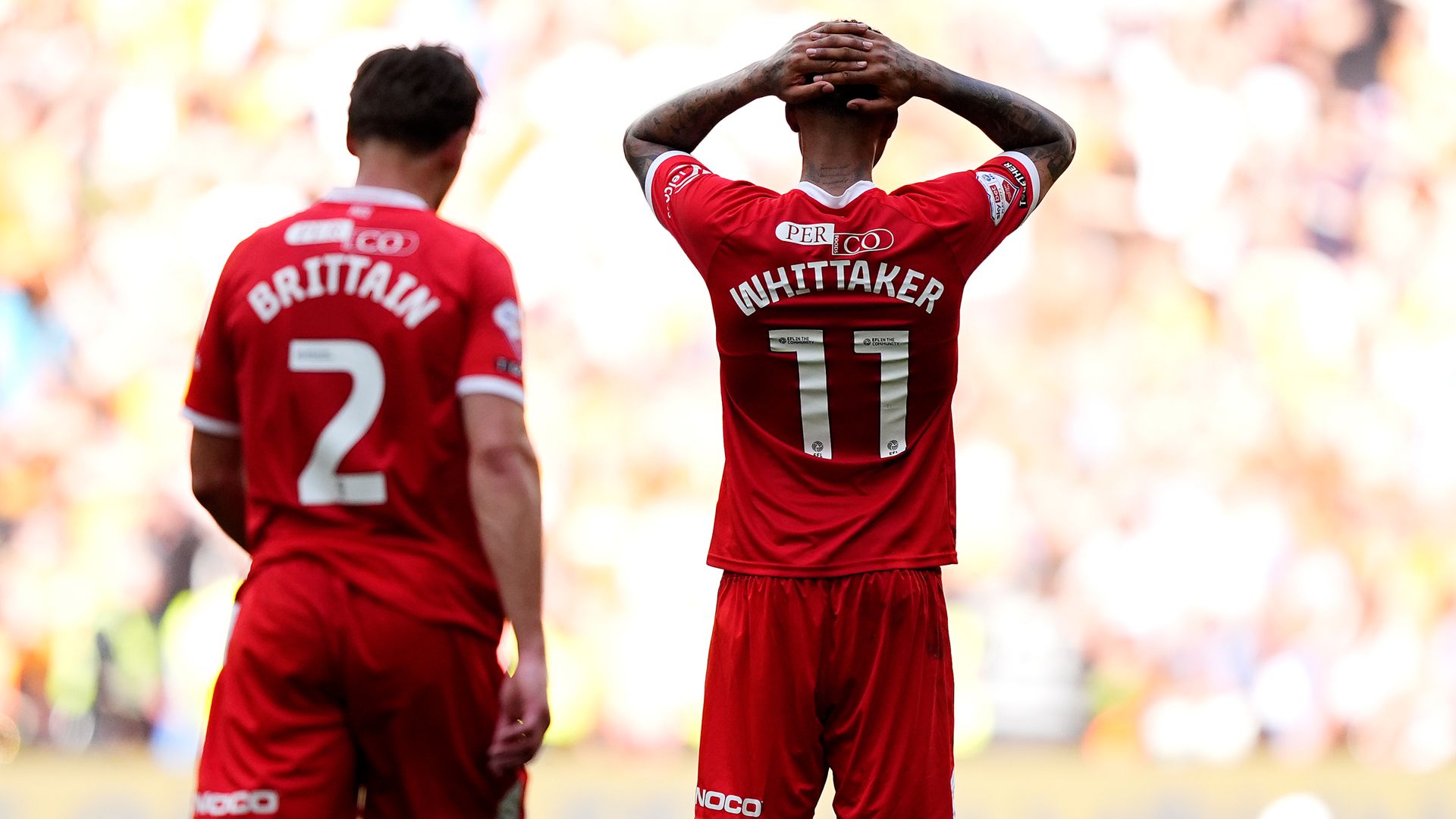
The English Football League Championship Playoff Final represents the highest-stakes single match in domestic football, where a 90-minute fixture dictates a revenue swing exceeding £170 million for the ascending club. When Middlesbrough conceded the final Premier League promotion berth to Hull City, the outcome was not a product of ephemeral concepts like luck or heartbreak. It was the direct consequence of structural inefficiencies in squad construction, tactical bottlenecks under high-pressure game states, and the compounding financial disparities inherent in the modern English football pyramid.
To analyze this fixture rigorously, one must move past emotional narratives and examine the game through three distinct analytical lenses: the economic asymmetry of promotion mechanics, the tactical breakdown of low-block exploitation, and the systemic consequences of a failed promotion cycle.
The Economic Asymmetry and the True Cost of Failure
The Championship Playoff Final is frequently mischaracterized as a simple sporting fixture. In reality, it is a high-risk financial inflection point governed by the unequal distribution of broadcasting revenues between the Premier League and the EFL.
The economic model of promotion operates on two primary financial pillars:
- The Baseline Guaranteed Revenue Shock: Promotion guarantees a minimum revenue surge driven by the Premier League's domestic and international broadcasting rights packages. A promoted club experiences an immediate baseline increase in turnover of approximately £100 million, primarily derived from centrally distributed media rights.
- The Parachute Payment Mitigation Structure: Even in the event of immediate relegation, the ascending club receives a cushioned descent via parachute payments distributed over a multi-year period. This mechanism protects against catastrophic revenue collapse, guaranteeing an additional £75 million to £90 million depending on the prevailing television rights cycle.
                  [ CHAMPIONSHIP PLAYOFF FINAL ]
                                |
          +---------------------+---------------------+
          |                                           |
 [ Hull City: WINNER ]                      [ Middlesbrough: LOSER ]
          |                                           |
   Immediate Revenue Surge (~£100M)            Revenue Stagnation (~£8-10M TV rights)
   Parachute Payment Protection (~£75-90M)     Wage-to-Turnover Stress (>80%)
   Squad Valuation Inflation                   Asset Liquidation Trajectory (Player Sales)
For Middlesbrough, the failure to secure promotion does not return the club to a neutral baseline. Instead, it initiates a period of financial compression. The club must navigate the strict financial regulations of the EFL's Profit and Sustainability Rules (PSR), which permit maximum losses of £39 million over a rolling three-year period, provided those losses are secured by owner investment.
Operating in the Championship without the influx of Premier League media revenue creates an immediate structural deficit. Matchday income and localized commercial sponsorships in the second tier rarely exceed £15 million to £20 million annually, forcing clubs to bridge the gap through player trading or aggressive cost-cutting.
Tactical Deconstruction: The Anatomy of a High-Stakes Bottleneck
The match dynamics between Hull City and Middlesbrough exposed a critical tactical vulnerability in Middlesbrough’s offensive transition models. During the regular Championship campaign, high-performing sides often exploit transitional space against lower-tier oppositions who commit bodies forward. However, the unique psychological and financial pressures of a playoff final systematically alter manager risk profiles, typically resulting in a lower defensive block from both sides.
Hull City's defensive strategy utilized a compact 4-4-2 mid-block that restricted space between the lines, effectively neutralizing Middlesbrough’s primary progressive passing lanes.
The Low-Block Progression Deficit
Middlesbrough’s tactical failure can be traced directly to a lack of elite spatial manipulation in the final third. Against a disciplined defensive block, horizontal ball circulation must occur at a high tempo to force defensive shifting, creating passing lanes into the half-spaces.
Middlesbrough’s progression data during the fixture revealed a significant bottleneck in central midfield. The double-pivot failed to execute vertical line-breaking passes, forcing the team to funnel possession wide to the wingers. This allowed Hull City to implement touchline traps, overloading the wide areas with a fullback, a tracking winger, and a shifting central midfielder.
This created an isolated offensive structure where Middlesbrough's central forward was starved of service, recording minimal touches inside the opposition penalty box.
The Asymmetric Transition Vulnerability
The second structural flaw was Middlesbrough's rest defense structure. When a team dominates possession against a low block, its defensive line must position itself aggressively to choke counter-attacks at the point of turnover.
Middlesbrough maintained a conservative rest defense, dropping their center-backs deeper than necessary due to a perceived lack of recovery speed against Hull City’s transition threats. This decision created an expansive gap between Middlesbrough’s midfield line and their defensive line. When possession was turned over, Hull City easily bypassed the initial counter-press, exposed this vacuum of space, and established controlled counter-attacks that forced Middlesbrough into desperate defensive actions.
Squad Construction Inefficiencies and Asset Degradation
The defeat exposes the inherent risks of a squad construction strategy optimized exclusively for promotion within a specific seasonal window. Championship squads are typically composed of three distinct asset categories: loan players from elite Premier League academies, short-term veteran signings with promotion experience, and core club assets.
The failure to achieve promotion immediately destabilizes this composition:
- The Loan Recall Inevitability: Highly productive loan players return to their parent clubs. Middlesbrough loses premium talent without receiving any financial compensation, destroying the tactical continuity built over the preceding ten months.
- Contractual Value Amortization: Core club assets entering the final 12 to 24 months of their contracts lose significant market value. Without the leverage of Premier League football, Middlesbrough faces a dual dilemma: renew these contracts at unsustainable Championship wage rates or sell the assets at a discounted market price to avoid losing them on free transfers.
- The Wage-to-Turnover Imbalance: Championship clubs routinely post wage-to-turnover ratios exceeding 100%, a practice that is fundamentally unsustainable without continuous owner bailouts or promotion. Middlesbrough’s wage structure, designed to compete with clubs receiving parachute payments, now requires immediate deflation to comply with PSR limitations.
This asset degradation cycle triggers a talent drain. Elite Championship performers naturally seek Premier League moves, meaning Middlesbrough will be forced to rebuild their squad with diminished financial resources while their direct competitors—those entering the league with Premier League parachute payments—operate with a distinct financial advantage.
Long-Term Structural Implications for the Sporting Operation
The structural bottleneck facing Middlesbrough is exacerbated by the macroeconomic reality of the modern Championship. The division is heavily distorted by parachute payments, creating a multi-tiered competitive ecosystem where clubs without these subsidies operate at a severe statistical disadvantage.
To mount another promotion challenge, the club cannot rely on repeating the exact same operational methods. The scouting apparatus must pivot away from high-reputation, high-wage domestic players and focus on undervalued markets, utilizing advanced data filtering to identify high-potential talents in secondary European leagues or lower domestic divisions. This model relies on high volume and high statistical probability, aiming to replace departing star talent with younger players whose market values will appreciate.
However, this strategy possesses inherent operational risks. Younger squads exhibit greater variance in performance, which often manifests as inconsistent point acquisition over a grueling 46-game Championship season.
Furthermore, integrating multiple new signings simultaneously disrupts tactical automation and delays the implementation of the manager’s game model.
The Strategic Path Forward
The data indicates that clubs failing in the playoff final experience a quantifiable performance regression in the subsequent season. The combination of psychological fatigue, squad depletion, and financial restructuring creates a compounding negative effect.
To mitigate this trajectory, Middlesbrough's executive leadership must execute a controlled financial and athletic recalibration.
The immediate priority must be the liquidation of high-value assets that have peaked in market valuation. Holding onto assets in a desperate bid to force promotion the following year frequently leads to total value destruction if the bid fails. The club must capitalize on peak valuations immediately, recycling that capital into multiple high-upside profiles to rebuild squad depth.
Simultaneously, the tactical model must be overhauled during the off-season. The coaching staff must develop a secondary tactical framework optimized specifically for breaking down low-block defensive structures, ensuring the team is no longer entirely dependent on transitional space to generate high-quality scoring opportunities. Failing to address these structural and tactical bottlenecks condemns the club to competitive stagnation within a division that penalizes inefficiency with financial ruin.


.png?width=1200&auto=webp&trim=0%2C0%2C0%2C0)