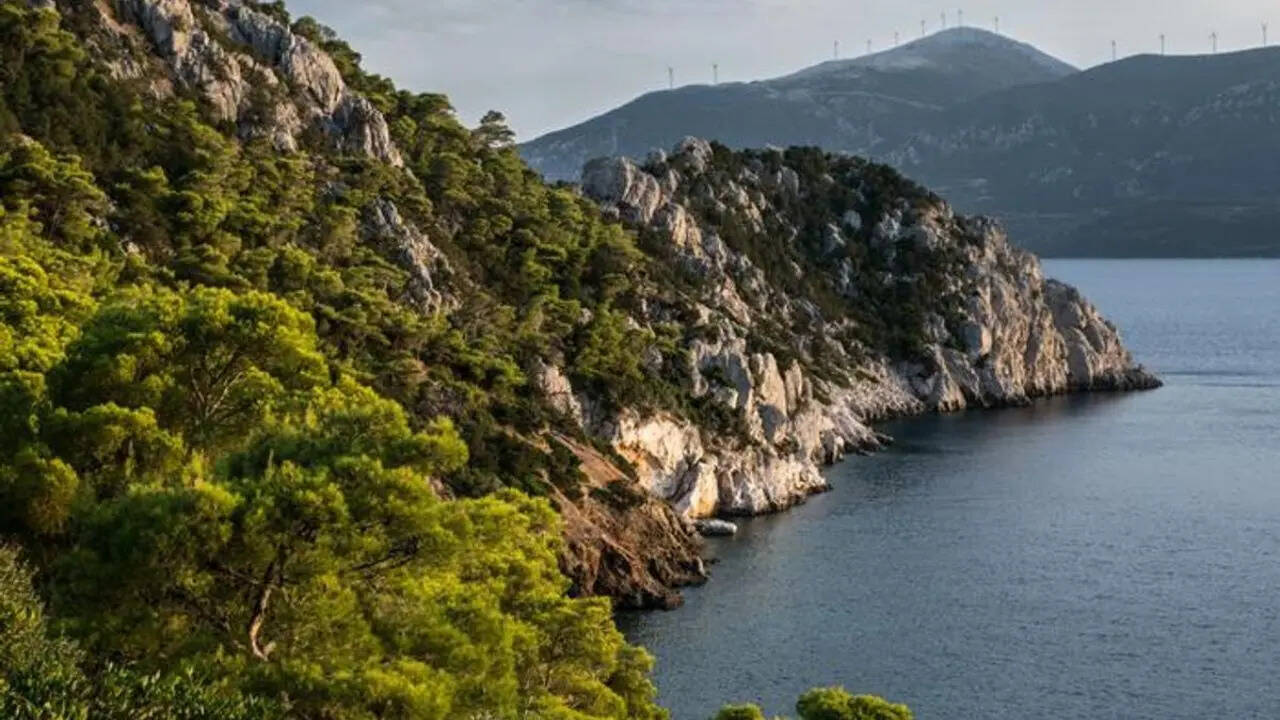
The ground in Methana doesn’t feel like a threat. It feels like an inheritance.
If you walk the rugged trails of this Greek peninsula, jutting out into the Saronic Gulf like a gnarled finger, you’ll smell the oregano before you smell the sulfur. You see the goats. You see the ancient stone terraces where farmers have coaxed grapes from volcanic soil for millennia. To the casual traveler, Methana is a sleepy relic of a quieter Mediterranean era, a place where time slows down to the pace of a fishing boat’s wake. Meanwhile, you can read other events here: Anthropogenic Risk and Ursine Behavioral Modification in the Yellowstone Ecosystem.
But look closer at the rocks. They are dark, jagged, and glassy—the cooled obsidian blood of a giant that everyone assumed had finally gone to sleep. For decades, the consensus was comfortable. The last major eruption happened in the 3rd century BCE, a historical footnote recorded by Ovid and Strabo. We labeled it "dormant." We moved on.
We were wrong. To see the bigger picture, check out the detailed report by The Points Guy.
The giant isn’t sleeping. It’s breathing. And it hasn’t stopped for 100,000 years.
The Illusion of a Static Earth
We have a human problem with time. We measure our lives in decades and our civilizations in centuries. On that scale, a volcano that hasn't coughed up fire in two thousand years is effectively a ghost. It’s a mountain. It’s a backdrop for a sunset.
Scientists recently pulled back the curtain on this geological masquerade using a combination of seismic imaging and thermal modeling. They discovered something that challenges our fundamental understanding of "dead" volcanoes. Beneath the scenic villages and the thermal baths of Methana, a complex plumbing system of magma has been active and evolving without pause.
Imagine a house where the furnace has been running for a century. From the outside, the chimney is cold. There is no smoke. You might assume the fuel ran out long ago. But if you press your ear to the floorboards, you hear the hum. If you touch the walls, they are warm. The fuel is still flowing; it just hasn't reached the ignite point yet.
Methana is that house. The "hidden" magma activity revealed by researchers isn't a new development. It is a persistent, unbroken chain of molten movement that suggests our definitions of volcanic life and death are dangerously binary.
The Scientists Who Listened to the Silence
To understand how a volcano hides in plain sight, you have to look at the data through the eyes of someone like Dr. Eleni, a hypothetical researcher whose career is spent squinting at seismic squiggles. For years, the Saronic Gulf was considered a low-risk zone. But when the team began analyzing the way earthquake waves slowed down as they passed beneath the peninsula, the story changed.
The waves didn't just pass through rock; they hit a "mush."
In geological terms, a mush zone is a reservoir of crystals and melt. It isn't a roiling lake of fire like you see in Hollywood movies. Instead, it’s more like a giant, underground sponge soaked in liquid rock. The new data shows that this sponge hasn't dried up. In fact, it has been constantly replenished by fresh magma rising from deep within the Earth's mantle.
This process—the constant flux of heat and material—is what keeps the volcano "alive" even when the surface remains peaceful. It’s a slow-motion chemical laboratory. Under the pressure of the crust, the magma evolves, changes its gas content, and waits.
Living on a Powder Keg
Consider the perspective of a local tavern owner in the village of Vathy. His family has lived here for generations. They know the hot springs. They know the "burning" smell that occasionally wafts from the vents in the hills. To them, these aren't warning signs; they are part of the landscape’s personality.
There is a profound disconnect between the statistical reality of a volcanic system and the lived experience of the people on top of it. This is the human element of the Methana discovery. When we hear that a volcano has been active for 100,000 years, our instinct is to panic. We want to know: When will it blow?
But the answer is rarely a date on a calendar. It’s a probability.
The research doesn't suggest that an eruption is imminent tomorrow morning. What it does is strip away the false security of the word "extinct." It reminds us that we are guests on a planet that is still under construction. The invisible stakes here aren't just about disaster preparedness; they are about the humility of our presence. We build towns on the cooling crust of a planet that is still fundamentally liquid at its core.
The Anatomy of a Hidden Giant
To visualize what the scientists found, think of the Earth’s crust not as a solid lid, but as a series of shifting plates. Methana sits in a particularly messy corner of the Mediterranean where the African plate is diving beneath the Eurasian plate.
This subduction creates intense heat and pressure. As the sinking plate descends, it releases water, which lowers the melting point of the surrounding rock. This creates the magma that feeds the Methana system.
What makes this specific study so groundbreaking is the realization that this feeding process is much more consistent than we believed. Previously, we thought volcanoes like this worked in "pulses"—a sudden burst of activity followed by long, cold deaths. Now, we see a continuous, simmering life.
The magma isn't just sitting there; it’s interacting. It’s rising through different "levels" of the plumbing system. Some of it stalls in the lower crust. Some of it migrates toward the surface, cooling just enough to stay hidden but remaining hot enough to keep the system primed.
The Fear and the Beauty
There is something unsettling about knowing the ground beneath your feet is dynamic. It triggers a primal anxiety. We like our mountains to be permanent. We like our "dead" things to stay dead.
Yet, there is also an incredible beauty in this hidden activity. It is the reason for the emerald-green waters of the Saronic Gulf. It is the reason the soil is so rich that the wine from this region tastes like nowhere else on Earth. The same heat that threatens to destroy is the heat that sustains the ecosystem.
The thermal baths at Methana have been famous since the time of Pausanias. People travel there to soak in the sulfurous waters, seeking cures for aches and pains. They are bathing in the diluted sweat of the volcano. Every bubble rising to the surface of those pools is a message from the 100,000-year-old furnace below.
The research into this hidden activity isn't meant to cause an exodus. It’s meant to provide a better map. By understanding the true state of the magma reservoir, authorities can design better monitoring systems. We can move from "guessing" to "listening."
Why This Matters Now
We live in an age where we think we have mapped every corner of the world. We have satellites that can read a license plate from space. We have sensors in the deepest parts of the ocean.
But Methana proves that the greatest mysteries are often right under our feet, disguised as something familiar. The discovery that this volcano has been "stealth-active" for a hundred millennia is a wake-up call for how we assess risk across the globe. There are likely dozens, if not hundreds, of similar systems worldwide that we have prematurely labeled as dead.
The technology used in Greece is now being looked at for other "dormant" sites. We are beginning to realize that the Earth doesn't owe us silence. Its clock is not our clock.
Imagine the 3rd-century villagers who watched the last eruption. They saw the sky turn black and the sea boil. To them, it was the wrath of the gods. To us, it is the result of a specific pressure-release valve in a 100,000-year-old system. Our science gives us clarity, but it shouldn't take away the awe.
The Constant Hum
Tonight, in the hills of Methana, the goats will huddle together against the cooling Mediterranean air. The tourists will finish their dinners and walk back to their hotels, perhaps noticing the faint, sharp scent of minerals in the breeze.
Deep below them—miles into the dark, pressurized heart of the peninsula—the crystals are shifting. A new batch of melt is rising from the mantle. The heat is transferring from rock to rock in a slow, relentless dance that has been performed since before the first human ever set foot on these shores.
The volcano isn't waiting for us to notice it. It doesn't care about our maps or our labels. It is simply existing, a massive, hidden engine of the Earth that has never known the meaning of "off."
We don't need to live in fear of the fire. We just need to remember that it’s there. The vineyard is beautiful, but the soil only exists because the fire allowed it. The giant is breathing, and for now, its breath is what keeps the world above it so vividly, dangerously alive.