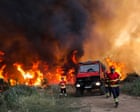
The conventional model of wildland fire suppression has reached a point of structural failure. For decades, emergency response strategies operated on the assumption that compounding personnel, mechanized equipment, and aerial retardant could contain outbreaks within predictable statistical variances. This assumption is no longer valid. The convergence of historical fuel accumulation, protracted atmospheric moisture deficits, and unchecked expansion of the Wildland-Urban Interface (WUI) has shifted wildfire dynamics from linear progression models to exponential, multi-directional conflagrations. Incident commanders no longer manage containment; they manage loss deceleration. This operational reality forces a shift from active suppression to strict triage, a systemic transformation that redefines the economics, ethics, and logistics of emergency management.
To understand the current breakdown in suppression efficacy, one must analyze the mathematical divergence between fire intensity and resource capacity. Modern megafires frequently exceed energy output thresholds of 10,000 kilowatts per meter of fire front. At this level of heat flux, direct attack methods—whether by ground crews cutting line or engines applying water—are physically impossible. The effectiveness of standard suppression tactics drops to zero. When a fire front surpasses these thermodynamic thresholds, the role of the firefighter transitions from active control agent to passive observer and tactical evacuator. The problem is not a lack of tactical resolve; it is an optimization problem where available inputs cannot match the scale of the energy output.
The Asymmetric Growth Function of Modern Wildfires
The fundamental mismatch in modern firefighting stems from a compounding relationship between environment and fuel. Standard fire behavior models dictate that the rate of spread and flame length are functions of fuel loading, fuel moisture, wind velocity, and topography. When these variables align unfavorably, the result is not a linear increase in fire size, but an exponential escalation in fire intensity.
Three distinct factors drive this asymmetric growth function:
- The Historical Suppression Paradox: A century of aggressive fire exclusion has disrupted natural low-intensity burn cycles. This policy has created unprecedented fuel density across millions of forested acres. Instead of frequent, low-severity surface fires that consume understory brush, ecosystems now suffer high-severity crown fires that destroy entire forest canopies.
- Atmospheric Vapor Pressure Deficit (VPD): Higher temperatures drive an exponential increase in the atmosphere's capacity to hold moisture, drawing water directly out of living and dead fuels. When the VPD reaches critical thresholds, fuel moisture drops below the fiber saturation point, rendering vast forest tracts essentially volatile.
- The Spotting Feedback Loop: Extreme fires create their own localized weather patterns, including pyrocumulus clouds and powerful convective columns. These columns loft burning embers miles ahead of the main fire front. This mechanism invalidates traditional containment lines, as a single main fire spawns dozens of secondary ignitions simultaneously, fracturing available suppression forces.
This combination of factors means that the initial attack phase—the critical window where fires are small enough to be contained by local resources—fails at an accelerating rate. Once a fire escapes initial attack, it enters the realm of extended attack, where resource constraints immediately dictate tactical choices.
The Three Pillars of Resource Bottlenecks
When a wildfire escalates to an extended attack or a complex incident, the Incident Command System (ICS) draws from a centralized, national pool of assets. This pool is finite, subject to severe structural bottlenecks that limit operational flexibility.
Personnel Depletion and Burnout Dynamics
The human capital core of wildland firefighting relies on federal, state, and inmate handcrews, alongside specialized Hotshot crews and smokejumpers. This workforce faces an acute retention crisis. The compensation structure for wildland firefighters historically lagged behind municipal structural firefighting roles, despite the escalating hazards and extended deployment schedules.
A typical deployment lasts 14 to 21 days, during which crews work 16-hour shifts under extreme physical stress. The cumulative psychological and physiological toll leads to high attrition rates. The loss of experienced mid-level leadership—specifically crew bosses and strike team leaders—creates a structural deficit. Inexperienced crews take longer to construct containment lines, require higher margins of safety, and exhibit lower operational efficiency, directly reducing the return on invested labor-hours.
Aviation Asset Scarcity and Thermodynamic Limitations
Aerial suppression—consisting of Type 1 heavy helicopters, Large Air Tankers (LATs), and Very Large Air Tankers (VLATs)—is often viewed as a primary solution. The reality is highly constrained. The global fleet of purpose-built firefighting aircraft is small and capital-intensive. Bureaucratic procurement cycles and high maintenance overhead restrict the expansion of this fleet.
Air assets face severe operational limits. Retardant drops do not extinguish fires; they merely slow the rate of spread to allow ground crews to establish an anchor point and construct line. In high-wind conditions or heavy smoke, aviation assets are grounded due to visibility and safety regulations. Furthermore, during peak fire season, multiple geographic areas compete for the same national air tanker contracts. A fire in the Southwest can strip assets from the Pacific Northwest, leaving entire regions exposed during critical burn windows.
Interoperability and Communications Failure
The third bottleneck is systemic fragmentation. Wildfire incidents frequently cross jurisdictional boundaries, requiring coordination between federal agencies (US Forest Service, Bureau of Land Management), state entities, and local municipal fire departments. These entities often operate on different radio frequencies, utilize distinct command hierarchies, and maintain conflicting operational mandates.
Federal agencies focus heavily on land management and resource preservation, prioritizing long-term containment strategies. Municipal departments focus on structural defense, prioritizing immediate asset protection. When these forces converge on a single incident without seamless digital and radio interoperability, tactical friction occurs. Orders are delayed, resource positioning becomes sub-optimal, and safety margins degrade, frequently forcing a total tactical retreat.
The Triage Matrix: Quantifying Unsolvable Trade-offs
When resources are saturated and fire intensity prevents direct containment, incident commanders must deploy a triage matrix. This framework categorizes assets and geographic zones based on defensibility and value. The decision-making process mimics battlefield medicine, where limited interventions are directed exclusively where they can demonstrably alter the outcome.
                  [ Asset Under Threat ]
                            |
             +--------------+--------------+
             |                             |
    [ Defensible? ]               [ Undefensible? ]
             |                             |
      +------+------+                      v
      |             |              [ Tactical Abandonment ]
[ High Value ] [ Low Value ]       (Withdraw resources)
      |             |
      v             v
[ Primary Asset  [ Secondary Asset
  Protection ]     Monitoring ]
The application of this matrix creates intense economic and ethical friction. The first priority is always life safety, followed by property protection, and finally natural resource conservation. However, the boundary between defendable and undefendable property is highly fluid and dependent on available resources.
If a subdivision lacks adequate defensible space—defined by vegetation clearance, fire-resistant building materials, and wide access roads—incident commanders will systematically bypass those homes. Defending a structurally vulnerable home in the path of a high-intensity crown fire requires a disproportionate allocation of engines and personnel. This commitment risks the lives of the crew and starves adjacent, more defensible areas of protection.
The economic implications of this triage are profound. Private insurance markets increasingly use these exact defensibility metrics to cancel policies or raise premiums to prohibitive levels within high-risk zones. The state becomes the insurer of last resort, shifting the financial liabilities of bad zoning and inadequate suppression capability onto the taxpayer.
Structural Deficits in Policy and Urban Planning
The current crisis cannot be solved within the bounds of emergency response mechanisms alone; it is fundamentally a failure of land-use planning and structural policy. The growth of the Wildland-Urban Interface remains a primary driver of risk. Millions of new homes have been constructed in fire-prone ecosystems over the past three decades, driven by affordable land prices and a cultural desire for proximity to nature.
Local municipal governments hold zoning authority but rarely bear the financial burden of wildfire suppression, which falls primarily on state and federal budgets. This decoupling of development authority from financial liability creates a moral hazard. Municipalities approve tax-generating developments in high-risk chaparral or timber zones, operating on the unstated assumption that state and federal agencies will absorb the cost of protecting those assets when a fire occurs.
Simultaneously, building codes in many fire-prone jurisdictions remain antiquated. While some states have implemented strict wildland-urban interface building codes requiring ember-resistant vents, metal roofs, and cleared perimeters, enforcement is highly variable. A single non-compliant home in a dense subdivision can act as a fuse, igniting adjacent structures via radiant heat transfer and rendering the entire neighborhood undefendable despite the compliance of neighboring properties.
Systemic Realignment and Risk-Managed Containment
To avoid complete operational collapse during peak fire seasons, the strategy must shift from a reactive doctrine of total suppression to a proactive framework of risk-managed containment and automated asset protection.
The first component of this shift requires redefining success metrics. Evaluating fire management agencies based on total acres burned is an outdated metric that incentivizes unsustainable suppression attempts on non-threatening lands. Instead, metrics must focus on asset protection efficiency and fire-intensity modification. Agencies must be empowered to let naturally ignited fires burn in remote areas under favorable weather conditions to restore ecological balance and reduce fuel loading, preserving high-value suppression assets for true WUI threats.
The second component requires a complete overhaul of WUI infrastructure economics. Federal and state infrastructure funding must be tied directly to the adoption and enforcement of strict wildland-urban interface building codes. Municipalities that continue to approve developments in high-hazard zones without mandated defensible space and secondary evacuation routes should face reduced state suppression support or mandatory risk-pooling fees.
The final component involves the technological automation of the triage line. Rather than risking human crews to defend structures with handlines and hoses, investments must pivot toward autonomous, pre-staged defense systems. This includes automated high-volume sprinkler networks fed by dedicated cisterns, localized applications of long-term fire retardant gels ahead of the fire season, and the deployment of unmanned aerial vehicles (UAVs) for continuous thermal mapping and spot-fire detection. By removing personnel from the immediate impact zone of high-intensity fronts, incident commanders can manage the triage matrix based on objective data rather than under the duress of imminent physical peril. This shift stabilizes operational capacity and matches the reality of modern wildfire behavior with a structured, resilient defense architecture.