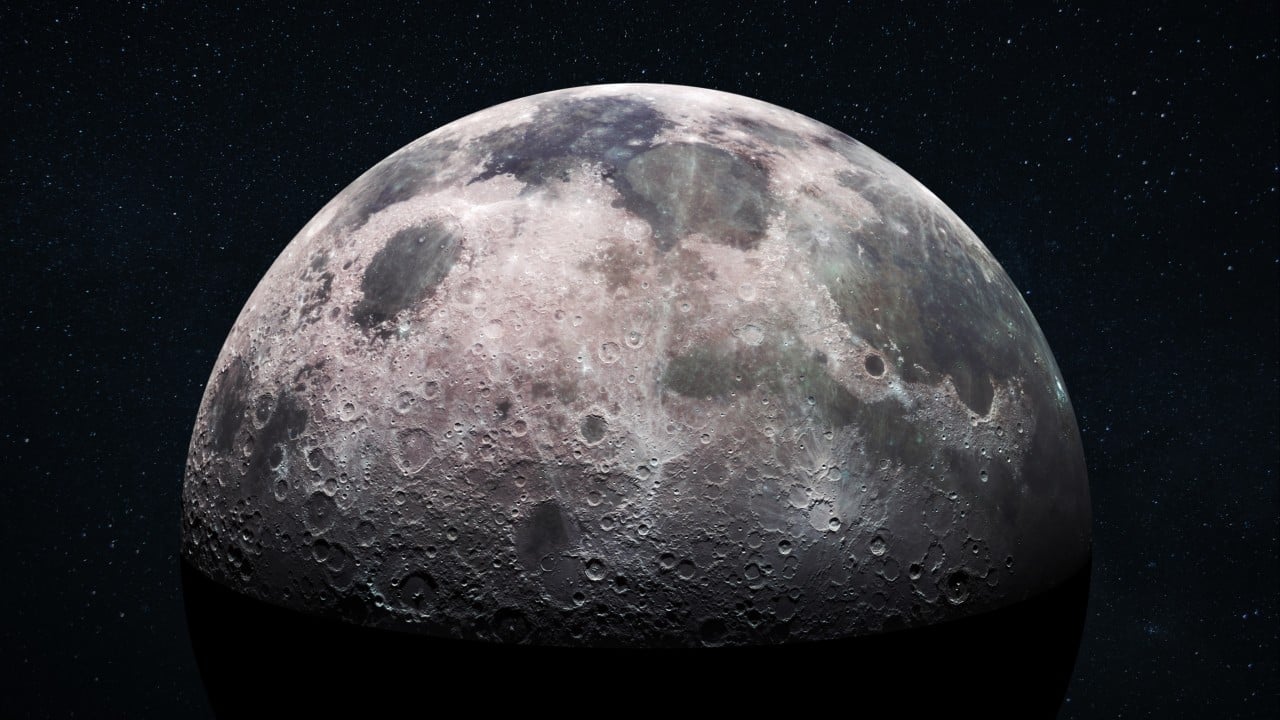
For thousands of years, humanity looked up at the moon and saw a god, a calendar, a poem, a dead white eye keeping watch over our petty wars. We drew our lovers under its silver glow. We measured our agricultural seasons by its phases. It was the one clean thing left. An absolute sanctuary untouched by the soot of our history, hanging in the quiet black of the vacuum.
That silence is about to shatter.
Chinese space scientists recently issued a stark, deeply unsettling warning that should stop every one of us in our tracks. The geopolitical fractures tearing apart our cities, our parliaments, and our oceans are rising. They are climbing past the troposphere, breaking through the stratosphere, and reaching for the dust of the Sea of Tranquility. War on Earth, these researchers argue, could easily spill over to the moon.
Think about what that actually means.
Imagine Commander Elena Vance, a hypothetical aerospace engineer stationed at a multinational lunar base inside the Shackleton Crater. It is three in the morning back on Earth, though down here in the permanent shadows of the lunar south pole, the concept of time is a mathematical fiction kept alive by flickering digital displays. Elena is staring out the reinforced quartz window of her habitat module. Outside, the regolith—that sharp, volcanic, charcoal-colored dust that clings to everything like pulverized glass—glows under the harsh, unblinking glare of a halogen work light.
Five miles away, across the ridge, sits a rival station. It belongs to another superpower. Last week, they shared a frequency to borrow spare oxygen scrubbers. Today, those same radio channels are buzzing with static, coded telemetry, and encrypted commands. Back on Earth, a diplomatic cable just snapped. A submarine cable was cut in the Atlantic, a trade embargo choked off a shipment of rare earth metals, and a cyberattack paralyzed a satellite constellation overhead.
Elena does not know who fired first. She only knows the telemetry data on her console. A kinetic impactor, traveling at orbital velocities, has just blotted out the power grid of the neighboring station. The air is venting. The crew is stranded in a world with one-sixth gravity and zero forgiveness. The battlefield has cleared the horizon.
This is not science fiction. This is the logical destination of our current trajectory.
We have a tragic habit of treating every new frontier as a fresh theater for our old arguments. We took the oceans, filled them with nuclear submarines, and choked the trenches with plastic. We took the skies, turned passenger jets into bombers, and filled low Earth orbit with thousands of dead satellites and high-speed shrapnel that now threatens to trap us in our own atmosphere.
Now, we are turning our eyes to the moon because the moon is valuable. Beneath its barren crust lie Helium-3 isotopes, water ice, rare earth minerals, and strategic high ground that offers an unobstructed view of every square inch of our home planet. Whosoever holds the moon holds the ultimate vantage point. And history teaches us a brutal, unyielding lesson: wherever value and strategic advantage coincide, humanity brings a sword.
The mechanics of lunar conflict are terrifyingly distinct from war on Earth. There is no atmosphere to absorb blast waves. An explosion on the moon does not produce a rolling wall of fire; it produces a silent, expanding shockwave of high-velocity shrapnel and superheated gas that travels unimpeded across the vacuum until it hits something. A single rifle bullet fired on the lunar surface could travel miles before finally dropping back to the dust, acting as an unpredictable projectile in a world where cover is scarce and heavy equipment is fragile.
More terrifying still is the vulnerability of the infrastructure. A lunar base is not a castle. It is a fragile balloon kept alive by complex life-support systems, solar arrays, and water recycling units. It requires absolute, uninterrupted harmony between technology and biology. Break that harmony for ten minutes, and you do not have prisoners of war. You have corpses preserved in the deep freeze of space.
When Chinese space scientists raise the alarm, they are looking at a mirror we refuse to face. They see the frantic rush to the lunar south pole—the race for water ice, the establishment of permanent outposts, the absence of an updated international legal framework for lunar sovereignty—and they recognize the powder keg.
The Outer Space Treaty of 1967 was drafted when the primary spacefarers were two cold war superpowers playing a high-stakes game of chess with primitive rockets. It banned weapons of mass destruction in orbit and on celestial bodies, but it left gaping holes. It says nothing about kinetic weapons, electronic jamming, military outposts disguised as scientific stations, or the defense of commercial mining rights. It is a legal document designed for the infancy of spaceflight, trying desperately to govern an era of hyper-technological gold rushes.
We are sleepwalking into a tragedy of cosmic proportions.
We look at the stars and feel an instinctive, beautiful yearning for unity. We tell ourselves that space belongs to all of us, that looking down at our pale blue dot from the blackness will cure us of our petty tribalism. It is a comforting myth. We thought the same thing about the oceans. We thought the same thing about the internet. We always manage to drag our demons with us, no matter how high we climb.
The warning from Beijing should be taken not as a threat, but as a final, desperate alarm bell.
Consider what happens next if we do nothing. The first commercial mining operations begin. A territorial dispute erupts over a crater rich in water ice. A security force is sent to protect corporate assets. A misunderstanding triggers a kinetic strike. Within hours, the pristine dust of the moon is stained with the oldest, dirtiest thing we know: human blood.
We still have a narrow, vanishing window of time to prevent this. We can demand updated treaties that explicitly demilitarize the moon. We can establish neutral zones, shared scientific mandates, and transparent communications channels that bypass earthly political squabbles. We can decide, right now, before the first shot is fired in the dark, that we will leave at least one world pure.
The moon has watched over us for millions of years. It has seen our empires rise and crumble into dust. It has watched us wage a thousand wars across green valleys and sunlit plains, indifferent to our noise.
It is waiting to see if we have grown up, or if we are simply bringing our poison to the stars.