Exhaustion has a specific gravity. You can see it in the slight slump of a shoulder under a tailored wool suit, or the way a smile takes half a second longer to reach the eyes when the camera flashes go off.
On November 13, 2017, inside the cavernous halls of the Cultural Center of the Philippines in Manila, that gravity was pulling hard on Donald Trump. He was standing at the tail end of a grueling, twelve-day marathon across five Asian nations—Japan, South Korea, China, Vietnam, and finally the Philippines. For a seventy-one-year-old man who famously preferred sleeping in his own bed and eating familiar food, the sheer physical toll of crossing eight time zones while conducting high-stakes diplomacy would have flattened most executives half his age. Learn more on a connected subject: this related article.
Yet there he was. Surrounded by a sea of waving miniature flags, flanked by Southeast Asian leaders, raising a clenched fist into the humid Manila air.
To understand what happened in those moments, we have to look past the surface noise of cable news punditry. Standard political reporting treats a summit like a box score: who shook whose hand, who missed a cue, how many minutes a speech ran over schedule. When reporters watched Trump in Manila, they noted two seemingly contradictory things. First, he was visibly worn down—a man running on fumes at the end of a historic tour. Second, he radiated an unmistakable, almost defiant confidence, punctuated by an unscripted five-minute extension to his prepared remarks and a willingness to mirror the signature strongman gesture of his host, Philippine President Rodrigo Duterte. Further analysis by NBC News highlights comparable perspectives on the subject.
Those five extra minutes were not an accident. They were a window into how power actually operates when the teleprompter stops scrolling.
The Architecture of a Twelve-Day Marathon
Imagine, for a moment, a hypothetical diplomatic aide—let us call her Elena—who has spent six months preparing briefing books for a presidential trip to Asia. For Elena, every minute of a summit is engineered down to the floorboards. The angle of the flags behind the podium, the exact phrasing of trade communiqués, the precise choreography of the group photo—known in diplomatic circles as the "family photo" handshake—are all designed to eliminate surprise. In traditional statecraft, predictability is safety. A stray word can rattle currency markets in Tokyo or send naval commanders in the South China Sea scrambling to decode a shift in American posture.
Now put Elena in the wings of the Cultural Center of the Philippines on that Monday afternoon in 2017.
She has watched her principal endure nearly two weeks of relentless pageantry. In Tokyo, there were rounds of golf and imperial audiences. In Seoul, an address to the National Assembly under the shadow of North Korean missile tests. In Beijing, a lavish "state visit-plus" inside the Forbidden City, complete with Peking opera and military bands. In Danang, Vietnam, a fiery speech to Pacific Rim CEOs declaring that the United States would no longer be taken advantage of on trade.
By the time Air Force One touched down in Manila for the Association of Southeast Asian Nations (ASEAN) summit, the schedule had already chewed through hours of bilateral meetings, motorcades snaking through locked-down boulevards, and late-night strategy sessions. Anyone who has ever stepped off a trans-Pacific flight knows the specific fog that settles behind the eyes—a sensation like walking through shallow water while someone whispers in your ear.
When Trump stepped up to the podium at the ASEAN gala and business events, the script was tight. Diplomatic protocol demanded brevity. Leaders were allotted strict time windows so the machinery of the summit could keep grinding forward.
Then Trump went off-script. He added five extra minutes.
Why Five Minutes Matter in Diplomacy
Five minutes sounds trivial until you have sat in a room where heads of state are waiting to speak.
In the rigid choreography of international summits, time is currency. Taking an extra five minutes is a subtle assertion of dominance—a silent reminder to everyone in the hall about who sets the tempo of the room. While aides in the back likely checked their watches and adjusted downstream schedules, Trump leaned into the microphone with the cadence of a man back home at a rally in Ohio or Florida.
He spoke about the warmth of the hospitality. He praised the economic trajectory of the region. He boasted, as he always did, about the booming American stock market, falling unemployment, and the deregulation back home. He looked tired—the edges of his voice carried the rasp of twelve days of speeches and air-conditioned hotel rooms—yet his posture was completely unbothered by the ticking clock.
It is easy to dismiss that divergence from the prepared text as mere vanity or lack of discipline. Critics certainly did. I have watched plenty of leaders over the years lose the thread of a speech simply because jet lag eroded their filter. Exhaustion makes people careless; it strips away the polite veneer we wear in public and exposes raw instinct.
But when exhaustion strips away a leader’s polish, what remains is their true operating system. And Trump’s operating system was built entirely on personal rapport and theatrical presence.
Think of traditional diplomacy like a symphony orchestra. Every diplomat plays from the exact same sheet music, watching the conductor’s baton so no single instrument drowns out the strings. Trump did not read sheet music. He played jazz—loud, brassy, improvisational, and anchored entirely to the reaction of the audience directly in front of him.
The Fists and the Flags
Nowhere was that improvisational instinct clearer than in the optics of the flags and the fists.
Inside the summit venues, the visual landscape was saturated with national colors—the blue, red, white, and yellow sun of the Philippines alongside the Stars and Stripes, multiplied across hundreds of tiny hand-held flags waved by enthusiastic crowds and official delegations. For a leader deeply attuned to television imagery, those flags were fuel. Regardless of the fatigue weighing on his frame, the sight of cheering crowds and waving banners acted like an adrenaline shot.
Then came the gesture that dominated headlines from Manila to Washington.
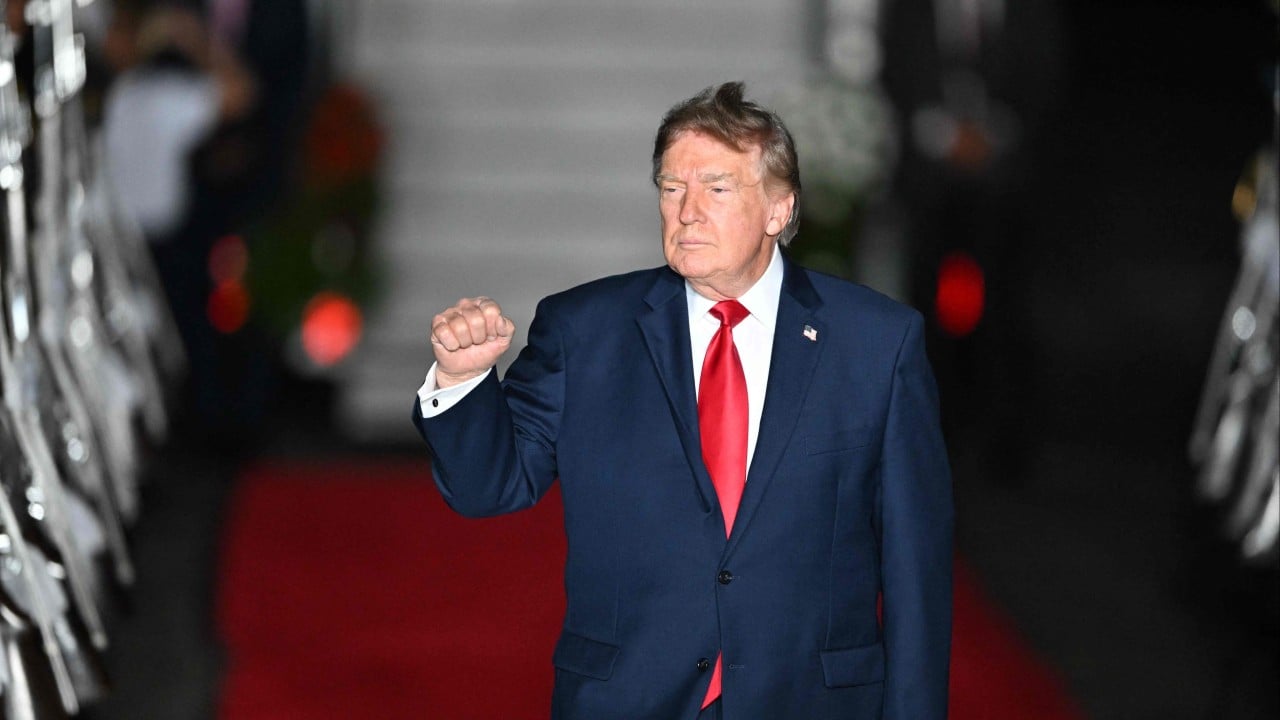
During a photo opportunity and moments surrounding the summit events, Trump raised his right hand, curled his fingers into a tight fist, and held it aloft—a unmistakable echo of Rodrigo Duterte’s signature campaign salute.
To understand why that single gesture sent shockwaves through diplomatic circles, you have to understand the context of 2017. At the time, Duterte was one of the most polarizing figures on the global stage. His brutal domestic crackdown on narcotics had drawn fierce condemnation from human rights organizations, the United Nations, and the previous American administration under Barack Obama. Relations between Washington and Manila—historically two of the closest treaty allies in the Pacific—had frayed badly. Duterte had openly insulted Obama and threatened to pivot the Philippines away from the United States and toward China and Russia.
When Trump mirrored Duterte’s fist, foreign policy veterans in Washington winced. To them, it looked like a casual endorsement of an authoritarian strongman, a visual erasing of decades of American emphasis on human rights and democratic norms.
Yet inside the room in Manila, the effect was immediate. Duterte beamed. The tension that had frozen US-Philippine relations for over a year visibly thawed in real time.
I remember watching the footage from Manila that week and feeling a deep sense of unease—the kind of cognitive dissonance that comes when you realize two contradictory things are true at the exact same moment. On one hand, seeing an American president adopt the populist salute of a leader accused of extrajudicial killings felt jarring, a sharp break from the moral vocabulary the United States had claimed since the end of World War II. On the other hand, looking purely at the geopolitical chessboard of the South China Sea, alienating Manila was a strategic disaster that handed Beijing a massive opening in the Pacific.
Trump was betting that personal chemistry could accomplish in forty-eight hours what formal diplomatic demarches had failed to do in two years.
The Awkward Choreography of Power
Of course, personal chemistry has its limits, especially when the choreography gets complicated.
One of the most telling moments of the Manila summit happened during the traditional ASEAN handshake—a notoriously tricky maneuver where leaders stand shoulder-to-shoulder, cross their arms in front of their chests, and grasp the hands of the leaders standing to their left and right.
It is an unnatural posture for anyone, let alone a seventy-one-year-old man at the end of a grueling international tour.
As the announcer called for the handshake, Trump initially crossed his arms, hesitated, glanced left and right to see how the leaders beside him—Vietnamese Prime Minister Nguyen Xuan Phuc and Philippine President Rodrigo Duterte—were positioning themselves, and briefly fumbled the grip before locking hands and breaking into a wide, amused grin.
Camera shutters clicked furiously. Within minutes, the clip was looping across social media, framed by detractors as proof of clumsiness or confusion.
Watch it closely, though, and you see something entirely human. You see a man who is physically drained, caught in an unfamiliar ritual, laughing off a minor awkwardness rather than stiffening in embarrassment. Confidence isn't the absence of a misstep; it is the refusal to be rattled when the cameras catch you stumbling.
What the Exhaustion Concealed
Look beneath the surface of those Manila appearances, and the fatigue tells a deeper story about the American presidency itself.
The modern presidency is an endurance sport disguised as a desk job. By the time a president reaches the final stop of an Asian swing, they have absorbed thousands of pages of intelligence briefings, navigated minefields of regional rivalries, and endured constant scrutiny where a single mispronounced name or drooping eyelid becomes an international incident.
During his bilateral meeting with Duterte in Manila, reporters shouted questions about whether Trump would raise human rights concerns. Trump brushed them off, noting simply that he and Duterte had a "great relationship." White House officials later insisted human rights were briefly mentioned, while Duterte’s spokesperson denied the topic ever came up.
That ambiguity was deliberate. It was the logical extension of Trump’s broader doctrine across Asia: "America First" did not mean American isolation; it meant transactional bilateralism. He was far less interested in multilateral institutions like ASEAN itself—in fact, he actually skipped the final East Asia Summit plenary session later in the day due to schedule delays, leaving Secretary of State Rex Tillerson to fill his seat—than he was in looking another leader in the eye and cutting a deal.
Skipping that final session was another tell. A younger, fresher president, or one more wedded to diplomatic orthodoxy, would have powered through the delays to occupy the chair until the closing gavel fell. Trump, tired and satisfied that he had already secured the visual and interpersonal wins he came for, boarded Air Force One and flew home.
The Invisible Stakes in the Humid Air
History rarely turns on a five-minute speech extension or a clenched fist in a photo line. Yet those small, unscripted moments often reveal the tectonic shifts happening beneath the surface of global politics.
In November 2017, Asia was watching closely to see whether the United States was retreating from the Pacific or doubling down. Beijing was pouring concrete onto reefs in the South China Sea, building airstrips and radar installations while offering billions of dollars in infrastructure loans to Southeast Asian nations. Leaders in Manila, Hanoi, Bangkok, and Kuala Lumpur were constantly calculating the odds: Would Washington still be there when the pressure mounted, or was the future inevitably Chinese?
When Trump stood under the bright lights in Manila—weary from twelve days on the road, hoarse from dozens of speeches, stubbornly taking five extra minutes at the microphone because he felt the energy in the room—he sent an unmistakable, if unconventional, message.
He was not the polished, predictable statesman Asia had grown accustomed to over seven decades. He did not speak the careful language of multilateral treaties or human rights frameworks. Instead, he offered raw presence, transactional loyalty, and the unmistakable swagger of a leader who believed his own force of personality was enough to bend the room to his will.
The flags kept waving. The cameras kept flashing. And as the doors of Air Force One finally swung shut on the tarmac in Manila, carrying a visibly exhausted president back across the Pacific, the leaders left behind on the ground were left to ponder a reality that would define global politics for years to come: the old rules of diplomacy had been torn up, and the man holding the pen was writing the new ones entirely off the cuff.