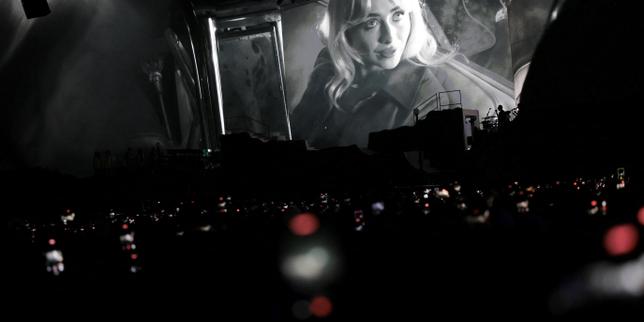
The wind in the Coachella Valley doesn't just blow; it scours. It carries the grit of the Mojave, a fine, relentless dust that settles into the lungs of the faithful and the famous alike. By the time the sun began its slow, bruised-purple descent over the Empire Polo Club last April, the air felt thick with anticipation and expensive hairspray. Thousands of people stood shoulder-to-shoulder, a sea of crochet tops and glitter-streaked faces, waiting for a girl who, for a long time, the industry treated as a footnote.
Sabrina Carpenter didn't just walk onto that stage. She emerged from a dream of mid-century Americana, a Technicolor vision that felt like a sharp jab to the ribs of anyone who thought she was just another graduate of the Disney machine.
The stakes were higher than the towering Ferris wheel spinning lazily in the distance. This wasn't just a festival slot. This was a trial. For years, the narrative surrounding Carpenter was one of "almost." She was almost a household name. She was almost the main character in the messy dramas of pop culture. But as the first notes of her set cut through the desert heat, it became clear that "almost" had been left behind in the dressing room.
The Architecture of a Heartbreak
To understand why this moment felt like a shift in the Earth’s crust, you have to look at the stage itself. It wasn't a standard festival rig. It was a sprawling, multi-level motel set, a nod to the cinematic glamour of old Hollywood, draped in a soft, cinematic glow. It looked expensive. It looked intentional.
Most artists at Coachella try to match the desert’s raw, chaotic energy. They go for grit. Carpenter went for polish so bright it was blinding. This choice tells a story about control. When you have been the subject of internet speculation and the target of a thousand "Drivers License" theories, you learn the value of building your own house. You learn that if you don't curate your own image, the world will do it for you, and they usually use a dull blade.
She stood there, barely five feet tall, silhouetted against a backdrop that suggested she was the owner of the most glamorous heartbreak in California. The contrast was the point. The tiny girl in the massive, artificial world she had built.
Consider the physical toll of a set like this. The temperature drops rapidly in the desert once the sun vanishes, but the stage lights keep the performers in a localized swelter. Every movement is calculated. Every high note is a gamble against the dry air that threatens to seize the vocal cords. Yet, she moved with the practiced ease of a veteran, flipping her hair with a precision that felt almost like a dare.
The Sound of 80,000 People Feeling Less Alone
The music wasn't just a background for the visuals. It was the weapon. When "Feather" began, the shift in the crowd was palpable. It wasn't just the fans in the front row—the ones who had been camping since noon with sun-scorched shoulders. It was the skeptics in the back, the ones who came for the "vibes" but stayed because they realized they were witnessing a genuine pop coronation.
There is a specific kind of alchemy that happens when a performer stops trying to impress and starts trying to connect. Carpenter’s lyrics are often laced with a wink—a self-aware, sometimes biting humor that acknowledges the absurdity of being young and in love.
"I’m a blonde, I’m a cheat, I’m a joke," she sang during one of her improvised "Nonsense" outros, a tradition that has become her signature. It is a moment of planned spontaneity. By poking fun at herself, she disarms the critics. She beats them to the punch. It’s a survival tactic disguised as a comedy bit, and on that Coachella stage, it served as her victory lap.
The Invisible Weight of the Pop Machine
We often talk about these stars as if they are products assembled in a lab. We see the custom outfits—the sparkling heart cut-outs and the towering platforms—and we forget the human being underneath the sequins.
Think about the sheer volume of rejection required to get to a Coachella main stage. Think about the years of being told "not yet" or "try this instead." For Carpenter, the journey wasn't a straight line. It was a jagged path through the woods of child stardom, a transition that has swallowed dozens of her peers whole.
The industry is littered with the ghosts of girls who were supposed to be the next big thing. To survive it requires a certain kind of callousness, or perhaps, a very specific kind of heart. Standing in that desert, she looked like someone who had decided she wasn't going to be a ghost. She was going to be the haunt.
The performance of "Espresso" felt like the final seal on the contract. It was fresh, it was caffeinated, and it was undeniably hers. The song hadn't even reached its peak cultural saturation yet, but the crowd reacted as if it were an anthem they had known their entire lives. That is the mark of a star who has finally synchronized with the zeitgeist.
The Desert After Dark
As the set drew to a close, the air grew colder, but the energy within the polo grounds was incandescent. There was no need for a grand summary or a list of accomplishments. The evidence was in the sweat on the brows of the dancers and the way the audience lingered long after the lights dimmed, unwilling to let the spell break.
She had turned a desert into a bedroom, a festival into a film noir, and a career of "almosts" into a definitive "now."
When the last note faded into the wind, she didn't just walk off. She vanished back into the motel of her own making, leaving the rest of us standing in the dust, wondering how someone so small had managed to take up all the space in the world. The desert was quiet again, but the silence felt different. It felt like the space left behind after a storm. Or a revolution.