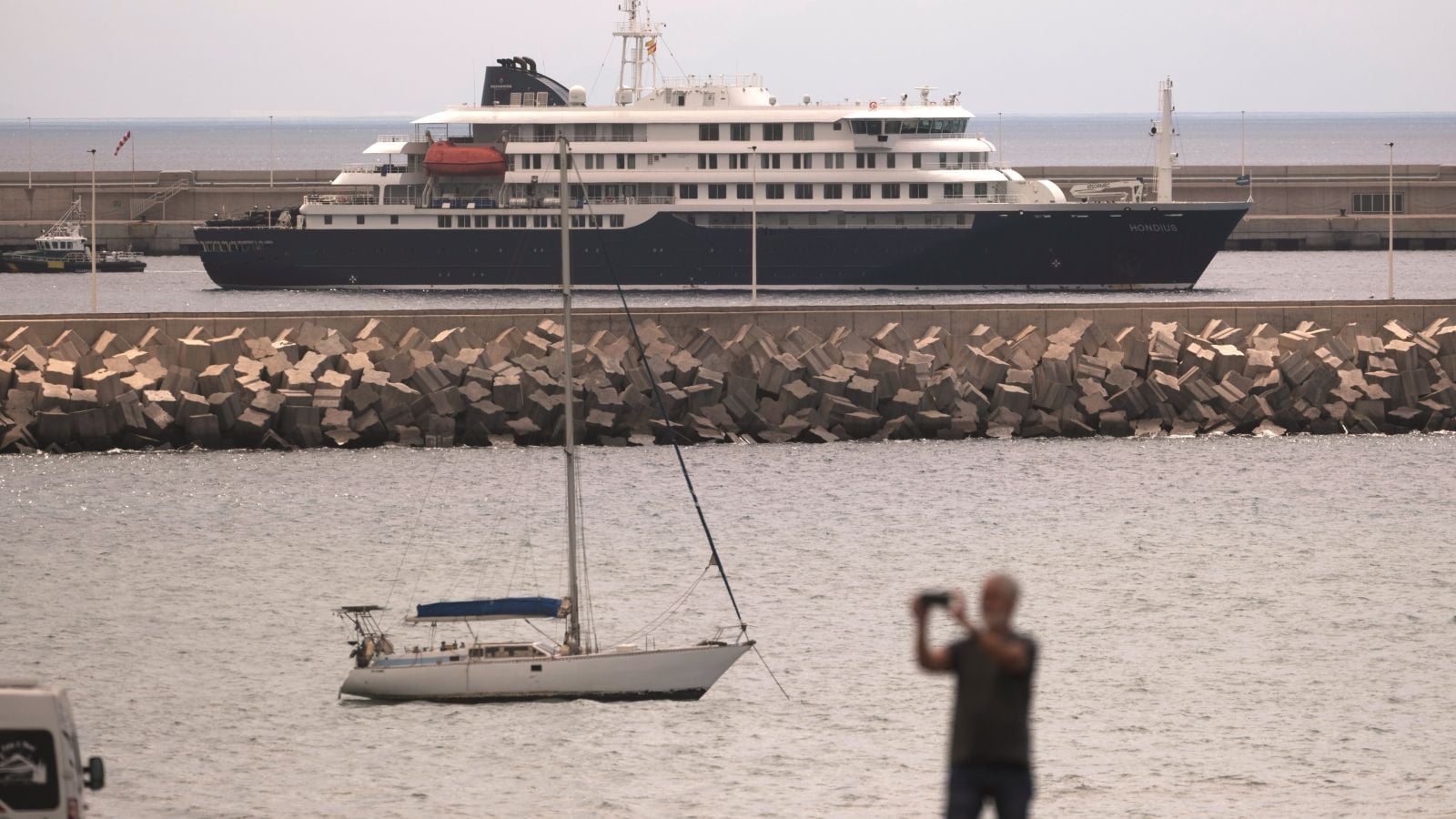
The steel hull of the Azure Horizon didn’t groan as it settled against the pier in the grey light of Tuesday morning. It was silent. Too silent for a vessel that had spent three weeks as a self-contained universe for three thousand souls. There were no streamers. No steel drum bands welcomed the weary. Instead, there was a perimeter of yellow tape and the rhythmic, blinking pulse of amber lights from waiting ambulances.
Elena stood at her balcony on Deck 9, clutching a railing that felt uncomfortably cold. She watched the first of the final passengers descend—a slow, staggered procession of people who looked less like vacationers and more like survivors of a long-term siege. They moved with a heavy, deliberate gait. Some wore masks; others simply stared at the concrete of the dock as if they couldn’t quite believe the ground had stopped moving.
The "Hantavirus Outbreak" was a headline to the rest of the world, a digital notification that flashed and was swiped away. But for those inside the steel walls, it was the smell of industrial bleach masking something sharper, something metallic. It was the sound of a cough echoing down a carpeted hallway at 3:00 AM.
The Invisible Stowaway
We tend to think of cruise ships as impenetrable fortresses of luxury. We pay for the illusion of total control. But biology doesn't care about your all-inclusive drink package. Hantavirus is a primitive, efficient traveler. Usually, it’s a ghost of the rural wilderness, transmitted through the aerosolized droppings of rodents. It belongs in dusty barns or long-abandoned cabins in the woods, not in the filtered air of a multi-billion-dollar maritime marvel.
How it got on board is the question that will haunt the legal depositions for years. Perhaps it was a shipment of dry goods from a port where the local deer mice had found a way into the warehouse. Maybe it was a single, stowaway vector nesting in the insulation of a sub-deck. It doesn't take much. A single breath of contaminated dust in a confined space is the spark.
Consider a hypothetical passenger named David. He’s sixty-four, a retired teacher who saved for two years to take this trip. On day four, David felt a slight chill. He chalked it up to the air conditioning in the theater. By day six, the muscle aches in his lower back weren't from the shore excursion; they were the first signs of his immune system declaring war on his own lungs.
Hantavirus Pulmonary Syndrome (HPS) is a deceptive thief. It begins with the mundane—fatigue, fever, a nagging ache in the large muscle groups. It feels like the flu. It feels like you just stayed in the sun too long. Then, the pivot happens. The lungs begin to leak fluid. Capillaries lose their integrity. You aren't just sick; you are drowning from the inside out while standing in a dry room.
The Tally on the Chalkboard
As the ship sat in quarantine three miles off the coast, the numbers began to climb. What started as "a few isolated gastrointestinal cases" morphed into a confirmed cluster. Then came the first death. Then the second.
The ship’s infirmary, designed for twisted ankles and seasickness, became a makeshift intensive care unit. The crew, young men and women from dozens of countries who signed up to serve mimosas and lead trivia nights, suddenly found themselves donning PPE and transporting sealed bags through service elevators.
Public health officials often speak in "case fatality rates." For Hantavirus, that number can hover terrifyingly near 38 percent. It is a statistic that feels abstract until you are the one sitting in a stateroom, listening to the captain's voice crack over the intercom as he announces another "medical emergency" in a specific cabin number.
The fear on the Azure Horizon wasn't loud. It wasn't a movie-style panic with people screaming in the buffet line. It was a quiet, suffocating dread. It was the way people stopped making eye contact in the elevators. It was the way a sneeze in the library would clear the room in thirty seconds.
The Logistics of a Living Ghost
By the time the final passengers were cleared to disembark this morning, the death toll had reached five. Dozens more remain in regional hospitals, some hooked to extracorporeal membrane oxygenation (ECMO) machines that do the work their lungs no longer can.
The challenge of clearing a ship like this is a nightmare of bureaucracy and biology. You cannot simply let three thousand people walk into a crowded terminal. Every passenger represents a potential branch on a tree of infection. Even though Hantavirus is generally not known to spread person-to-person—unlike the more common Norovirus that plagues cruises—the sheer scale of the exposure on the Azure Horizon forced a level of caution usually reserved for the most virulent pathogens.
Health inspectors moved through the ship like ghosts in white Tyvek suits. They peeled back panels. They tested the HVAC filters. They looked for the telltale signs of the "invisible stowaway."
Logic dictates that the risk to the general public is low. The virus is fragile once it hits the open air and sunlight. But logic is a cold comfort to the families waiting behind the police tape. For them, the ship is no longer a vessel of joy; it is a giant, floating laboratory where their loved ones were the test subjects.
The Cost of the Horizon
We are living in an era where the lines between the wild and the civilized are blurring. As we push further into remote areas for resources or recreation, and as global logistics chains become more complex, the "wilderness" comes with us. The Azure Horizon is a microcosm of a larger reality: our systems are optimized for efficiency and comfort, not for the sudden intrusion of the primordial.
Elena finally walked down the gangplank at 11:15 AM. She didn't have her luggage; that was being held for "deep sanitation." She carried only her handbag in a plastic zip-top bag and the heavy, buzzing exhaustion of someone who hasn't slept in a week.
She reached the end of the ramp and felt the solid, unyielding concrete of the pier beneath her boots. A paramedic in a mask asked her a question, something about her temperature or her breathing. She nodded, but her eyes were fixed on the ship behind her.
From the outside, the Azure Horizon looked magnificent. The white paint gleamed in the sun. The balconies looked like neat little boxes of paradise. But Elena knew what was behind the glass. She knew about the empty chairs in the dining room and the way the silence felt in the corridors at night.
The final passenger, an elderly woman clutching a single framed photograph, stepped off the ship just before noon. The gangplank was retracted with a mechanical whine that seemed to echo across the harbor. The ship was empty now, a silent city of three thousand rooms, left to the inspectors and the ghosts of those who didn't make it to the dock.
The water in the harbor slapped rhythmically against the pylons. Life in the city continued. Cars moved on the highway. People checked their phones. But on the pier, the air felt different. It felt thin. It felt like something that should be cherished, something that can be taken away by a single, invisible breath in the dark.
The yellow tape fluttered in the breeze. The ship sat tall and vacant, a monument to the fragility of the walls we build against the world outside. We sail toward the horizon because we want to see the beauty of the unknown, forgetting that the unknown always has a way of sailing back with us.