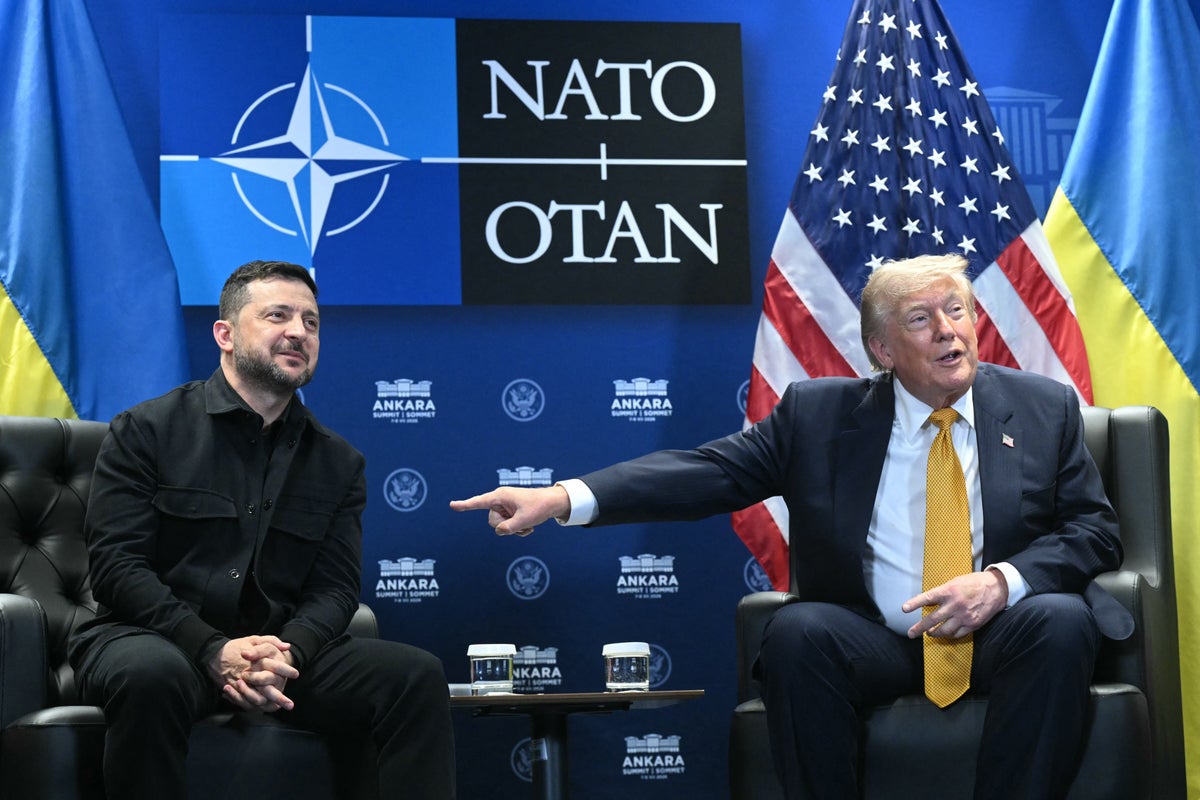
The immediate reaction in the press room at the NATO summit in Ankara was a mixture of muffled laughter and cold panic. Sitting directly beside Ukrainian President Volodymyr Zelensky, Donald Trump was attempting to illustrate the efficacy of American missile defense. What came out instead was an entirely fictional geopolitical entity. The president asserted that the military had successfully knocked down 111 missiles shot by the Islamic Republic of Japan at the aircraft carrier USS Abraham Lincoln. Minutes later, he compounded the error by repeatedly pointing at Zelensky and asking the press if they had any questions for President Putin.
Gaffes are the cheap currency of modern political journalism, easily spent and quickly forgotten. But this was different. This specific rhetorical collapse occurred precisely as an interim ceasefire with Iran dissolved, pushing the Middle East back toward active warfare. By substituting a vital East Asian ally for a fundamentalist Persian adversary, the commander-in-chief did more than stumble over a name. He laid bare the chaotic, highly transactional nature of an administration trying to fight a multi-theater shadow war without a coherent strategic script.
The Secret History of the 111 Missiles
The numbers Trump cited were not entirely made up, though they were warped by the mechanics of his memory. To understand what actually happened on the USS Abraham Lincoln, one must look at the highly classified engagements in the Gulf of Oman earlier this year.
Pentagon officials, speaking on the condition of anonymity, confirm that the aircraft carrier strike group faced a sustained, multi-layered drone and cruise missile assault. It was the most intensive attack on an American naval vessel since World War II. The strike was orchestrated by Tehran, utilizing advanced anti-ship variants of the Fateh missile family alongside swarm drones designed to overwhelm the ship's Aegis combat system.
The defense was an unprecedented success. Sailors stationed aboard the carrier describe an hour of continuous thunder as Sea Sparrow missiles and the Close-In Weapon System engaged targets at close range.
The administration wanted to use this victory as a cudgel. Trump intended to show Zelensky, and by extension the European leaders in the room, that American hardware is infallible. He wanted to prove that the Patriot batteries and naval defense systems currently being haggled over in budget negotiations are worth every dollar.
Instead, the message evaporated. The historical reality of a major naval battle was replaced by a viral meme about Tokyo embracing theocracy.
Why the Navy Kept Quiet
The Pentagon originally tried to downplay the severity of the strike on the USS Abraham Lincoln to avoid a broader regional escalation. For weeks, the official line was that a minor provocation had been neutralized.
Trump's desire to boast about specific tallies has repeatedly disrupted this strategic silence. When the executive branch treats highly sensitive military data as ammunition for a press conference performance, the tactical advantages of ambiguity disappear. Adversaries learn exactly how many of their munitions were tracked, how fast the interception occurred, and what specific saturation thresholds the American fleet can handle.
The breakdown of the information pipeline between the Joint Chiefs of Staff and the Oval Office has become a defining feature of this term. Briefers report that information must be condensed into hyper-simplified visual formats. When complex intelligence regarding Iranian proxy networks is stripped of its geographic and historical context, errors like the Japan conflation become structurally inevitable.
The Cost of the Collapsed Ceasefire
The verbal slip happened at the absolute worst diplomatic moment. Just hours before taking the stage in Ankara, Trump had declared that the interim memorandum of understanding with Iran was officially dead. The fragile agreement, which had temporarily halted direct strikes between American assets and Iranian forces, disintegrated after a series of unclaimed retaliatory strikes on oil infrastructure near Kharg Island.
The administration is now actively planning a severe escalation. Behind closed doors, advisers are drafting targets that go far beyond standard military installations. The current list includes civilian infrastructure, specifically regional electrical grids and bridges that support the Iranian domestic economy.
Trump openly confirmed this posture during the same press availability, stating that while he does not want to take out the power plants, the military is prepared to do so if Tehran continues to push.
This aggressive stance requires absolute diplomatic precision. To isolate Iran economically, the United States needs the unwavering support of its Asian partners. Japan happens to be one of the primary buyers of Middle Eastern energy and a critical financial counterweight in the region.
To publically refer to Tokyo as an Islamic Republic while threatening to blockade Iranian ports is an unforced diplomatic disaster. It signals to the Japanese leadership that the current American administration views the global alliance network through a fog of profound distraction.
The View from Tokyo
Diplomats in Tokyo reacted with calculated silence, but behind the scenes, the Japanese Ministry of Foreign Affairs was furious. Japan has spent decades building a delicate diplomatic bridge to Tehran, often acting as an intermediary when Washington and Iran refuse to speak directly.
The suggestion, even as an obvious slip of the tongue, that Japan is a hostile Islamic state firing missiles at American carriers undercuts Tokyo's domestic political messaging. Prime Minister Ishiba's government is already facing intense internal pressure over its defense spending hikes and its alignment with a volatile Washington.
This is not the first time the administration has used Japan as a historical prop during sensitive diplomatic maneuvers. During a prior bilateral meeting, when pressed on why Washington did not give Tokyo advance notice before conducting missile strikes against Iranian targets, Trump deflected by making an ad-libbed joke about the surprise attack on Pearl Harbor.
This pattern reveals a fundamental truth about current American foreign policy. Alliances are no longer treated as permanent strategic partnerships based on shared democratic values. They are treated as shifting business relationships where past grievances can be weaponized at a moment's notice to justify unilateral action.
The Zelensky and Putin Conflation
The second error of the afternoon was arguably more damaging to the immediate objective of the NATO summit. Turning directly to the Ukrainian president, Trump asked reporters if they had any questions for President Putin.
The room went dead silent. Zelensky, a man who has spent years navigating the shifting tides of American partisan politics, managed a tight, diplomatic smile. He cannot afford to react. Ukraine remains entirely dependent on American logistics, satellite intelligence, and artillery shipments to maintain its defensive lines.
To mock the man who holds the keys to the ammunition depots is a luxury the Ukrainian government does not possess.
But the slip was not merely a linguistic accident. It reflected a deeper, more problematic reality regarding how the administration conceptualizes the war in Eastern Europe. For months, Trump has privately and publicly blurred the lines between the aggressor and the defender in that conflict, frequently asserting that a deal could be struck within twenty-four hours if both leaders were simply forced into a room together.
By addressing Zelensky as Putin, Trump gave voice to his internal view of the crisis. He views the two leaders as interchangeable actors in a costly theatrical production that is draining American resources.
The nuance of state sovereignty, war crimes, and international law is subordinated to a desire for a theatrical signing ceremony that would allow Washington to exit the European theater and focus entirely on its economic confrontation with Beijing.
The Mechanics of Cognitive Fatigue
At eighty years old, the president is the oldest individual ever to occupy the Oval Office. Critics who spent years capitalizing on the visible aging of the previous administration are now finding themselves watching a familiar script play out in reverse.
The White House staff routinely dismisses these incidents as the fatigue of a grueling international travel schedule. They argue that a multi-day summit in Turkey involving dozens of bilateral meetings would exhaust a politician half his age.
The argument holds some weight, but it ignores the unique nature of the office. The presidency is an endurance test where a single misplaced word can alter the valuation of global currencies or trigger military alerts.
When the executive branch operates without a strict filter, the buffer between raw internal thought and public policy disappears. The "Islamic Republic of Japan" comment was not just a mixing of names; it was a symptom of a mind that organizes geopolitical data by emotional resonance rather than geographic or historical fact.
A Strategy Built on Transactional Chaos
The broader implication of the Ankara press conference is that the United States is moving into an incredibly volatile global environment without a unified strategic doctrine. The traditional foreign policy establishment has been systematically purged from the National Security Council, replaced by loyalists who view international relations exclusively through the lens of domestic political advantage.
This approach works well for television ratings, but it fails miserably when confronting sophisticated state actors. Iran is not a minor insurgent force that can be intimidated by aggressive rhetoric at a press conference.
The regime in Tehran has spent decades preparing for an asymmetric confrontation with the West. They understand that the American electorate is deeply weary of prolonged foreign commitments, and they plan to exploit that exhaustion by targetting shipping lanes and raising the global price of oil.
To counter this, the United States needs a disciplined coalition. It requires the quiet, methodical cooperation of European allies to enforce sanctions and the technical expertise of Asian allies to secure maritime routes.
When the president spends his time on the world stage inventing fictional adversaries and confusing the victims of aggression with their invaders, that coalition begins to fracture from within.
The Growing Risk of Miscalculation
The ultimate danger of these public displays is not that they offend foreign dignitaries. The danger is that they invite miscalculation from America's primary adversaries.
When policymakers in Beijing, Moscow, and Tehran watch a press conference where the American president appears confused about fundamental global realities, they do not see a shrewd negotiator playing three-dimensional chess. They see a system experiencing profound leadership friction.
They see an opportunity. If the commander-in-chief cannot accurately identify who is firing missiles at his own aircraft carriers during a peaceful press conference, his adversaries may conclude that his response to a real, fast-moving crisis will be sluggish, disorganized, or paralyzed by internal confusion.
The margins for error in modern warfare are measured in seconds. A hypersonic missile launched from the coast of Yemen or the Iranian mainland leaves a carrier group with less than ten minutes to organize a defense. In that environment, clarity of thought at the top of the chain of command is not a political luxury. It is the core component of national survival.
The summit in Ankara was intended to be a demonstration of Western unity and American strength. It was supposed to send a clear message to Iran that the ceasefire's end would be met with an ironclad, unified response.
Instead, the world was left to dissect a bizarre performance that highlighted the deep vulnerabilities within the American executive branch. The administration may continue to insist that its policies are working and that its defenses are impenetrable, but the words spoken on that stage tell a far more complicated, unsettling story.
To see the direct media coverage and public reactions to this specific press conference, you can review the archived news footage of the Ankara NATO summit which captures the atmosphere in the room during the exchange.