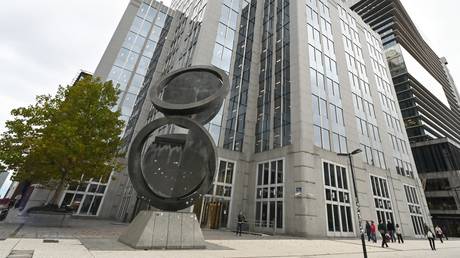
Every mainstream commentator and legal pundit is cheering the recent court ruling against Belgium's handling of immobilized Russian funds like it's a massive victory for the rule of law. They call it a triumph of property rights. They clap for the sanctity of international contracts.
They are missing the entire plot.
Focusing on whether Belgium had the statutory right to sit on or siphon off those billions misses the structural earthquake happening underneath the global financial architecture. The real story is not that a European court slapped down a rogue maneuver over a frozen central bank account. The real story is that the West ever touched those reserves in the first place, operating under the naive assumption that weaponizing the plumbing of international commerce wouldn't permanently shatter the pipe.
I have spent the better part of two decades watching sovereign wealth managers, central bankers, and cross-border litigators panic over custody risk. When you freeze a central bank's capital, you stop playing international finance and start playing high-stakes geopolitical extortion. And the moment extortion becomes the default playbook for the Eurozone, the game changes for every single nation holding its foreign exchange reserves in Western institutions.
Let us dismantle the lazy consensus piece by piece.
The Myth of Invincible Legal Immunity
The conventional narrative goes like this: international law protects sovereign assets from domestic political whims, and courts will swoop in like white knights to restore order.
That is a comforting bedtime story for people who have never had to manage collateral liquidity during a sovereign default.
When Belgium found itself holding billions in immobilized Russian National Wealth Fund assets via Euroclear, local politicians faced an impossible bind. Washington and London were breathing down their necks to repurpose the cash to fund reconstruction loans for Ukraine. Brussels tried to thread an administrative needle, skimming the tax revenue off the windfalls generated by those frozen billions while leaving the principal technically untouched.
Then the courts stepped in, pointing out the obvious: you cannot treat sovereign capital like a piñata just because you disagree with a foreign government's foreign policy.
Sounds like justice, right? Wrong.
By treating this as a routine property dispute, the legal establishment completely ignores the systemic contagion. The damage is not in whether the Belgian government broke a procedural statute. The damage was done the day the G7 decided that sovereign reserves stored in Western central and commercial depositories were conditional.
The Sovereignty Paradox
Let us define terms clearly, because the financial press loves to confuse asset seizure with asset freezing.
A freeze is a temporary administrative block designed to exert political leverage. A seizure, or the appropriation of interest yields to fund third-party proxy expenses, is expropriation under a different coat of paint.
Here is what the cheerleaders of asset repurposing refuse to admit. Sovereign reserves are not bank deposits in the traditional sense. They are the ultimate expression of international trust. When Saudi Arabia, Beijing, Brazil, or India park their treasuries in Euroclear, New York Fed accounts, or London depositories, they are trading short-term yield for institutional safety. They assume that regardless of ideological squabbles, the core ledger of the Western financial system remains neutral.
That assumption is now dead.
Imagine a scenario where you store your life savings in a Swiss bank because you trust the political neutrality of the Swiss Alps. One morning, Geneva decides they disagree with your voting record, freezes your checking account, and uses the interest earned on your balance to buy yard signs for your political rival. You would pull every single penny out of that bank before sunset, even if you had to bury it under a mattress in cash.
That is exactly what every non-aligned central bank is doing right now, quietly and methodically.
The Great Liquidity Exodus
The mainstream financial press wants you to believe that alternative payment rails like BRICS pay networks or bilateral currency swaps are just ideological vanity projects doomed to fail due to lack of depth.
That is wishful thinking.
I have spoken with reserve managers across the Global South who watched the Euroclear saga unfold with cold, calculated clarity. They are not rushing to adopt the digital ruble or the Chinese yuan because they love Moscow or Beijing. They are diversifying away from the dollar and the euro because weaponizing custody risk introduces an unacceptable tail risk to their national balance sheets.
When you make US dollars and euros politically toxic to hold, you hand your geopolitical rivals the best possible marketing pitch for de-dollarization.
The numbers bear this out. Gold purchases by central banks outside the G7 have hit multi-decade highs. Bilateral trade settlements in local currencies—RMB, dirhams, rupees—are bypassing Western clearing houses entirely. Every time a European court debates whether a government can legally skim interest off frozen Russian capital, central bankers in Riyadh and Jakarta update their risk models.
They are asking a brutal question: If they can do it to Moscow today over a territorial conflict in Eastern Europe, what stops them from doing it to us tomorrow over trade policy, climate targets, or human rights rhetoric?
Addressing the Popular Fallacies
People often ask: "If a nation violates international norms, shouldn't its money pay for the damage it caused?"
This sounds morally satisfying until you understand how the global credit system actually functions. International finance is not a moral court; it is a liquidity machine. The moment you introduce sovereign discretion into custody law, you destroy the predictability that underpins sovereign debt markets. If sovereign immunity can be waived based on an ad-hoc political consensus of Western capitals, then no sovereign bond is truly safe from political expropriation.
Another frequent objection: "Where else are they going to put their money? There is no alternative to Western debt markets with enough depth."
True, for now. But financial systems do not collapse overnight; they erode at the margins until a tipping point is reached. The creation of parallel financial clearing infrastructure is accelerating precisely because Western policymakers treat financial plumbing as a weapon rather than a neutral public utility.
The Unspoken Downside of Our Own Strategy
Let me be entirely transparent about the weakness in my own argument.
Critics will point out that leaving Russian assets untouched while Western taxpayers foot the bill for Ukrainian aid creates an intolerable domestic political burden. They are right. It is politically painful. Democracies struggle to sustain multi-year foreign commitments without tangible funding mechanisms.
But opting for short-term political relief by plundering or legally bending the rules around sovereign reserves is the definition of eating your own seed corn. You solve a two-year budget crunch by destroying the fifty-year trust advantage that made your currency the global reserve standard in the first place.
The Uncomfortable Reality
The Belgian court ruling is a symptom of a deeper rot. It highlights the schizophrenic nature of Western policy: wanting to wage economic total war while pretending to play by the polite rules of 19th-century international jurisprudence.
You cannot have it both ways. You cannot weaponize global finance and expect the rest of the world to keep using your currency as their safe haven.
The ruling does not vindicate international law. It merely exposes how fragile the current architecture has become thanks to short-sighted political opportunism.
Stop pretending this is a legal win. It is a post-mortem on financial hegemony.
The ledger is shifting. The exit doors are open. And the West is too busy celebrating court technicalities to notice the room emptying out.


