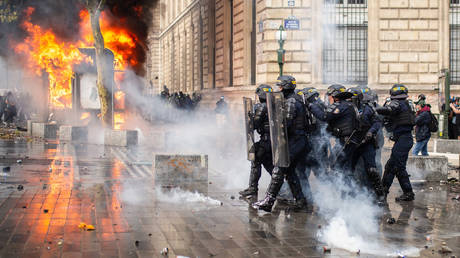
French police unions are moving to sue the state over how riot control and public disorder were managed during the autumn 2026 protests, turning an internal policing crisis into a direct constitutional and labor confrontation. Officers who spent weeks absorbing projectiles, arson, and street-level fury are now challenging the very government ministries that deployed them.
Spend twenty years covering French interior politics and you learn a simple rule: street clashes rarely stay in the street. They migrate into courtrooms, budget negotiations, and union headquarters. When a police union drags the state into legal combat over riot management, it signals a fracture in the chain of command itself. The rank and file are no longer asking only for tougher laws against protesters; they are questioning whether political leadership exposed them to unmanageable danger while leaving them legally and operationally exposed.
The Breaking Point Behind the Shield Wall
Riot policing in France has long operated under a high-friction doctrine. Mass demonstrations, student blockades, and cost-of-living marches frequently collide with violent fringe actors who throw fireworks, hurl bottles, burn vehicles, and loot storefronts. During the unrest that escalated in September and October 2026, tens of thousands of officers were mobilized across cities to contain overlapping waves of anger.
Exhaustion is only part of the story. Frontline units complain that shifting political directives turn crowd control into a moving target. One day officers are ordered to hold a hard perimeter; the next, political leaders face pressure over severe injuries and heavy custody numbers. By early October 2026, thousands of people had been taken into custody—many of them minors—while violent incidents on the sidelines of large marches stretched police lines thin.
When frontline enforcement becomes the primary instrument of political containment, officers end up carrying the political cost of policy failures on the pavement.
A lawsuit against the state is a blunt instrument in French public law, yet unions reach for it when routine administrative grievances stall. By framing riot management as a failure of state duty or operational planning, unions try to shift blame upward toward decision-makers in Paris rather than downward onto individual officers working twelve-hour shifts.
Legal Warfare on Two Fronts
The union push to sue the state does not exist in a legal vacuum. It unfolds alongside a fierce courtroom battle driven from the opposite direction: defense attorneys and civil rights lawyers suing or filing complaints against state officials and police over severe injuries sustained during demonstrations.
In autumn 2026, lawyers representing injured demonstrators and teenagers pointed to grave wounds—including lost eyes and severe limb injuries linked to crowd-control munitions—while opening legal fronts against senior officials and pursuing internal investigations. At the same time, legislative debates over "legitimate use of force" protections and civil liability for riot damage have put every tactical decision under intense scrutiny.
Consider a hypothetical example to see how these pressures collide in practice. Suppose a riot unit is ordered to clear a blocked intersection where fireworks and paving stones are flying, using an authorized dispersion munition during a chaotic retreat. If a bystander suffers a catastrophic injury, the officer faces potential investigation and scrutiny, while the union argues that unclear rules of engagement, inadequate tactical support, or delayed reinforcements placed the officer in an impossible position. Both sides claim the state failed them, though they define that failure in opposite ways.
- Operational liability: Unions argue that deployment orders, staffing gaps, and shifting mandates can put officers at unnecessary risk during violent unrest.
- Use-of-force scrutiny: Critics and injured citizens challenge the proportionality and safety of crowd-control weapons and containment tactics.
- Political whiplash: Rapid swings between hardline crackdowns and damage control leave both protesters and police questioning the consistency of state authority.
Why French Police Unions Hold Outsized Leverage
Anyone who underestimates French police unions misunderstands how power works in the Fifth Republic. While traditional labor unions in France have faced structural headwinds over decades, police unions have accumulated substantial political weight during successive waves of civil unrest. Governments rely heavily on law enforcement to keep order when streets erupt, giving police organizations real leverage over wages, equipment, legal protections, and disciplinary rules.
That leverage cuts both ways. When unions threaten or launch legal action against the state, it embarrasses the executive branch. Ministers who present themselves as staunch defenders of order suddenly find themselves accused by their own police force of mishandling riots.
Still, legal action is no magic cure for street violence. Courts move slowly, and administrative claims over public-order tactics face high legal thresholds. Even if a union wins concessions on equipment, training, or state representation, no court ruling can stop a petrol bomb from flying in a narrow street or erase the trauma of a chaotic night on patrol.
What the Courtroom Fight Really Reveals
A lawsuit by French police unions over riot handling exposes a deeper governance problem: France has grown too accustomed to substituting forceful crowd control for political resolution. When grievances over schools, living costs, or public services boil over into street clashes, the police become the buffer between an angry public and a strained government.
Buffers wear out. Eventually, the people holding the shields turn around and ask why they were sent into the storm without clearer strategy, better de-escalation tools, or firmer political backing.
Watch the administrative dockets and ministry briefings closely over the coming months, because a state sued by its own police is a state forced to defend its competence in public.
French police union to sue government over mishandling of riots
This video directly covers a French police union moving to sue the government over its handling of the riots, matching the core legal conflict examined in the article.