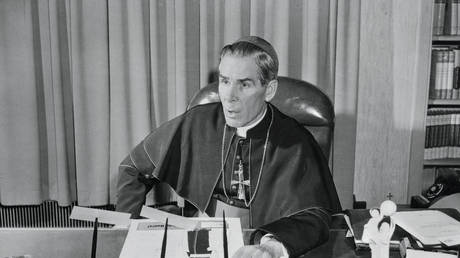
Long before the internet made media personalities out of anyone with a ring light, one Catholic bishop was already commanding an audience of thirty million weekly viewers. Archbishop Fulton J. Sheen didn't rely on flashy studio gimmicks or modern algorithmic outrage. He stood in a simple suit, used a blackboard to draw diagrams, and spoke directly to the camera as if he were sitting in your living room.
When tens of thousands of faithful packed into the Dome at America's Center in St. Louis for his official beatification, it wasn't just a nod to history. It was a massive public acknowledgment of a man who mastered communication decades before social media existed. If you've ever wondered how a midwestern preacher captured the cultural imagination of mid-century America—and why his path to sainthood took decades of legal and theological battles—the story goes much deeper than old television reruns.
The Original Media Pioneer
We take digital ubiquity for granted today, but in the early 1950s, television was still uncharted territory for religious leaders. When Sheen launched his program Life Is Worth Living in 1952, network executives warned him that a churchman talking straight to a camera for thirty minutes without visual aids would bomb.
They were dead wrong.
Sheen pulled in ratings that competed directly with powerhouse entertainers like Milton Berle and Frank Sinatra. In 1953, he beat out comedy legend Lucille Ball to win an Emmy Award for Outstanding Television Personality. His acceptance speech became legendary when he thanked his "four writers—Matthew, Mark, Luke, and John".
What made him magnetic wasn't just his theatrical delivery or his signature sign-off, "God love you". It was his refusal to talk down to his audience. Roughly seventy percent of his weekly viewers weren't even Catholic. Protestants, Jews, and agnostics tuned in because Sheen addressed practical human anxiety, morality, and the search for meaning rather than getting bogged down in dense theological jargon.
The Road Through Controversy and Courtrooms
The journey from television icon to the altars of beatification was anything but smooth. Sheen died in 1979 at the age of eighty-four, and his cause for canonization officially opened in the Diocese of Peoria in 2002. For years, the process stalled amid administrative disputes and a high-profile legal battle over his physical remains.
For decades, Sheen was entombed inside St. Patrick’s Cathedral in New York. However, his family—led by his niece—fought a protracted legal battle to transfer his body to Peoria, Illinois, where he grew up and was ordained. New York courts ultimately ruled in favor of the family, and in 2019, his remains were moved to the Cathedral of St. Mary of the Immaculate Conception. That relocation cleared the logjam, setting the stage for the massive ceremony in St. Louis.
The 61-Minute Miracle
To cross the threshold into beatification—the final major step before formal sainthood—the Vatican requires rigorous verification of a miracle attributed to the candidate's intercession. In Sheen’s case, the verified event reads like a medical anomaly that baffled attending physicians.
In September 2010, a baby named James Fulton Engstrom was born stillborn at home near Peoria. For an astonishing sixty-one minutes, emergency responders and medical staff performed CPR and advanced life support with zero pulse or vital signs. As doctors prepared to call time of death, family and friends desperately prayed for Sheen's intercession.
Suddenly, without medical explanation, the infant's heart kicked back into a normal rhythm. While doctors initially predicted severe organ failure or permanent brain damage, the boy developed normally. A panel of medical experts, theologians, and cardinals unanimously cleared the event as inexplicable by natural science, paving the way for Pope Francis to advance his cause.
Why His Message Endures Today
In an era dominated by soundbites, polarized shouting matches, and digital noise, Sheen's enduring appeal offers a sharp critique of modern discourse. He understood that cultural decay wasn't just a political problem—it was a spiritual vacuum.
He didn't shy away from complex cultural issues, yet he consistently pointed back to personal responsibility and interior discipline. Decades after his final broadcast, reruns on networks like EWTN continue to pull in viewers who are exhausted by modern cynicism. His elevation to "Blessed" serves as a reminder that intellectual depth paired with genuine charisma leaves a mark far longer than fleeting internet fame.
If you want to understand how faith can engage mass media without losing its soul, look back at the bishop who treated every viewer not as a consumer, but as a human being worth fighting for.
The World Over | Full episode: Fulton Sheen Beatified!
This video provides a comprehensive broadcast look at the historic beatification celebrations and panel discussions surrounding Archbishop Fulton Sheen's legacy in St. Louis.


