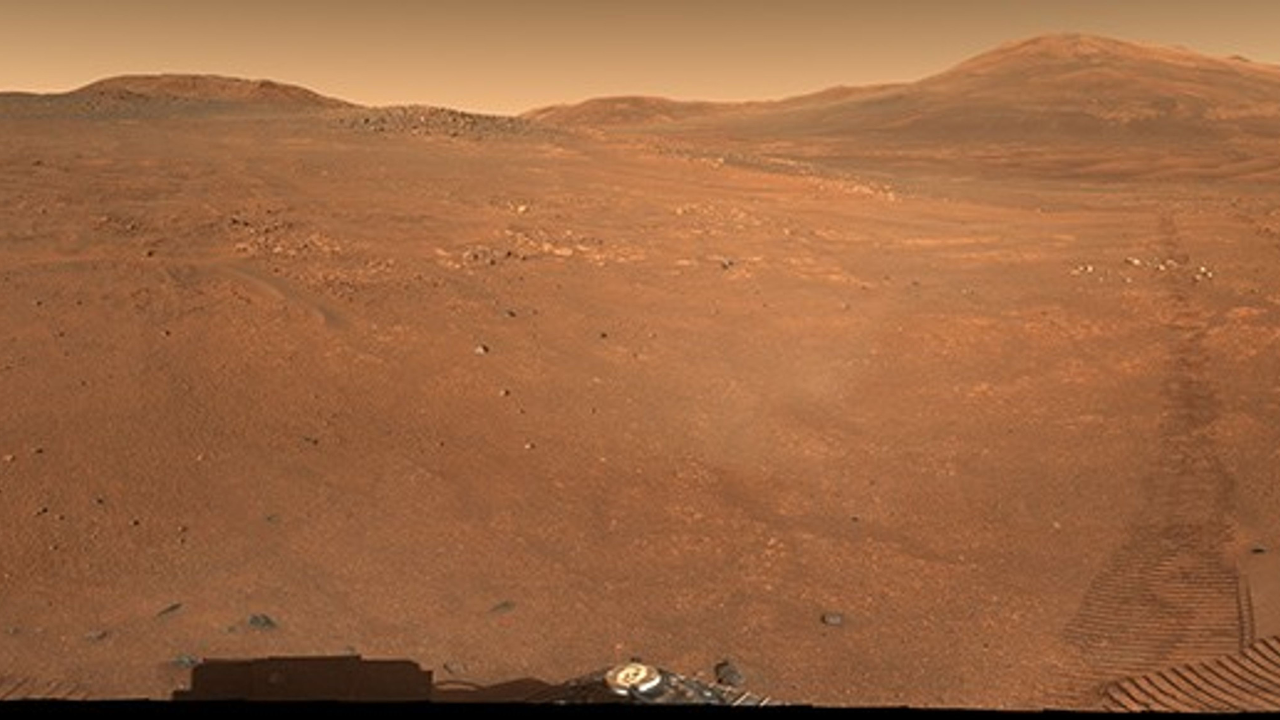
The discovery of the Crocodile Bridge feature within Jezero Crater is not a geological curiosity but a high-value data point in the reconstruction of the Martian paleohydrological system. While casual observation focuses on the pareidolia of its reptilian shape, the structural integrity and positioning of these jagged, upturned rock slabs provide a diagnostic profile of the forces that governed the Neretva Vallis delta. Understanding this site requires moving beyond visual description toward a rigorous assessment of depositional energy, diagenesis, and the mechanical properties of the Martian crust.
The Triad of Formation Mechanisms
The Crocodile Bridge does not exist in isolation. It is the physical manifestation of three intersecting geological processes that define the current state of the Jezero Crater floor.
1. High-Energy Fluvial Deposition
The primary architecture of the site was established during the active phase of the Neretva Vallis. The specific orientation of the rock fragments suggests a high-energy environment where water volume and velocity were sufficient to transport large clasts. The "bridge" itself is composed of sedimentary layers that were once horizontal, deposited as the delta expanded into the ancient crater lake. The thickness of these layers serves as a proxy for the duration and intensity of the flooding events that fed the basin.
2. Differential Lithification
Not all Martian dust is created equal. The Crocodile Bridge highlights the role of chemical cementation. In this region, groundwater rich in minerals—likely carbonates or silica—percolated through the sediment. This process, known as lithification, turned loose sand and silt into hard rock. However, this mineralization was non-uniform. The segments that remain today represent the most heavily cemented portions of the delta, while the surrounding material was less resilient, creating the relief we observe.
3. Aeolian Scouring and Mechanical Stress
The final shaping of the Crocodile Bridge is a result of billions of years of wind erosion. Martian winds, despite the thin atmosphere, carry fine abrasive dust that acts as a sandblaster. This aeolian process targets the weakest points in the rock. The upturned, "toothy" appearance of the formation is a textbook example of "yardang" development on a micro-scale, where wind carves out softer inter-layers, leaving the hardened ribs behind. Furthermore, thermal cycling—where temperatures swing by over 100 degrees Celsius between day and night—creates mechanical stress that fractures these hardened ribs, leading to the jagged profile.
Technical Constraints of In-Situ Analysis
The Perseverance rover is operating within a specific cost-benefit framework regarding instrument deployment at the Crocodile Bridge. Every measurement consumes a finite power budget and adds "wear and tear" to the robotic arm.
Spectral Signature Limitations
The rover utilizes the SHERLOC (Scanning Habitable Environments with Raman & Luminescence for Organics & Chemicals) and PIXL (Planetary Instrument for X-ray Lithochemistry) instruments to map the elemental composition of these rocks. The primary bottleneck is the "dust factor." Even a micron-thick layer of Martian dust can mask the true chemical signature of the underlying rock. To bypass this, Perseverance must use its drill to abrade the surface—a destructive process that requires significant torque and time.
The Problem of Contextual Ambiguity
A significant challenge in analyzing the Crocodile Bridge is determining whether the rocks are "in-situ" (in their original location) or "float" (moved from elsewhere).
- In-situ strata allow scientists to date the specific era of the Jezero delta.
- Float rocks provide a broader survey of the Neretva Vallis catchment area but lose the chronological context.
The tilt of the slabs at Crocodile Bridge suggests they may have been displaced by ancient impact events or significant tectonic settling within the crater, which complicates the stratigraphic mapping of the region.
Quantifying the Astrobiological Potential
The Crocodile Bridge is a priority target because it represents a "taphonomic window"—a specific environment where evidence of ancient life, if it existed, could be preserved.
Carbonate Preservation Theory
Carbonates are critical in the search for life because they often precipitate from water and can trap organic molecules or microbial structures. The Crocodile Bridge sits in a zone where orbital spectroscopy previously identified strong carbonate signatures. If these rocks are carbonate-rich, they function as a chemical vault, protecting sensitive organic compounds from the intense ultraviolet radiation that sterilizes the Martian surface.
The Porosity Variable
The potential for biosignature preservation is inversely proportional to the rock's permeability post-lithification. High porosity allows for the entry of oxidizing fluids (like perchlorates) that destroy organic matter. The dense, resistant nature of the Crocodile Bridge slabs suggests a low-porosity matrix, which increases the probability of finding intact molecular fossils within the interior of the rock, shielded from the harsh surface environment.
Operational Logistics and Sample Selection
The decision to cache a sample from a site like Crocodile Bridge involves a rigorous weighing of variables known as the Sample Value Matrix. NASA’s mission planners must balance:
- Diversity: Does this rock represent a unique geological unit not already in the cache?
- Return Integrity: Will the sample survive the mechanical vibrations of a rocket launch from the Martian surface?
- Scientific Yield: Does the sample contain the specific minerals (e.g., clays, carbonates) required to answer the primary mission questions?
The Crocodile Bridge slabs are particularly attractive because their hardness—demonstrated by their survival against eons of wind—ensures they will remain intact during the 300-million-mile journey back to Earth.
Structural Vulnerabilities in Current Models
While the fluvial-aeolian model is the prevailing theory, it contains significant gaps. The most prominent is the "Time-Mass Disconnect." The volume of erosion required to create features like the Crocodile Bridge implies a much thicker atmosphere or a much longer period of liquid water than current climate models for Mars suggest.
The presence of such sharply defined, hard rock features suggests that either the Martian atmosphere remained dense for longer than previously hypothesized, or that the chemical cementation processes were far more aggressive, perhaps driven by localized hydrothermal activity rather than simple lake-bottom sedimentation.
Strategic Path Forward
The focus must now shift from visual reconnaissance to deep-tissue analysis. The tactical priority for the Perseverance mission at the Crocodile Bridge is the deployment of the RIMFAX (Radar Imager for Mars' Subsurface Experiment). Ground-penetrating radar will reveal whether the "bridge" slabs extend deep into the subsurface or are merely surficial remnants.
If the radar confirms a deep, continuous sub-strata, the site should be reclassified as a primary drilling location for a "depot" cache. This would provide the Mars Sample Return mission with a definitive record of the Jezero delta's peak flow period. If the radar shows the slabs are disconnected boulders, the rover should proceed immediately toward the "Bright Angel" region to avoid wasting operational cycles on displaced material. The mission must prioritize structural context over visual uniqueness to maximize the return on the multi-billion-dollar investment in the Mars Sample Return architecture.