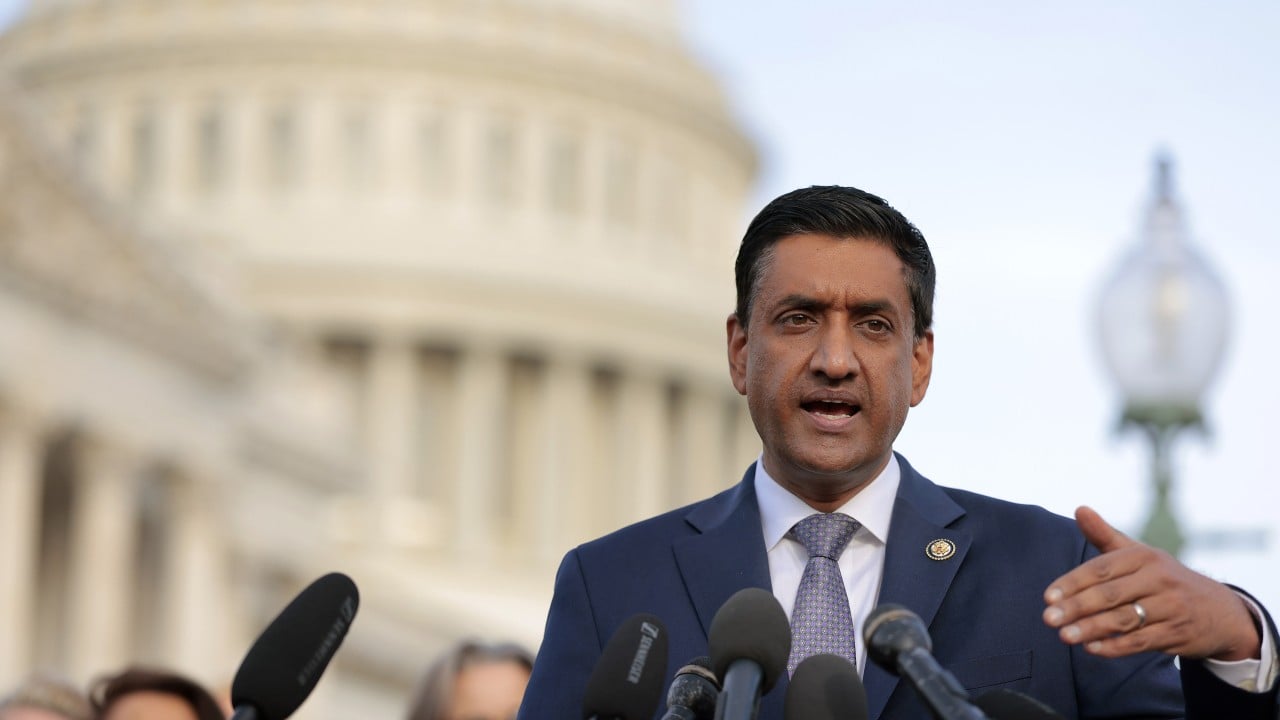
The modern legislative hearing functions less as a fact-finding mechanism and more as a high-stakes optimization engine for political signaling. When Representative Ro Khanna confronted Republican witness Michael Lucci during a House Select Committee hearing on the Chinese Communist Party, the resulting clash over birthright citizenship and racial bias was not merely an isolated rhetorical dispute. It was an acute systemic friction point where two fundamentally incompatible models of risk management collided: state-centric defensive realpolitik versus rights-based constitutional protectionism.
The core friction in this interaction stems from an escalating tension in United States policy. As the state moves to insulate its technological, industrial, and social infrastructure from foreign adversaries, the policy instruments proposed begin to scrape against foundational legal guarantees, specifically the Fourteenth Amendment. Understanding this clash requires deconstructing the underlying policy logic, quantifying the mechanics of the legal debate, and assessing the strategic fallout of using personal accusations as a tool of legislative oversight.
The Tri-Border Policy Dilemma
The dispute centered on a proposal regarding individuals born in United States territories who are subsequently raised in foreign adversary nations—specifically China—and who may maintain allegiance to an adversarial state. The witness, Michael Lucci, pointed to an estimated demographic of 1,500 individuals who allegedly fit this profile, framing them as a distinct national security vulnerability.
This argument relies on a three-part conceptual structure:
- The Geographic Nexus: Exploitation of birthright policies within sovereign U.S. territories or jurisdictions to secure legal status with minimal domestic integration.
- The Foreign Socialization Vector: Prolonged exposure and socialization within an adversarial state, creating a primary behavioral allegiance detached from the country of birth.
- The Operational Vulnerability: The subsequent utilization of U.S. passport privileges to access restricted tech sectors, dual-use supply chains, or sensitive intelligence frameworks without undergoing the rigorous vetting applied to foreign nationals.
From a pure defense-consulting perspective, this structure attempts to minimize a vector of asymmetric risk. However, the mechanism proposed to neutralize this risk—denaturalization or the selective restriction of birthright citizenship—introduces a massive systemic failure mode into the domestic legal architecture.
The Cost Function of Rights Deprivation
The primary analytical failure of the national security model presented by the witness is its disregard for the institutional cost function. In security optimization, eliminating a minor risk vector is counterproductive if the mechanism used destabilizes the broader legal operating system.
Systemic Cost = (Targeted Security Gain) - (Institutional Instability + Target Group Alienation)
By proposing to scale back or review the citizenship status of individuals based on their family background or country of socialization, the policy shifts from a behavioral risk assessment to a categorical risk assessment.
The structural flaw in categorical risk assessment is twofold:
1. The Slippery Slope of Sovereign Definitions
If the federal government establishes a precedent where birthright citizenship is conditional upon post-birth residency or familial alignment, the definition of a "secure" citizen becomes dynamic rather than fixed. This creates a regulatory bottleneck where the status of millions of natural-born citizens belonging to diaspora communities could fluctuate based on shifting geopolitical definitions of "foreign adversaries."
2. The Talent Supply Chain Bottleneck
The United States tech sector, particularly in artificial intelligence, semiconductor fabrication, and quantum computing, relies heavily on high-skill immigrant talent and second-generation citizens. Implementing policies that signal institutional suspicion toward specific ethnic groups disrupts this supply chain. The long-term cost to national competitiveness outweighs the marginal security gain of monitoring a statistically minute demographic.
Rhetorical Escalation as a Diversion from Policy Architecture
Representative Khanna’s sharp line of questioning, culminating in the point-blank question, "Are you simply a racist?", represents a specific tactical maneuver in congressional oversight: the reduction of complex structural proposals to individual moral intent.
While effective for media amplification, this tactical shift alters the analytical landscape. By focusing on whether the witness harbored personal bias, the committee bypassed a rigorous legislative dissection of why the proposal is legally unviable.
The witness countered this line of attack by citing his personal family structure, noting his Chinese wife and four children. This exchange highlights the limits of personal identity metrics in structural policy debates:
- The Witness's Fallacy: The assumption that personal or familial proximity to a group inherently immunizes a policy proposal from carrying disparate, discriminatory impacts against that same group.
- The Legislator's Fallacy: The assumption that a poorly constructed, potentially discriminatory policy proposal can only originate from an individual acting with explicit racial animus, ignoring the role of hyper-hawkish security frameworks that systematically undervalue civil liberties.
The actual systemic flaw in the witness's proposal is not a question of personal morality; it is a question of constitutional mechanics. The Fourteenth Amendment explicitly states: "All persons born or naturalized in the United States, and subject to the jurisdiction thereof, are citizens of the United States." The text provides no mechanism for the executive or legislative branches to retroactively revoke this status based on subsequent foreign residency or ideological alignment.
Strategic Outlook for National Security Policy
The confrontation serves as a definitive indicator of how the bilateral escalation between the U.S. and China is reshaping domestic policy boundaries. Moving forward, the policy apparatus will increasingly face these boundary disputes.
The optimal strategic play for policymakers navigating this landscape requires abandoning broad, categorical restrictions that target citizenship or ethnicity. Instead, the national security framework must optimize behavioral vetting models.
Security frameworks must focus strictly on verifiable data points: financial transactions, corporate affiliations, and direct technical data transfers, rather than attempting to modify foundational constitutional definitions. The preservation of internal institutional stability and the rule of law remains the ultimate prerequisite for long-term geopolitical endurance.


