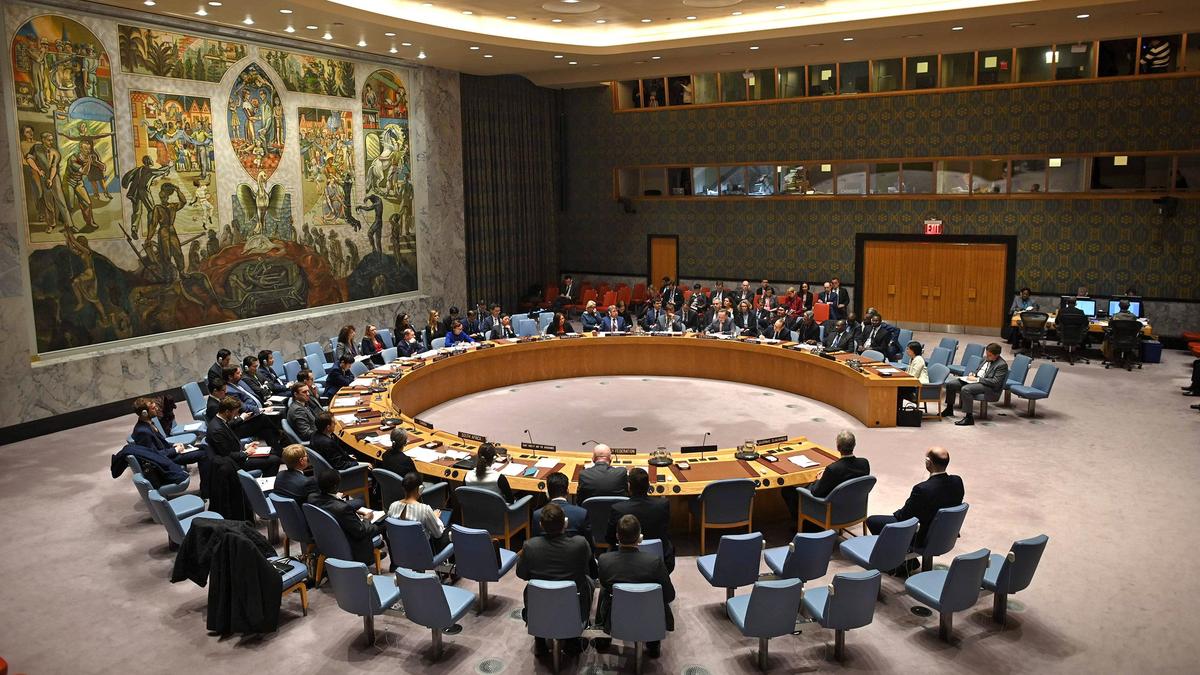
The United Nations Security Council has hit a wall that no amount of backroom diplomacy seems able to scale. At the center of this latest diplomatic wreckage is a fundamental dispute over the American-led Program of Work, which has been effectively neutralized by a coordinated blockade from Russia and China. This isn't just another routine procedural disagreement. It is a calculated strike against the U.S. Presidency of the Council, specifically targeting the inclusion of Iranian proliferation as a priority item. While the public spat looks like a debate over a calendar, the reality is a high-stakes struggle to redefine which nations get to set the global security agenda.
Russia and China have formally objected to the American schedule, arguing that the focus on Iran is disproportionate and politically motivated. By refusing to adopt the Program of Work, these two permanent members have essentially stalled the formal machinery of the Council. This maneuver forces the body to operate on a day-to-day basis, stripped of the long-term strategic planning that usually defines a successful presidency. It is a message sent directly to Washington: the era of uncontested American agenda-setting is over.
The Weaponization of Procedure
In the windowless rooms of the UN headquarters, "procedure" is the primary weapon of the disgruntled. Usually, the adoption of the monthly Program of Work is a formality. It is the administrative skeleton that allows the Council to function. However, by withholding consensus, Moscow and Beijing have turned this administrative tool into a political cage.
Their objection centers on the U.S. insistence on highlighting Iran’s nuclear activities and regional influence. For Russia, protecting Iran is a matter of strategic necessity, given the deepening military and economic ties between the two nations since the invasion of Ukraine. For China, it is about maintaining a "balanced" approach that prevents Western powers from using the Council as a platform for unilateral pressure.
When a Program of Work is rejected, the Council doesn't stop meeting, but it loses its rhythm. It becomes reactive. This state of limbo serves those who benefit from a weakened international oversight mechanism. If the Council cannot agree on what to talk about, it certainly cannot agree on what to do.
The Iranian Shadow
The specific friction point is the 2231 format—the mechanism established to monitor the Iran nuclear deal. The United States intended to use its presidency to bring fresh scrutiny to Iranian advancements in uranium enrichment and drone exports. Russia and China viewed this as a "politicized" diversion from other global crises, such as the situation in Gaza or the ongoing fallout from Western sanctions.
Russia’s UN mission has been vocal about what it calls the "artificial" inflation of the Iran issue. They argue that because the U.S. withdrew from the JCPOA (Joint Comprehensive Plan of Action) under the Trump administration, it has no moral or legal standing to dictate the terms of Iranian compliance today. China echoes this sentiment, often framing its opposition as a defense of the "sovereign rights" of Global South nations against Western interference.
But there is a deeper layer of irony here. By blocking the program, Russia and China are not just protecting Iran; they are protecting themselves from a precedent. If the U.S. can force a specific focus on Iran's regional "destabilization," what stops them from doing the same to Russian activities in Africa or Chinese maneuvers in the South China Sea? The blockade is a defensive perimeter.
A Council Divided by Default
We are witnessing the birth of a "Permanent Minority" mindset among the P5. For decades, the veto was the primary tool of obstruction. Now, the battle has moved upstream to the very planning phase of diplomacy. This shift indicates a total breakdown in the "gentleman's agreement" that previously allowed the Council to function even during the height of the Cold War.
In the past, even when the U.S. and the Soviet Union disagreed on the substance of a resolution, they generally allowed the Program of Work to pass so that the business of the UN could proceed. That courtesy is dead. Today, the objective is often to prevent the conversation from happening at all.
This paralysis has a cascading effect. When the Security Council is locked in a procedural civil war, smaller nations lose their voice. The ten non-permanent members (the E10) find themselves sidelined, their own priorities—like climate security or regional peacekeeping—buried under the weight of a superpower standoff they didn't ask for.
The Myth of the Neutral Referee
The U.S. Presidency of the Security Council is often marketed as a position of neutral stewardship, but every veteran analyst knows it is a month-long opportunity to exert soft power. By selecting which "signature events" to hold, the presiding country can force the world to look at specific problems.
Washington wanted the world to look at Iran.
Moscow and Beijing wanted the world to look at the failures of American diplomacy.
The result is a stalemate that leaves the Council's credibility in tatters. To the outside observer, this looks like bickering over a Google Calendar. To the diplomat, it is a fight for the soul of international law. If the rules of the Council can be used to prevent the Council from discussing security threats, then the institution is no longer fit for its primary purpose: the maintenance of international peace and security.
The Cost of Inaction
While the diplomats argue over the wording of the agenda, the ground realities continue to deteriorate. Iranian centrifuges continue to spin. The conflict in Ukraine shows no signs of abating. The humanitarian catastrophe in the Middle East deepens.
The failure to adopt a Program of Work means that every single meeting must now be negotiated individually. This consumes hundreds of man-hours that should be spent on substantive policy. It turns the UN into a theatre of the absurd, where the actors spend all their time arguing about where the chairs should be placed instead of performing the play.
This is not a temporary glitch. It is a feature of the new multipolar reality. Russia and China are no longer content to simply say "no" to American proposals; they are now actively preventing the U.S. from even making those proposals in a formal setting.
Beyond the Iran Dispute
We must look past the immediate headlines about Iran to see the broader strategy at play. This procedural blockade is a trial run. By successfully neutralizing the U.S. Presidency over a relatively niche (though important) issue like the 2231 format, Russia and China have created a roadmap for future obstruction.
They have demonstrated that they can hold the entire Council hostage without ever having to cast a high-profile veto that might draw public ire. It is a quiet, bureaucratic assassination of American influence.
The U.S. finds itself in a difficult position. To get the program passed, it would have to strip out the very items it considers most vital to its national security interests. To refuse to compromise is to accept a month of paralyzed leadership. It is a classic "lose-lose" scenario designed by master tacticians in Moscow and Beijing.
The Infrastructure of Obfuscation
The complexity of UN procedure acts as a veil. It allows member states to hide their true intentions behind a fog of "technical concerns" and "points of order." When a spokesperson says they object to the "methodology" of the Program of Work, they are usually saying they find the truth inconvenient.
The current standoff proves that the Security Council's 1945-era structure is buckling under 2026-era pressures. The veto was designed to prevent the P5 from going to war with each other. It was never intended to be used as a scalpel to dissect the daily administrative functions of the body.
If the Council cannot move past this, we are looking at a future where the General Assembly or regional blocs like the G7 and BRICS become the true centers of global decision-making. The Security Council risks becoming a museum of 20th-century ambitions—a place where diplomats go to read prepared statements to an empty room while the real world burns outside the gates.
The U.S. mission may continue to push for its agenda, but the leverage has shifted. Every day that passes without a formal Program of Work is a day that Russia and China have won. They have successfully framed the U.S. as an "isolated" power, unable to build consensus even on a calendar.
Watch the next few days closely. If the U.S. yields and removes the Iran-specific briefings, it signals a massive concession to Russian and Chinese pressure. If they hold firm, they preside over a ghost ship. Either way, the message to the international community is clear: the United Nations is no longer the place where the world's most pressing problems get solved. It is the place where they go to die in a thicket of procedural red tape.
The move to block the Program of Work is the final nail in the coffin of the post-Cold War diplomatic order. We are now in a period of "Zero-Sum Diplomacy," where any gain for one side is viewed as an existential threat to the other. In this environment, the very concept of a "Security Council" becomes a contradiction in terms.
The deadlock over Iran is just the beginning of a much longer, much uglier chapter in the history of the UN. Washington can no longer rely on the prestige of the presidency to carry its agenda through the halls of Turtle Bay. The floor has dropped out from under the podium.
The immediate next step for the U.S. mission is to decide if they will bypass the Council's formal structure entirely and hold "Arria-formula" meetings—informal sessions that don't require a program of work but also carry no legal weight. Choosing this path would be a public admission that the Security Council, in its current form, is broken beyond repair.