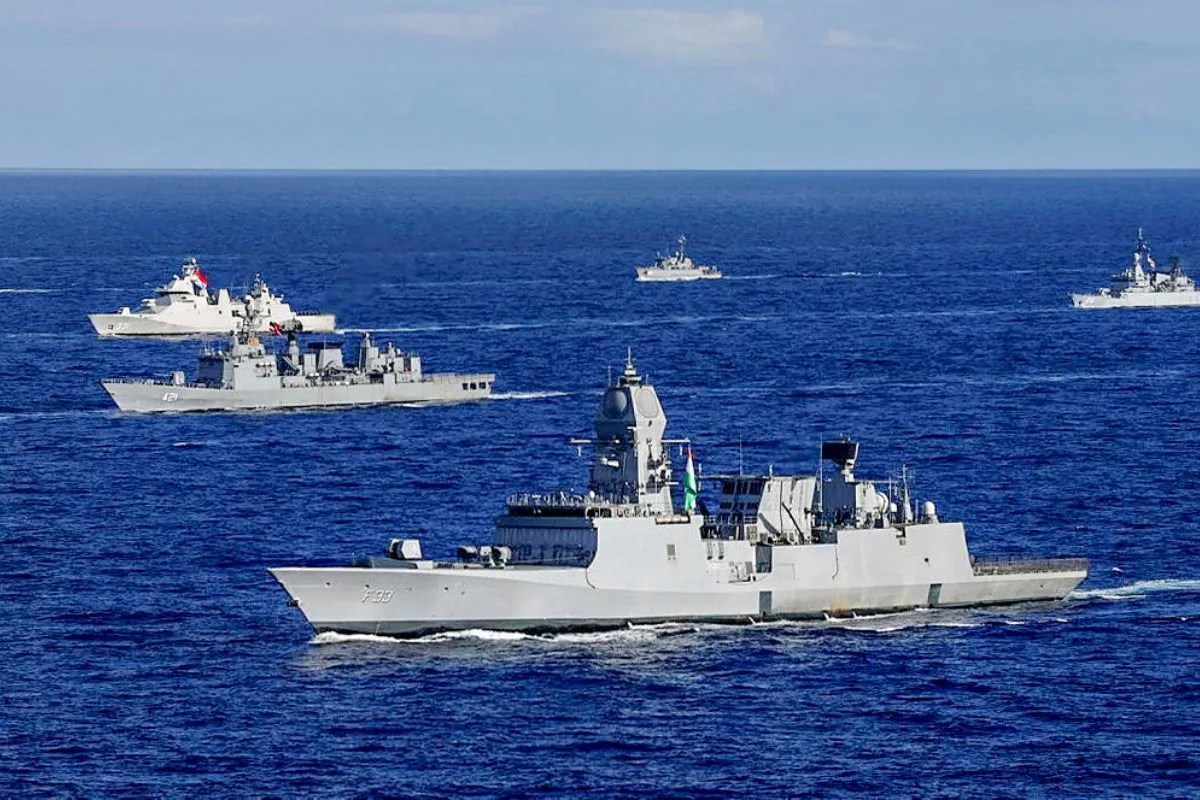
New Delhi’s maritime counter-encirclement strategy known as the Necklace of Diamonds has not contained China in the Indo-Pacific region. While often framed as a triumphant geopolitical checkmate against Beijing’s String of Pearls, the reality on the water tells a far more complicated story. India has successfully expanded its access to critical naval choke points from Duqm in Oman to Sabang in Indonesia. However, this web of logistics agreements lacks the operational muscle and financial backing required to truly neutralize Chinese maritime power.
The strategy aims to match Chinese naval presence through a network of strategic military bases and listening posts. Yet, treating this network as a finished defensive wall overlooks a glaring vulnerability. Geography does not equal capability. Access to a port is not the same as maintaining a permanent, heavily armed naval presence capable of projecting power during a conflict.
The Anatomy of the Encirclement Myth
For over a decade, Indian defense planners watched with growing alarm as China built commercial and military footholds across the Indian Ocean. Beijing secured Hambantota in Sri Lanka, Gwadar in Pakistan, and a full-scale military base in Djibouti. The response from New Delhi was the Necklace of Diamonds, a series of bilateral agreements designed to surround China's primary shipping lanes.
The key nodes in this strategy span the entire expanse of the Indian Ocean.
- Changi Naval Base, Singapore: Provides the Indian Navy with direct logistical support near the vital Malacca Strait.
- Sabang Port, Indonesia: Situated at the mouth of the Malacca Strait, offering deep-water access close to India's Andaman and Nicobar Command.
- Duqm Port, Oman: Grants India access to the Western Indian Ocean and the Arabian Sea, acting as a counterweight to Pakistan’s Gwadar.
- Assumption Island, Seychelles: A critical listening post and maritime facility aimed at tracking ship movements in the southwestern quadrant of the ocean.
- Chabahar Port, Iran: An economic and strategic gateway bypassing Pakistan to access Central Asia.
On paper, this list looks impressive. It traces a neat arc across the map, suggesting that India can choke off Chinese merchant shipping at a moment's notice.
But maps can lie.
The agreements governing these ports are primarily logistical, not mutual defense pacts. If a shooting war breaks out between India and China, there is no guarantee that sovereign nations like Indonesia, Singapore, or Oman will allow the Indian Navy to use their facilities to launch offensive operations. These countries depend heavily on trade with China. They are highly unlikely to sacrifice their economic survival to fight New Delhi's battles.
The Asymmetry of Modern Naval Power
Naval power requires massive, sustained capital expenditure. This is where the Indian strategy faces its harshest bottleneck. China’s People’s Liberation Army Navy (PLAN) is building warships at a rate not seen since the Second World War. It possesses the world's largest navy by ship count and possesses the industrial capacity to replace losses rapidly.
India’s naval procurement remains plagued by bureaucratic delays and budget constraints. The Indian Navy has long advocated for a 170-ship fleet, yet it consistently hovers well below that target. The domestic shipbuilding pipeline is slow. Constructing an aircraft carrier or a nuclear-powered submarine in Indian yards takes twice as long as it does in Dalian or Shanghai.
This capability gap fundamentally undermines the Necklace of Diamonds. A necklace needs string. In maritime terms, that string is a fleet large enough to patrol these far-flung nodes simultaneously. Currently, the Indian Navy is forced to practice sea denial rather than sea control. It can protect its own backyard, but it cannot realistically project sustained power into the South China Sea or isolate the Western Indian Ocean concurrently.
The Choke Point Delusion
A central pillar of Indian maritime thought is the ability to close the Malacca Strait during a crisis. The logic states that because China imports the vast majority of its crude oil through this narrow passage, India holds a permanent veto over Beijing's economic stability.
This scenario ignores the rapid diversification of Chinese energy routes.
Beijing has spent hundreds of billions of dollars constructing overland pipelines through Central Asia, Russia, and Myanmar. The China-Pakistan Economic Corridor (CPEC), despite its systemic economic troubles, exists precisely to provide an overland alternative to the Malacca Strait. Furthermore, China is actively developing the Northern Sea Route through the Arctic. By the time India builds the necessary naval infrastructure at Sabang or the Andaman islands to effectively seal the Malacca Strait, China will have reduced its reliance on that waterway to a manageable level.
Local Resistance and the Sovereignty Barrier
Deploying a strategy is easy; maintaining local compliance is brutal. India’s attempts to secure its maritime necklace have run headfirst into local political opposition and accusations of heavy-handed regional bullying.
Consider the case of the Seychelles. The agreement to develop military infrastructure on Assumption Island was stalled for years by domestic political opposition within the Seychelles parliament. Local politicians feared losing their sovereignty and being dragged into a superpower conflict. To this day, the scale of Indian operations there remains limited, focused mostly on coast guard training and radar installation rather than true power projection.
A similar story unfolded in the Maldives. The archipelago has spent the last several years oscillating between "India First" and "India Out" foreign policies. When a pro-Beijing government takes power in Male, Indian military personnel are expelled, and Indian naval vessels are denied docking privileges while Chinese research ships are welcomed with open arms.
A defensive strategy that relies on the shifting political winds of small island nations is inherently fragile. China understands this vulnerability. It does not just build ports; it embeds itself into the economic fabric of these nations through massive infrastructure debt, creating long-term structural leverage that India simply cannot match financially.
The Hidden Costs of the Quad Alliance
To compensate for its individual resource deficits, India has increasingly leaned into the Quadrilateral Security Dialogue (Quad), partnering with the United States, Japan, and Australia. While the Quad provides enhanced intelligence sharing and joint naval exercises, it also introduces a dangerous element of strategic distraction.
The United States views the Indo-Pacific through the lens of Taiwan and the South China Sea. Washington wants India to play a role in deterring a Chinese invasion of Taiwan.
New Delhi, however, faces an immediate land threat on its northern border along the Line of Actual Control (LAC). Every rupee spent on a blue-water navy capable of sailing into the Western Pacific is a rupee not spent on high-altitude artillery, cold-weather gear, and border infrastructure in Ladakh and Arunachal Pradesh.
This is India’s classic continental dilemma. China is a multi-theater power; India is currently constrained by geography to be a single-theater power with maritime aspirations. Relying on the Necklace of Diamonds to solve a border crisis in the Himalayas is a profound miscalculation.
Reforming the Maritime Framework
If India wants its maritime strategy to be more than a collection of press releases, it must shift from a posture of passive access to active enforcement. This requires a hard-nosed reassessment of how New Delhi handles its closest maritime territory.
The Andaman and Nicobar Islands are India's most potent weapon in the Indian Ocean, yet they remain chronically underutilized. Sitting at the western entrance to the Malacca Strait, this archipelago offers a natural unsinkable aircraft carrier. Instead of spending political capital trying to build facilities on foreign soil like Assumption Island, New Delhi must turn the Andaman and Nicobar Command into a heavily fortified, permanently deployed joint-services hub.
This transformation requires upgrading runways to support heavy bombers, constructing permanent submarine pens, and deploying advanced anti-ship missile batteries across the island chain. India must focus on turning its own sovereign territory into an impassable barrier before it attempts to project power through foreign ports where its welcome could expire after the next election cycle.
The Indian Navy must also abandon the vanity of matching China hull-for-hull. It cannot win an industrial shipbuilding race against the world's factory. Instead, the focus should shift entirely to asymmetric denial. Investing heavily in a large fleet of quiet, conventionally powered attack submarines equipped with long-range cruise missiles offers a far greater return on investment than building a third expensive aircraft carrier that would require half the fleet just to protect it.
True security in the Indo-Pacific will not be achieved by drawing lines on a map and calling it a necklace. It will be achieved by building the specific, lethal capabilities required to hold those choke points regardless of who controls the surrounding ports.