High-level state visits operate on an intricate matrix of staging, security logistics, and signaling. When foreign heads of state travel to Washington, the visible choreography of red carpets, honor guards, and bilateral press briefings masks a parallel arena of public friction. The convergence of state power and organized dissent outside diplomatic venues produces a dual-track dynamic where institutional diplomacy and street-level resistance run concurrently. Analyzing this phenomenon requires stripping away the ceremonial veneer to examine the structural costs, information vectors, and strategic constraints governing bilateral summits.
The Structural Anatomy of State Visits
A presidential summit functions as a high-stakes bargaining environment designed to project stability and mutual accommodation. The hosting administration balances domestic political imperatives with international signaling. Inviting a major geopolitical rival or competitor involves managing multiple friction points simultaneously. Ceremonial elements such as personal airport welcomes, tours of executive facilities, and candlelit state dinners serve a specific purpose. They establish a baseline of diplomatic cordiality, regardless of underlying structural conflicts or deep-seated policy disagreements.
The architectural layout of Washington, District of Columbia, directly influences the logistics of public dissent during these events. Proximity to centers of executive power is strictly regulated through perimeter security, temporary fencing, and designated protest zones. Lafayette Park, situated directly north of the White House, functions as the primary pressure valve for public expression. When demonstrators gather within earshot of the executive mansion, the acoustic architecture of the city permits chants and amplified sound to cross security barriers. This creates an unavoidable audio backdrop for official proceedings, puncturing the sanitized atmosphere intended by summit planners.
Security protocols deployed during these visits represent a massive allocation of municipal and federal resources. Intelligence agencies, secret service personnel, and metropolitan police departments coordinate multi-agency operations to maintain physical separation between opposing factions. This physical buffering is designed to prevent violent clashes while preserving constitutionally protected assembly rights. However, the heavy concentration of barricades and law enforcement personnel transforms the urban core into an armed enclave, physically manifesting the underlying geopolitical tensions that diplomacy attempts to resolve.
The Economics of Dissent and Coalition Coordination
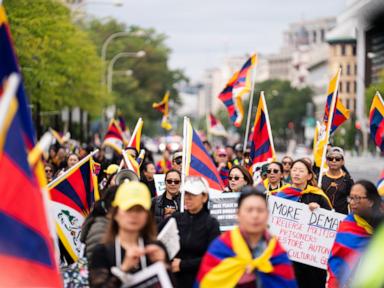
Mobilizing opposition forces during a high-profile visit requires significant organizational infrastructure. The crowds assembled outside executive corridors do not constitute a monolithic ideological faction. Instead, they form a loose federation of disparate interest groups, each pursuing distinct regional or sectoral objectives.
The coalition typically features several distinct advocacy streams:
- Organizations advocating for religious autonomy and political reform in Tibet
- Groups campaigning against mass internment and cultural suppression in Xinjiang
- Movements supporting self-determination and civic preservation in Hong Kong
- Security-focused entities demanding defensive guarantees and diplomatic deterrence for Taiwan
Each constituent group operates under its own resource constraints and internal calculus. The convergence of these factions during a presidential visit maximizes media visibility through collective mass. By pooling logistical capabilities—such as shared staging equipment, coordinated messaging, and synchronized chanting—minority interest groups amplify their signal far beyond their individual organizational capacities. This coalition strategy forces media coverage to broaden its scope beyond standard bilateral trade or security metrics, incorporating human rights grievances into the core narrative of the summit.
Resource allocation within these activist networks is characterized by decentralization and digital mobilization. Unlike state-sponsored delegations with bottomless operational budgets, grassroots organizations rely on donor networks, volunteer labor, and viral communication channels. The ability to coordinate simultaneous demonstrations across multiple embassy sites and government plazas requires sophisticated logistical planning. Activists utilize encrypted messaging applications, crowd-sourced funding platforms, and social media algorithms to maintain operational security and maximize turnout at critical junctures.
Counter-Mobilization and State-Aligned Display
State visits involving authoritarian leaders routinely trigger a parallel mobilization by pro-government supporters and diaspora organizations loyal to the home regime. These counter-demonstrations operate on different tactical principles than anti-government protests. While dissidents focus on disruption, moral condemnation, and policy intervention, pro-state participants prioritize validation, cultural pride, and institutional loyalty.
The logistical deployment of pro-government demonstrators usually centers around the accommodations of the visiting delegation, such as luxury hotels or secure transit corridors. Waving national flags and chanting standardized slogans serves an internal messaging function. These displays are recorded, processed, and transmitted back to domestic media channels within the home country. The strategic utility lies in narrative control. State media utilizes footage of enthusiastic diaspora supporters to counteract reports of international hostility, presenting an image of global prestige and unyielding national unity to domestic audiences.
The psychological dynamics of these counter-protests reveal deep fractures within diaspora communities living in Western democracies. Individuals who maintain familial ties or business interests in their country of origin face complex pressures from intelligence operatives and diplomatic missions abroad. Transnational repression and community surveillance ensure that participation in pro-regime rallies is frequently incentivized or coerced, creating a visible manifestation of foreign state influence operating directly within domestic civic spaces.
Information Warfare and Diplomatic Spillover
The juxtaposition of state-level negotiations and street-level protests generates immediate reverberations across international information networks. Modern summits are subjected to real-time digital surveillance, social media amplification, and targeted narrative construction by state-backed media agencies and independent observers alike.
Information management during these events follows a predictable trajectory. The hosting government attempts to compartmentalize human rights criticisms, relegating them to peripheral status in favor of security cooperation, economic stability, and strategic risk reduction. Conversely, advocacy networks exploit the presence of global media corps to inject contentious issues directly into the headlines.
The presence of lawmakers, human rights activists, and civil society leaders near the perimeter alters the domestic political calculus for the host administration. Elected officials face intense scrutiny from constituents and legislative colleagues if they appear overly deferential to leaders accused of severe civil liberties violations. This structural tension forces executive branches to calibrate their public rhetoric carefully, balancing pragmatic diplomatic engagement against the domestic political necessity of acknowledging democratic norms and human rights concerns.
Digital platforms act as force multipliers in this information environment. Algorithms prioritize high-conflict visual content, ensuring that footage of police barricades, shouting demonstrators, and flag-waving crowds achieves massive global reach within minutes of occurrence. This real-time visibility strips away the controlled messaging of formal press releases, exposing the raw friction of international relations to a global audience.
The Mechanics of Institutional Friction
Beyond the immediate spectacle of street protests, diplomatic summits create severe friction points within the legislative and executive branches of the host government. The separation of powers ensures that while the executive branch manages the operational diplomacy of welcoming a visiting head of state, the legislative branch retains the constitutional authority to conduct oversight, introduce restrictive legislation, and amplify dissident grievances.
During high-level visits, opposition lawmakers and bipartisan congressional committees frequently seize the opportunity to launch legislative initiatives targeting the visiting regime. These maneuvers are designed to signal resolve to domestic voters and constrain the executive branch's capacity to offer unconditioned concessions. Committee hearings, open letters signed by prominent politicians, and public press conferences outside the Capitol building run parallel to the demonstrations occurring at the White House perimeter.
This multi-pronged pressure creates a complex bargaining matrix. The visiting leader must calculate whether the economic or security agreements negotiated with the executive branch are secure against future legislative pushback. At the same time, the host executive must manage domestic coalition partners who view uncritical diplomatic engagement as a betrayal of core national values. The resulting institutional friction ensures that bilateral summits rarely yield clean, uncontested victories for either participating government.
The Long-Term Policy Impact of Perimeter Protests
Assessing the efficacy of demonstrations held in the shadow of executive architecture requires examining measurable policy shifts rather than immediate concessions. Authoritarian regimes rarely alter core strategic doctrines in response to street-level protests occurring thousands of miles from their capital. The domestic security apparatus of a major power is insulated from foreign public pressure.
However, repeated demonstrations institutionalize long-term structural friction. They serve as a persistent reminder to policymakers that engagement strategies carry domestic political costs. Sustained advocacy efforts shape legislative agendas, influence think-tank research priorities, and gradually harden public opinion over extended periods. When dissident groups successfully insert their demands into the media coverage surrounding a presidential summit, they establish a baseline of opposition that future administrations ignore at their peril.
To maximize strategic influence, civil society coalitions must transition from episodic outrage during high-profile visits to continuous legislative tracking and economic accountability measures. Advocacy groups should focus on supply chain transparency, targeted sanctions compliance, and institutional audits of bilateral agreements. Shifting the arena of contestation from temporary street protests to permanent regulatory frameworks ensures that policy changes outlast individual diplomatic summits.