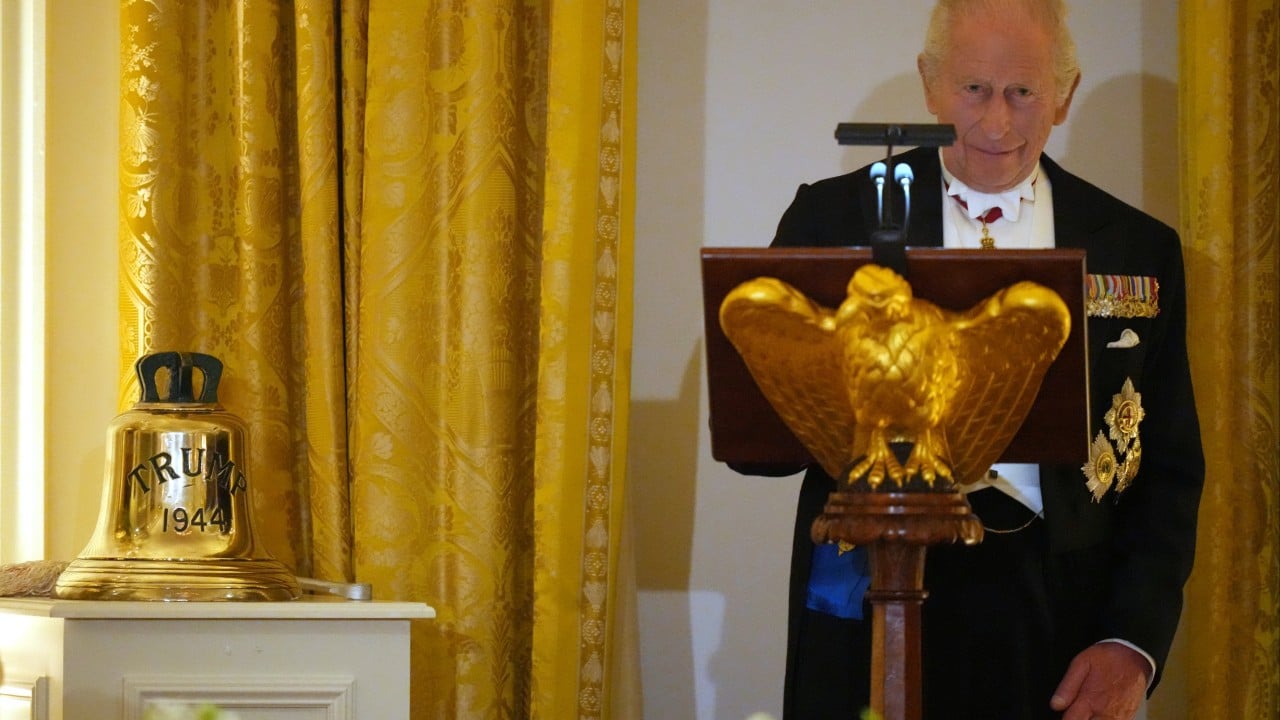
The gifting of a "Trump bell"—a ceramic figurine of former President Donald Trump depicted as a meditative Buddha—from King Charles III to the 47th President of the United States functions as a high-velocity catalyst for digital discourse in the People’s Republic of China (PRC). While Western media interprets this through the lens of quirky diplomatic trivia, a structural analysis reveals a complex intersection of linguistic irony, digital subculture, and the specific mechanics of the Chinese internet's "meme economy." The humor derived from this object is not incidental; it is the product of three distinct pillars: linguistic homophones, the secularization of religious iconography for political commentary, and the deliberate subversion of Western diplomatic norms.
The Mechanics of the Westward Buddhist Homophone
The primary driver of the Chinese internet's reaction is rooted in a specific pun that bridges Mandarin phonetics with American political nomenclature. The Trump Buddha figurine is known in Chinese digital circles as "Xi Jianfu" (西建福), a name constructed through precise linguistic substitution. Learn more on a related topic: this related article.
- The Phonetic Root: The first character, Xi (西), translates to "West," signaling both the subject's origin and a play on the traditional Buddhist concept of the "Western Heaven."
- The Nominal Anchor: The second character, Jian (建), is the first character of the Chinese transliteration for "Donald" (唐纳德·特朗普 - Tángnàdé Tèlǎngpǔ). However, it more critically references the phrase Jian Guo (建国), meaning "build the country."
- The Strategic Rebrand: By combining these, netizens dubbed him "Comrade Jianguo." Within the framework of Chinese internet satire, this suggests that Trump’s protectionist policies and perceived destabilization of Western alliances unintentionally "build" or strengthen China's global standing.
This linguistic structure creates a feedback loop where the gift is seen not as a gesture of goodwill between the UK and the US, but as a confirmation of a pre-existing satirical narrative. The "Trump bell" validates the "Comrade Jianguo" persona, transforming a physical object into a verified data point for a long-standing digital trope.
The Secularization of Iconography as Political Commentary
The physical form of the gift—a bell shaped like a Buddha—exploits a specific tension between traditional Eastern aesthetics and modern Western populism. In the Chinese market, where these figurines originated on e-commerce platforms like Taobao and JD.com, the "Trump Buddha" is marketed under the slogan "Make Your Company Great Again." Additional analysis by USA Today explores related perspectives on the subject.
This represents a commodification of "Zen" aesthetics to satirize the perceived chaotic nature of Trump’s political style. The logical framework here is the Contrast of Extremes:
- Variable A (Traditional Buddha): Represents stillness, the removal of ego, and internal harmony.
- Variable B (Trump Persona): Represents disruption, high-ego branding, and external conflict.
The convergence of Variable A and Variable B into a single object creates a cognitive dissonance that the Chinese internet resolves through humor. This is a form of "cynical consumption," where the purchase or discussion of the object serves as a critique of both Western political volatility and the absurdity of global consumerism. The "Trump bell" is a physical manifestation of this dissonance, now elevated to the level of state-level diplomatic exchange.
Information Arbitrage and the Great Firewall
The amusement of Chinese internet users is further amplified by "Information Arbitrage." This occurs when a domestic subculture (the creation of the Trump Buddha on Taobao) is exported to the West, filtered through a high-status institution (the British Monarchy), and re-imported back to the original source.
The lifecycle of this information follows a specific trajectory:
- Production: Chinese manufacturers create the figurine as a kitsch novelty.
- Export: The product gains niche popularity on Western social media as a "weird" find.
- Institutional Adoption: King Charles III, or his protocol team, identifies the object as a gift.
- Re-entry: The news returns to Weibo and WeChat, where users experience a sense of "cultural feedback."
The humor is derived from the perceived failure of British diplomatic intelligence. To the Chinese observer, King Charles is using a "meme" that originated in their own digital backyard, likely without fully grasping the satirical "Comrade Jianguo" subtext. This creates a perceived power imbalance where the Chinese netizen possesses a higher level of "contextual literacy" than the British monarch.
The Diplomatic Cost Function of Irony
The selection of this gift introduces a specific risk-reward ratio in international relations. Traditional diplomacy relies on the Principle of Non-Ambiguity, where gifts are intended to represent shared values or historical ties. By choosing an object rooted in internet satire, the British protocol office has shifted toward a Strategy of Calculated Levity.
However, this strategy faces a bottleneck in translation. In the UK, the gift may be seen as a lighthearted acknowledgment of Trump’s "larger-than-life" personality. In the US, it may be interpreted as a gesture of personal rapport. In China, it is decoded as a meta-commentary on the decline of Western institutional seriousness.
The unintended consequence is the reinforcement of a specific narrative within the PRC: that Western leadership is increasingly defined by "showmanship" (zuo xiu) rather than substantive policy. This perception is not merely a social media trend; it influences the psychological framing used by Chinese state media to describe the stability of the "Rules-Based International Order."
Structural Limitations of the Digital Reaction
It is a mistake to view the Chinese internet's reaction as a monolith of support or derision. The discourse is segmented by demographic and platform-specific algorithms:
- The Weibo Layer: High-velocity, meme-heavy, and focused on the "Comrade Jianguo" pun.
- The WeChat Layer: Focused on the business and "success" branding of the Buddha figurine, often discussed in entrepreneurship circles.
- The Zhihu Layer: Intellectualized analysis of what this says about the "downward trajectory" of British influence (the "Little Britain" narrative).
The structural limitation of this amusement is that it remains confined to the digital sphere. While it signals a sophisticated understanding of Western politics among Chinese youth, it does not necessarily translate into a change in geopolitical sentiment. The humor is an outlet for the observation of absurdity, not a driver of policy.
Strategic Recommendation for Global Communication Offices
For entities operating at the intersection of Western diplomacy and Eastern digital markets, the "Trump bell" incident serves as a primary case study in Contextual Risk Mapping. Any symbolic action taken in a Western capital will be instantly localized and re-contextualized within the Chinese digital ecosystem.
The final strategic play is not to avoid humor, but to perform a Subtext Audit before the deployment of symbolic capital. This requires:
- Linguistic Reverse-Engineering: Identifying potential homophones or puns in Mandarin that could alter the intended message.
- Origin-Source Tracking: Determining if a physical object has a pre-existing "digital life" in the target market’s e-commerce or social media spheres.
- Asymmetric Analysis: Recognizing that what appears "quirky" in a London press release will be viewed through a lens of "institutional decline" in a Beijing newsfeed.
The King Charles gift has inadvertently provided the Chinese internet with a high-status confirmation of its own satirical tropes. The amusement is not at the gift itself, but at the realization that the "center" of Western tradition—the Monarchy—has become a participant in the periphery's digital jokes. Success in modern diplomatic signaling now requires the ability to predict how a message will be "memed" before it is ever sent.



