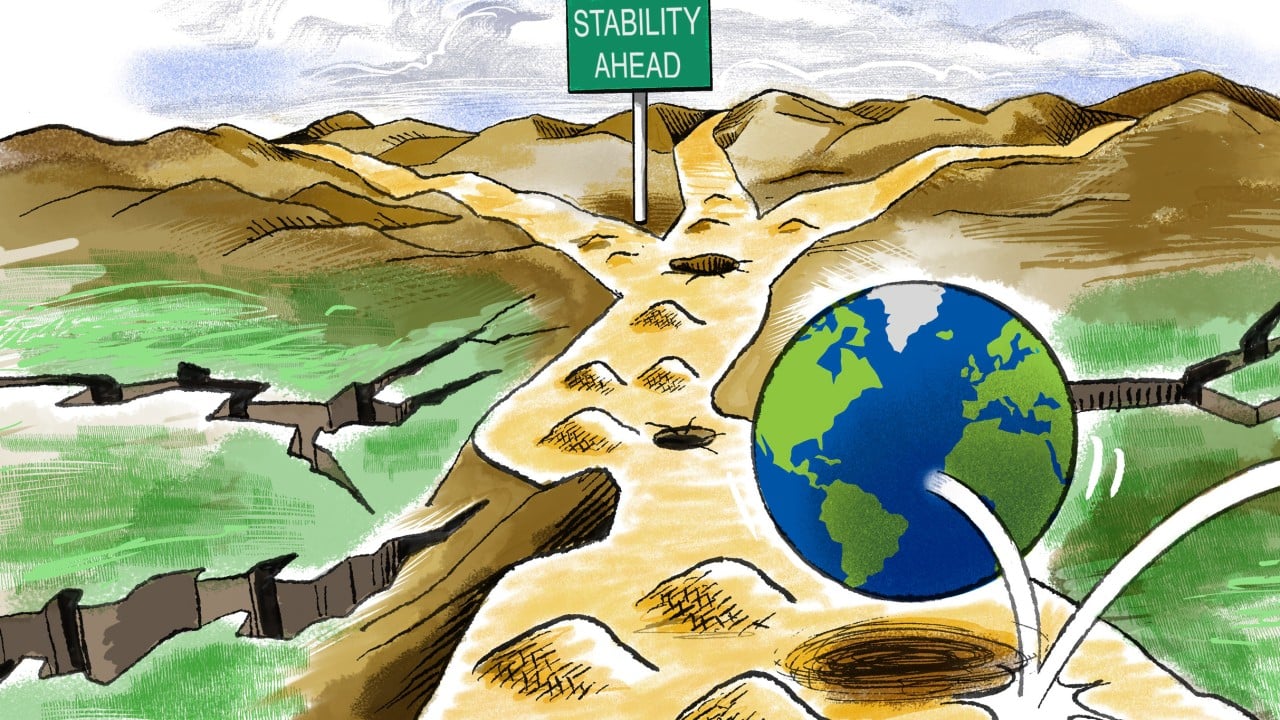
Geopolitical disruptions in the Middle East do not impact global inflation through energy channels alone. The standard economic assumption—that a conflict-driven spike in crude oil simply trickles down to consumer gasoline prices—overlooks the far more insidious transmission mechanism: the compounding of core inflation via supply chain velocity and maritime freight pricing. When geopolitical friction escalates, it triggers a non-linear inflation response that alters manufacturing inputs, transport logistics, and corporate pricing behavior simultaneously. Understanding this dynamic requires moving past superficial consumer price index (CPI) headlines and dissecting the structural cost functions that dictate global wholesale prices.
The current escalation in Middle Eastern hostilities has pushed a primary US inflation gauge to its highest level since mid-2023. This is not a temporary blip driven by volatile food or energy components. Instead, it represents a structural shift where geopolitical risk is directly pricing itself into the "core" elements of the economy—goods and services that exclude volatile sectors. To map how a regional conflict transforms into a domestic inflationary forcing function, we must evaluate the three pillars of the modern supply-side transmission network.
The Three Pillars of Geopolitical Inflation Transmission
The macroeconomic impact of regional stability breakdown can be quantified through three distinct vectors. Each vector operates on a different time lag, meaning the inflationary pressure observed today is the cumulative result of decisions made weeks or months prior.
Pillar 1: The Maritime Freight Risk Premium
The immediate consequence of military conflict near critical global choke points, such as the Strait of Hormuz or the Bab al-Mandab Strait, is the instantaneous repricing of maritime logistics. This occurs through two distinct mechanisms:
- Route Deviation Economics: Ocean carriers reroute vessels away from high-risk zones, such as circumnavigating Africa via the Cape of Good Hope instead of utilizing the Suez Canal. This adds roughly 3,000 to 3,500 nautical miles to a typical Asia-to-Europe or Asia-to-US East Coast transit, extending voyage times by 10 to 14 days.
- Vessel Capacity Degradation: Because ships spend more time at sea per voyage, the effective global fleet capacity drops by an estimated 10% to 15%. A reduction in effective supply, matched with constant global demand, causes spot freight rates to surge exponentially rather than linearly.
- Insurance Underwriting Adjustments: War risk premiums for commercial vessels transiting near conflict zones can jump from nominal fractions of a percent to upwards of 1% of the total hull value within days, adding hundreds of thousands of dollars to a single voyage's operational expenditure.
Pillar 2: Secondary Industrial Input Compounding
While the public focuses on the price of a barrel of Brent crude, industrial manufacturing is highly sensitive to the derivatives of that barrel. Petroleum is a foundational feedstock for petrochemicals, plastics, synthetic fibers, and industrial solvents.
When upstream oil prices rise due to conflict expectations, chemical processing plants immediately adjust their forward pricing curves. Consequently, manufacturers of consumer packaged goods, automotive components, and medical devices experience a sudden spike in raw material costs. This is an embedded cost that cannot be mitigated by switching to cheaper alternative suppliers, as the underlying commodity constraint is systemic.
Pillar 3: The Velocity of Inventory Pre-Ordering
Anticipating prolonged disruptions, enterprise procurement teams shift from "just-in-time" inventory management to "just-in-case" stockpiling. This behavioral shift creates an artificial demand shock.
As corporations rush to secure inventory before shipping lanes degrade further, warehouse utilization hits capacity limits, causing domestic storage rates to climb. The combination of higher acquisition costs, inflated ocean freight rates, and elevated domestic warehousing fees creates a compounding cost function that businesses must eventually pass down to end consumers to protect operating margins.
Quantifying the Cost Function of Core Inflation
To understand why current inflation readings have reached multi-year highs, we must model the relationship between external supply shocks and domestic wholesale pricing. The traditional view assumes that businesses absorb minor cost fluctuations. The reality is dictated by the Producer Price Index (PPI) transmission coefficient.
Historically, changes in the intermediate goods stage of the PPI manifest in final demand consumer metrics within two to four months. The current inflationary impulse is driven heavily by the "services" component of core inflation, which includes transportation, distribution, and warehousing services.
$$C_{\text{total}} = I_{\text{raw}} + L_{\text{maritime}}(t) + W_{\text{domestic}} + P_{\text{risk}}$$
Where:
- $C_{\text{total}}$ represents the total landed cost of goods.
- $I_{\text{raw}}$ is the raw industrial input cost.
- $L_{\text{maritime}}(t)$ is the maritime logistics cost as a function of transit time.
- $W_{\text{domestic}}$ represents domestic warehousing and distribution costs.
- $P_{\text{risk}}$ is the geopolitical risk premium applied by insurers and capital markets.
When $L_{\text{maritime}}$ increases due to a two-week route extension, it simultaneously drives up $W_{\text{domestic}}$ because inventory velocity slows, forcing companies to hold safety stock longer. This mathematical compounding explains why a 10% increase in crude oil can result in a disproportionately higher surge in the core inflation metrics monitored by central banks.
Structural Bottlenecks in Central Bank Intervention
The traditional playbook for combating elevated inflation readings is the manipulation of monetary policy via interest rate adjustments. However, this strategy faces severe structural limitations when confronting geopolitically induced supply shocks.
Monetary policy is fundamentally a demand-side tool. By raising benchmark interest rates, central banks increase the cost of capital, which cools consumer spending and reduces corporate capital expenditure. This works efficiently when inflation is caused by an overheating domestic economy.
When inflation is driven by maritime rerouting, physical scarcity of inputs, and rising war risk insurance premiums, demand destruction must be severe to force prices down. Raising interest rates does not clear blocked shipping lanes, nor does it lower the cost of marine gas oil. Therefore, relying solely on monetary tightening to curb a geopolitically induced inflation wave risks creating a stagflationary environment: depressed economic growth coupled with stubbornly high, supply-driven prices.
The second limitation is the divergence between headline and core inflation metrics. Central banks prefer to target core inflation because it filters out the noise of commodity volatility. Yet, as detailed in the input compounding model, sustained high energy and logistics costs inevitably bleed into core goods and services. By the time these factors register in the core readings—as they have now, reaching heights not seen since 2023—the inflationary impulse has already embedded itself into the broader pricing architecture of the corporate sector.
Strategic Playbook for Corporate Supply Chain Insulation
Waiting for regional geopolitical tensions to de-escalate is an unviable corporate strategy. Enterprises operating global supply chains must transition from reactive mitigation to structural adaptation to insulate margins from the ongoing inflation wave.
1. Dynamic Freight Contract Bifurcation
Relying entirely on long-term fixed-rate ocean contracts or pure spot-market exposure leaves an organization vulnerable to capacity allocation failures or extreme price spikes.
Organizations must structure maritime logistics procurement through a bifurcated framework: allocate 60% of baseline volume to multi-year asset-backed contracts with strict space guarantees, and manage the remaining 40% via a rolling basket of index-linked container contracts (ILCs) and air-freight options for high-margin SKUs. This configuration maintains cost predictability while ensuring operational liquidity when major trade lanes are compromised.
2. Algorithmic Margin-Pass-Through (MPT) Protocols
Manual, reactive pricing adjustments cannot keep pace with high-velocity input shocks. Corporations must implement automated margin-pass-through mechanisms tied directly to upstream PPI indices.
By integrating supply chain ERP systems with real-time commodity and freight indexes, businesses can execute micro-adjustments to wholesale pricing structures automatically. This prevents margin erosion during the two-to-three-month window when inflation metrics are climbing toward peak levels, shifting the burden from lagging quarterly reviews to real-time operational execution.
3. Geographic Sourcing Dispersion and Near-Sourcing
The concentration of manufacturing infrastructure in regions dependent on volatile maritime transit corridors represents a systemic vulnerability.
Strategic capital allocation must be directed toward duplicating production capabilities in cross-border regions that utilize terrestrial or short-sea shipping lanes. Moving assembly or component sourcing to domestic or adjacent markets decreases reliance on critical oceanic chokepoints, effectively reducing the $L_{\text{maritime}}(t)$ variable to near zero and eliminating the geopolitical risk premium from the core cost equation.