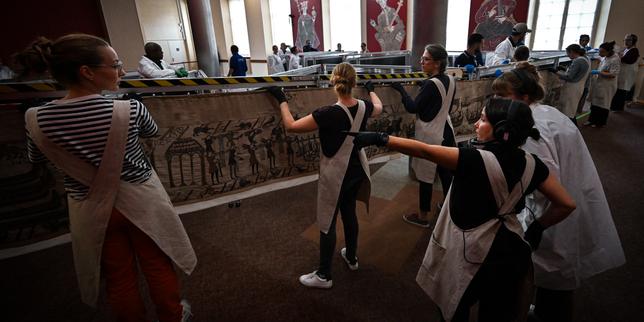
The announced loan of the 11th-century embroidered narrative detailing the Norman Conquest of England—commonly known as the Bayeux embroidery—to the United Kingdom represents a calculated exercise in cultural diplomacy rather than a simple museum exchange. This transactional piece of statecraft utilizes a highly fragile historical asset to achieve specific diplomatic, economic, and institutional outcomes. Analyzing this event requires stripping away the sentimental narrative of a "homecoming" and evaluating the structural mechanics across three distinct vectors: bilateral diplomatic leverage, logistical risk management, and microeconomic asset monetization.
The Diplomatic Lever: Soft Power Asymmetric Exchange
Cultural diplomacy operates on a framework of asymmetric reciprocity. France’s decision to permit the physical relocation of a delicate, 70-meter-long linen artifact across the English Channel serves as a high-value concession designed to generate goodwill, alter diplomatic friction points, and secure counter-concessions in non-cultural sectors. You might also find this similar article interesting: Inside the Scientific Funding Crisis Nobody is Talking About.
The transaction operates on a two-tiered strategic framework:
- The Symbolic Reciprocity Vector: The artifact serves as a visual manifestation of shared Anglo-French history, specifically highlighting a period where the political structures of England and France were deeply intertwined. By controlling the asset, the lending nation retains historical primacy while using the loan to signal a willingness to lower bilateral tensions.
- The Bureaucratic Leverage Point: Loans of this magnitude require direct state-level intervention, bypassing standard museum-to-museum channels. This elevates the artifact to a diplomatic bargaining chip, enabling the lending state to extract diplomatic capital or policy alignment on unrelated bilateral negotiations, such as cross-border security or maritime trade protocols.
The structural limitation of this strategy lies in its diminishing returns. The diplomatic capital generated by a cultural loan depreciates rapidly once the physical asset returns to its home jurisdiction. Therefore, the borrowing nation must rapidly convert the temporary reputational lift into concrete policy outcomes. As discussed in latest coverage by BBC News, the implications are widespread.
Logistical Architecture and Risk Mitigation Frameworks
The physical relocation of a 950-year-old textile presents a severe risk profile. The material composition—wool yarn embroidered onto a plain-weave linen backing—renders the asset highly susceptible to mechanical stress, environmental fluctuations, and microclimatic shocks. A rigorous logistical framework must govern the operation to prevent irreversible structural degradation.
Environmental Stabilization Metrics
The preservation protocol dictates rigid parameters that cannot be compromised during transit or exhibition. Relative humidity must be maintained at a constant 50% ($\pm 3%$), and the temperature must remain stabilized at 18°C ($\pm 1^\circ\text{C}$). Ultraviolet light exposure must be strictly limited to a maximum of 50 lux to prevent the acceleration of photochemical fading in the organic plant dyes (such as woad and madder) used in the wool threads.
Mechanical Stress Vector Control
The traditional display method of winding or mounting the textile horizontally induces uneven tensile strain along the warp and weft fibers.
[Tensile Strain Distribution] -> High Stress at Hanging Points -> Micro-tearing of Linen Backing
To counter this, transport engineering requires custom-built, climate-controlled chambers fitted with vibration-dampening suspension systems to absorb low-frequency kinetic energy during transit. The structural integrity of the linen backing must be mapped using high-resolution hyperspectral imaging prior to movement to establish a baseline for post-transit micro-damage assessment.
Microeconomic Polarization and Institutional Optimization
The relocation of a primary cultural asset triggers an immediate redistribution of tourism capital and institutional revenue. While the lending institution experiences a temporary contraction in visitor volume and secondary spend (retail, hospitality), the receiving institution gains an immediate spike in high-margin revenue streams.
Borrowing Institution: Spike in High-Margin Revenue -> Ticket Premiums + Secondary Spend
Lending Institution: Temporary Contraction -> Devaluation of Standard General Admission
This economic transfer creates a distinct operational bottleneck:
- The Capital Outlay Shock: The borrowing institution must absorb the upfront capital expenditures associated with specialized conservation, high-security transport, insurance underwriting, and specialized exhibition architecture.
- The Audience Satiation Curve: Ticket premiums can offset these initial costs, but the revenue model relies entirely on volume within a compressed chronological window. Once local demand is saturated, the marginal cost of maintaining the high-security exhibition infrastructure begins to erode the initial profitability.
To stabilize the economic model, regional hospitality networks must align their capacity with the exhibition schedule, transforming a singular museum event into a broader regional economic driver.
Execution Framework for Transnational Artifact Management
Museum executives and cultural policymakers must approach the deployment of high-value heritage assets through a clinical risk-reward matrix.
First, establish a joint conservation commission composed of textile scientists from both nations to hold veto power over any transit decision based purely on structural telemetry.
Second, isolate the financial underwriting of the project from general museum operating budgets; use dedicated state-backed indemnity schemes rather than commercial insurance to eliminate prohibitive premium costs.
Finally, structure the exhibition layout to funnel visitor traffic through high-margin secondary retail zones to maximize the extraction of per-capita value before the natural deceleration of visitor interest occurs mid-way through the loan tenure.