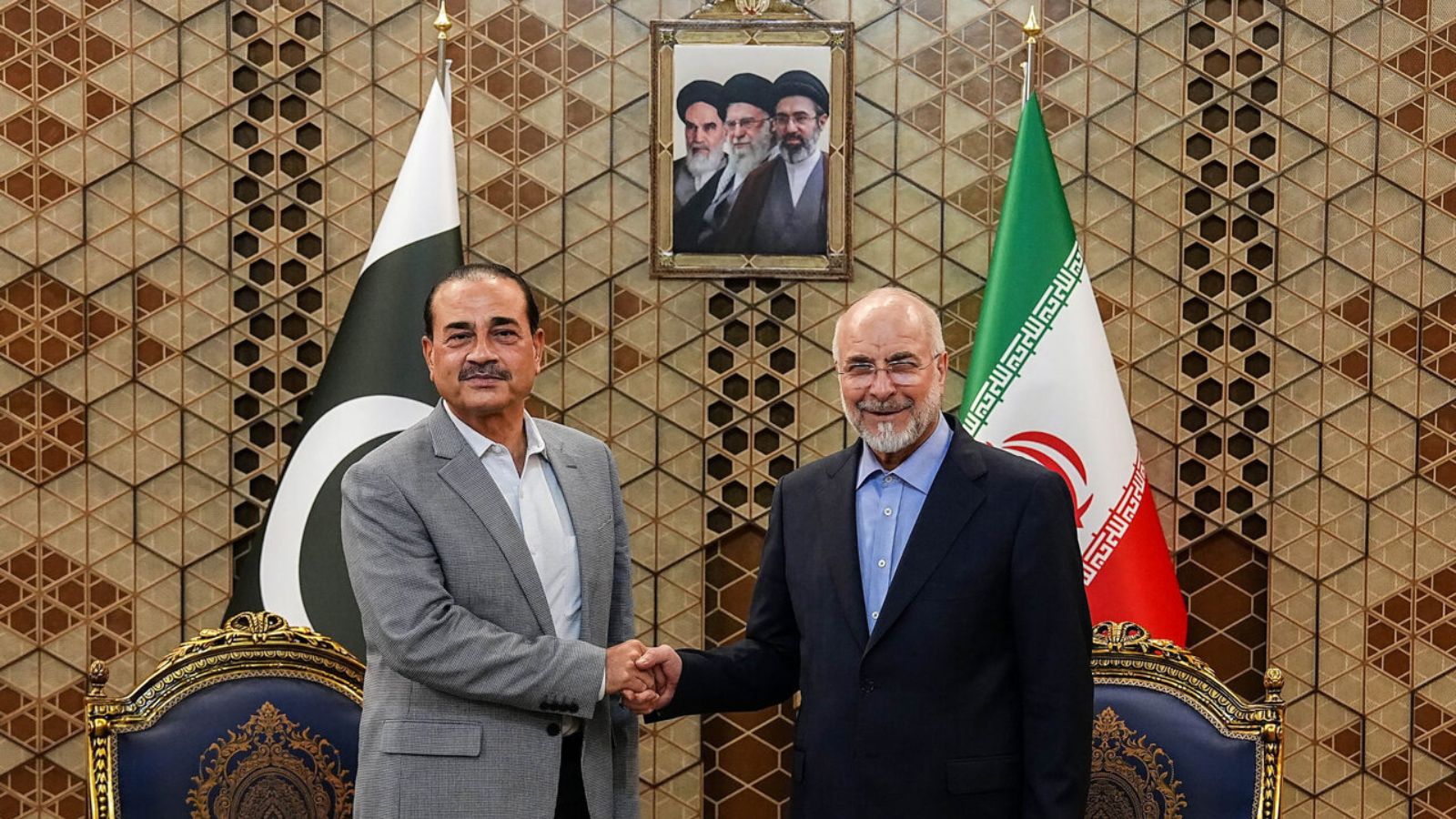
The fragile ceasefire brokered between the United States and Iran has entered a critical inflection point, exposing the deep structural misalignment between Washington’s maximum-pressure diplomatic strategy and Tehran’s deterrence calculus. While standard media narratives frame the latest diplomatic engagements in Tehran as a series of warnings and reactive postures, a rigorous strategic analysis reveals a highly calculated signaling mechanism. The core of this friction lies in the interaction between Iran’s domestic military replenishment and the backchannel mediation architecture managed by Pakistan.
Understanding the viability of this truce requires deconstructing the strategic calculations of the three primary actors: the Iranian negotiating team led by Parliament Speaker Mohammad Bagher Qalibaf, the Pakistani mediation apparatus headed by Field Marshal Asim Munir, and the Trump administration's coercive diplomatic framework.
The Tripartite Strategic Calculus
The current diplomatic architecture operates as a complex, three-variable game where each participant attempts to exploit the current pause in hostilities to optimize their long-term position.
[United States: Coercive Diplomacy] ---> (Naval Blockade / Threat of Strikes)
                                                 |
                                                 v
[Pakistan: Mediation & Transmission] <---> [Iran: Deterrence & Replenishment]
1. Iran's Deterrence Function and Material Replenishment
Tehran’s strategic posture, articulated by Qalibaf during his May 23 meetings with Munir, directly links the sustainability of diplomacy to physical deterrence. Qalibaf's public declaration that Iran’s armed forces have comprehensively rebuilt their capabilities since the April 8 ceasefire is not merely rhetorical bravado. It represents a specific calculation designed to alter the United States' risk-assessment matrix.
Iran's strategy operates on a clear cost-imposition logic:
- Asset Regeneration: Utilizing the six-week pause to reconstitute air defense nodes, drone production facilities, and anti-ship ballistic missile stockpiles depleted during the joint US-Israeli strikes on February 28.
- Asymmetric Leverage: Signaling that a resumption of hostilities will not encounter the same degraded defense infrastructure found during the initial phase of the war.
- Negotiating From Strength: Refusing to accept a lopsided diplomatic settlement under the pressure of the ongoing US naval blockade.
2. Pakistan's Mediation Architecture and the Role of Field Marshal Munir
Islamabad has positioned itself as the indispensable diplomatic pipeline between Washington and Tehran. Field Marshal Asim Munir’s second high-level visit to Tehran within five weeks underscores Pakistan's unique institutional capacity to act as a security guarantor and trusted interlocutor.
The Pakistani mediation strategy relies on a distinct operational framework:
- The 14-Point Framework: Directing negotiations around a structured 14-point document proposed by Iran, which addresses the mutual sequential steps required to achieve a permanent end to the war.
- Dual-Track Communication: Simultaneously carrying explicit American ultimatums while offering technical and legal delegations to operationalize potential agreements. The US messaging delivered by Munir contains a dual track: assurances that highly disputed long-term issues can be deferred if an initial deal is reached, contrasted against explicit warnings of severe military consequences if the terms are rejected.
- Institutional Diplomacy: Utilizing direct military-to-military communication channels. Munir's interaction with Iranian leaders relies on shared institutional norms, creating a layer of professional trust separate from volatile political rhetoric.
3. The Trump Administration's Coercive Diplomacy Framework
The White House is executing a high-stakes strategy of coercive diplomacy, balancing active backchannel negotiations against visible preparations for renewed military interventions.
This policy is constrained by competing systemic variables:
- The Blockade Leverage: The United States maintains a strict naval blockade to constrict Iran's economic survival, specifically targeting its oil export capacity through the Strait of Hormuz.
- The Threat of Decisive Strikes: President Donald Trump and Secretary of State Marco Rubio have calibrated their messaging to indicate that while "slight progress" has been achieved via Pakistani mediation, the military option remains fully authorized if negotiations stall over Tehran's nuclear program and regional posture.
- External Pressures: The administration must balance its desire for a decisive strategic victory against requests from regional partners, such as Gulf Arab leadership, who have advocated for prolonged diplomatic windows to avoid catastrophic energy market disruptions.
Operational Bottlenecks in the Ceasefire Framework
The collapse of the initial peace initiatives and the failure of the mid-April Islamabad Talks—which involved direct engagement by Vice President JD Vance—point to a fundamental structural flaw in the negotiation design. This structural breakdown can be analyzed through two primary bottlenecks.
The Verification-Compliance Dilemma
The principal obstacle to a permanent diplomatic settlement is the sequence of compliance. The United States demands immediate, verifiable concessions regarding Iran’s nuclear development and a permanent cessation of regional asymmetric operations prior to granting comprehensive sanctions relief. Conversely, Iran views its nuclear infrastructure and regional alliances as its primary leverage points.
Agreeing to dismantle these assets prior to the verified lifting of the naval blockade and economic sanctions constitutes an unacceptable strategic risk for Tehran. This creates a classic game-theoretic stalemate where neither actor can safely initiate the first phase of compliance without exposing themselves to exploitation by the other.
The Honesty Deficit and Asymmetric Information
Qalibaf's explicit statement that the United States is "not an honest party" highlights the profound deficit in credibility that hampers backchannel mediation. Because Washington previously enacted a naval blockade following a prior ceasefire agreement, Iran operates under the assumption that any commitment made by the Trump administration is subject to unilateral revocation. This perceived lack of institutional reliability increases the transaction costs of diplomacy, forcing Iran to rely on hard military deterrence rather than contractual assurances.
The Economics of the Strait of Hormuz Compromise
At the core of the technical negotiations occurring behind closed doors in Tehran is a proposed transactional swap involving global energy security and international finance. The basic mechanisms of this potential compromise involve a direct trade of maritime access for economic restitution.
| Component | Iranian Obligation | United States Obligation |
|---|---|---|
| Primary Action | Complete reopening of the Strait of Hormuz to international shipping. | Formal termination of the naval blockade on Iranian ports. |
| Financial Mechanism | Cessation of direct interference with commercial maritime traffic. | Provision of financial compensation or targeted sanctions waivers to unlock frozen state assets. |
| Security Guarantee | Suspension of advanced uranium enrichment and drone proliferation. | Explicit non-aggression guarantees and suspension of joint US-Israeli offensive planning. |
The structural limitation of this framework is its vulnerability to localized escalation. Even if a technical agreement is reached via the Pakistani delegation, the presence of deeply embedded proxy networks and independent naval commanders means that a single tactical miscalculation in the Persian Gulf could trigger an immediate return to large-scale kinetic operations.
Strategic Action and Tactical Paths
The current diplomatic pause cannot be sustained indefinitely. The interaction between Iran’s military rebuilding cycle and the United States’ domestic political pressure to secure a decisive resolution creates a highly compressed timeline for Field Marshal Munir’s mediation efforts.
The most viable strategic play for regional stability requires a shift from a comprehensive grand bargain to a highly synchronized, incremental escalation-management blueprint:
- Establish a Phased De-escalation Corridor: Rather than attempting to resolve the nuclear program and the naval blockade simultaneously, mediators must decouple immediate maritime security from long-term strategic disputes. The initial phase must focus exclusively on a synchronized pause: Iran halts drone and missile assembly lines in exchange for a verified relaxation of the US naval blockade for humanitarian and non-military commercial vessels.
- Institutionalize the Pakistani Technical Channel: The legal and technical delegations arriving from Islamabad must establish a continuous, tri-lateral incident-management cell. This cell must possess direct communication lines to both the US Fifth Fleet and the Islamic Revolutionary Guard Corps naval command to instantly verify and defuse maritime friction points before they trigger political retaliation.
- Formalize the Deferral Protocol: Both Washington and Tehran must formally accept the US-proposed protocol to defer structural disagreements regarding regional alignment and long-term nuclear enrichment to a secondary convention. Attempting to extract foundational concessions under the immediate threat of airstrikes will reliably trigger an Iranian defensive breakout, rendering a permanent peace mathematically impossible.