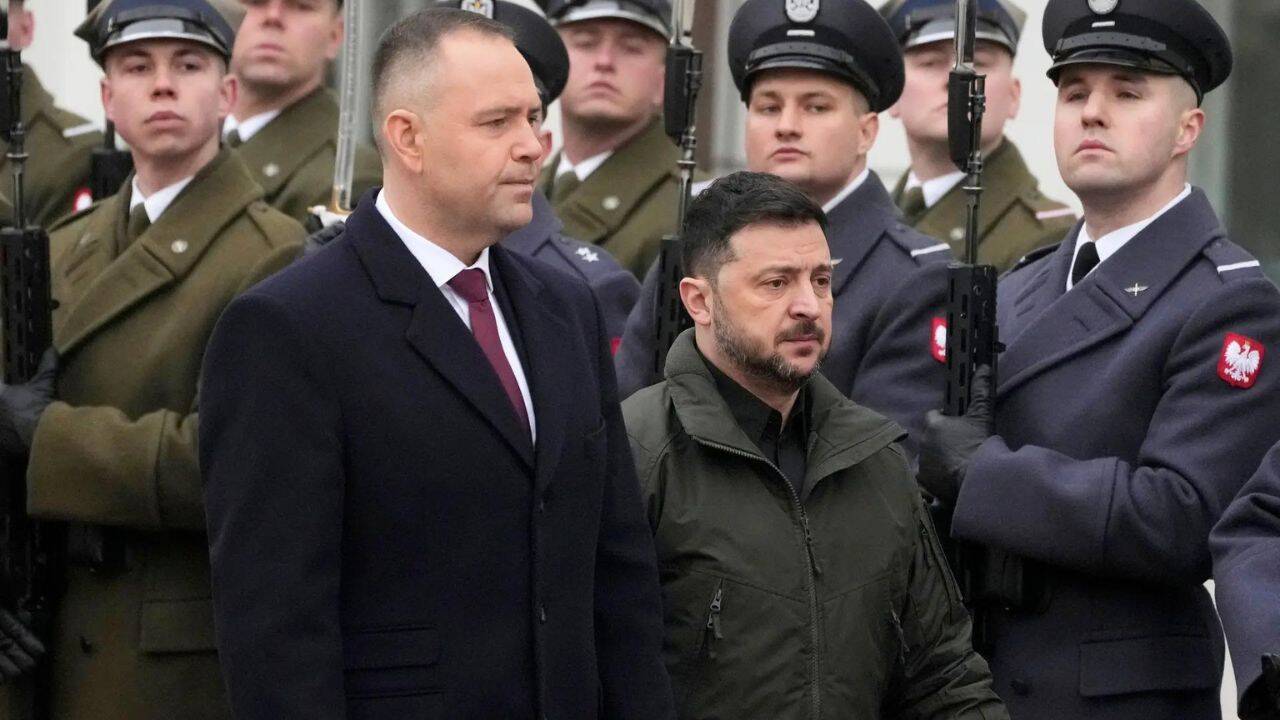
The revocation of Poland's highest state decoration, the Order of the White Eagle, from Ukrainian President Volodymyr Zelenskyy exposes a structural vulnerability in wartime coalitions: the friction between acute security alignment and long-term domestic historical memory. When Polish President Karol Nawrocki finalized the decision to strip the honor, the catalyst was a Ukrainian presidential decree designating an elite Special Operations Forces center as "named after the Heroes of the UPA" (the Ukrainian Insurgent Army). This diplomatic crisis reveals that while material, intelligence, and logistical cooperation operate on immediate threat-mitigation logic, state legitimacy relies on historical narratives that resist tactical compromise.
Understanding this fracture requires analyzing how historical memory functions as an unyielding domestic constraint, how Ukraine's internal military optimization creates external diplomatic friction, and how adversaries exploit these cognitive asymmetries to weaken international coalitions.
The Strategic Cost Function of Commemorative Politics
State actions regarding national symbols operate within a cost-benefit framework. For Ukraine, the internal utility of invoking the UPA is rooted in military mobilization and psychological resilience. For Poland, the domestic political cost of permitting the glorification of an organization responsible for the World War II Volhynia massacres—where an estimated 100,000 ethnic Poles were killed—is prohibitively high.
This friction can be modeled through three distinct operational dimensions.
1. The Internal Mobilization Versus External Alignment Conflict
Ukraine's defense strategy demands the cultivation of historical lineages that emphasize anti-Russian and anti-Soviet resistance. The UPA fought against Soviet forces well into the 1950s, making its symbols highly potent for modern military morale. However, optimizing for internal troop morale creates an immediate negative externality for Poland, where the UPA is legally and historically recognized as an architect of genocide. The Ukrainian state chose to prioritize localized, short-term military psychological capital over international diplomatic capital, assuming the shared existential threat of Russian aggression would buffer against a Polish diplomatic reprisal. This assumption proved incorrect.
2. Narrative Inelasticity in Sovereign Identity
Poland’s political structure possesses low elasticity regarding World War II-era history. The consensus spanning Poland’s political spectrum—from Karol Nawrocki’s conservative alignment to Prime Minister Donald Tusk’s liberal administration—demonstrates that historical trauma functions as a non-negotiable component of state legitimacy. When the Polish state trains thousands of Ukrainian soldiers, the introduction of symbols associated with historical atrocities creates an unacceptable domestic friction point. Polish leadership cannot justify to its electorate the funding and training of military units that operate under banners linked to the slaughter of Polish civilians.
3. The Information Warfare Premium
By utilizing highly contentious historical nomenclature, Ukraine inadvertently lowered the cost of information operations for its adversary. Russian strategic doctrine relies heavily on driving wedges between Western allies and Kyiv. The introduction of UPA symbols provides verified, non-fabricated material for disinformation campaigns designed to erode public support for Ukraine within European border states. The diplomatic friction generated by the naming decree acts as a force multiplier for adversary propaganda, shifting the narrative focus from modern defensive warfare to unresolved historical grievances.
The Asymmetry of Historical Perspectives
The diplomatic crisis stems from an irreconcilable divergence in how both states categorize the same historical entity. This is not a misunderstanding that can be resolved via communication; it is a structural clash between two distinct, functional state mythologies.
+--------------------------------------------------------------------------+
|                       THE UPA NARRATIVE ASYMMETRY                        |
+--------------------------------------------------------------------------+
|                                                                          |
|  [UKRAINIAN STATE PERSPECTIVE]           [POLISH STATE PERSPECTIVE]      |
|  Primary Attribute: Anti-Soviet/Nazi     Primary Attribute: Perpetrator  |
|  Resistance & Sovereignty.               of Genocidal Volhynia Massacres.|
|                                                                          |
|  Functional Goal: Internal wartime       Functional Goal: Defense of     |
|  mobilization & troop morale.            ancestral memory & state honor. |
|                                                                          |
+--------------------------------------------------------------------------+
|                                 |                                        |
|                                 v                                        |
|                    [TACTICAL STRATEGIC DISCONNECT]                       |
|                    Cooperating on real-time security                     |
|                    while colliding on historical memory.                 |
+--------------------------------------------------------------------------+
In the Ukrainian paradigm, the UPA is viewed primarily through a functional lens: an insurgent force that maintained a multi-front fight for national sovereignty against totalitarian regimes. The dark chapters of its operations are frequently minimized as secondary or localized collateral actions within a wider liberation struggle.
Conversely, the Polish paradigm views the UPA through an existential lens: a paramilitary organization whose foundational ideology led to systematic, ethnically motivated violence against defenseless populations in Volhynia and Eastern Galicia. Polish leadership explicitly rejects the idea that political necessity should dictate the sanitization of these historical facts.
Realpolitik and the Decoupling Mechanism
The critical analytical takeaway from the execution of this diplomatic sanction is the explicit decoupling of historical memory from hard security infrastructure. In his address, President Nawrocki deliberately delineated the boundaries of the diplomatic response, confirming that the revocation of the Order of the White Eagle does not alter Poland's strategic security posture regarding the defense of Ukraine.
This operational separation demonstrates that contemporary European security alliances are dictated by structural realism rather than shared ideological or historical consensus. Poland continues to act as the primary logistical transit hub for Western military hardware entering Ukraine, and it maintains its commitments to regional air defense and intelligence sharing. The calculation is cold and precise: a collapsed Ukraine poses a direct, existential threat to Polish sovereign territory, regardless of the symbols displayed by Ukrainian brigades.
Therefore, the alliance persists at a functional, material level even as the diplomatic superstructure experiences severe institutional fracturing.
Strategic Adjustments for Coalition Longevity
To prevent historical friction from degrading functional defense cooperation, international statecraft must implement specific adjustments to identity management and diplomatic coordination.
- Establish Symbolic Demilitarized Zones: State leadership must decouple modern military heroism from ethnically polarizing historical organizations. Honoring contemporary battlefield actions through newly minted, modern lineages prevents the activation of historical triggers in allied nations.
- Implement Prior-Consultation Mechanisms: For states heavily dependent on foreign logistical corridors, training infrastructure, and financial aid, an internal vetting process must evaluate the international diplomatic externalities of domestic symbolic decrees before enactment.
- Accelerate Joint Historical Commissions: To mitigate the impact of historical disputes on international entry paths—such as Ukraine's integration into European structures—bilateral historical commissions must be empowered to resolve issues like victim exhumation and memorialization outside the sphere of daily political maneuvering.
The structural reality remains absolute: nations can share an identical geopolitical objective without sharing an identical historical memory. When statecraft confuses internal mobilization tactics with international coalition management, the resulting friction creates systemic vulnerabilities that can be exploited by adversaries. Survival requires the precise calibration of internal narratives to match the requirements of external dependency.
The strategic realities of this geopolitical alliance and its deep historical roots are further explored by regional experts in this detailed analysis: Poland slams Ukraine over controversial wartime militia. This panel discussion breaks down how the legacy of the UPA impacts modern European integration and bilateral security agreements.