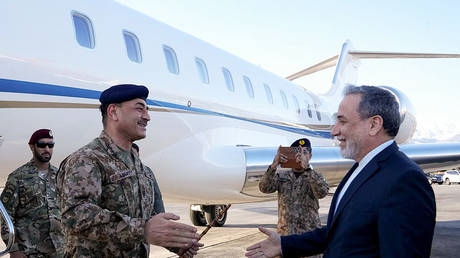
The recent reports of a breakthrough in United States-Iran relations, facilitated by Pakistani mediation, indicate a shift from ideological confrontation to a calculated optimization of regional stability. This process is not a product of sudden diplomatic goodwill but rather the alignment of three distinct strategic imperatives: the mitigation of Iran's "Maximum Pressure" fatigue, the United States' requirement for Middle Eastern resource reallocation toward the Indo-Pacific, and Pakistan's urgent need for a stabilized Western border to manage internal economic volatility.
The Architecture of the Intermediation Framework
Traditional diplomacy often fails between the U.S. and Iran due to the "Trust Deficit Penalty," where any unilateral concession is viewed as a sign of weakness by domestic hardliners. Pakistan’s role functions as a buffer, or a "Neutral Synchronizer," allowing both parties to test commitment levels without public-facing vulnerability. This framework relies on three structural pillars: Discover more on a related subject: this related article.
- Deniable Signaling: Pakistan provides a secure channel for the exchange of "Non-Paper" proposals—documents that carry no official letterhead or signatures—enabling both sides to explore radical concessions without political risk.
- The Proximity Logic: Unlike European mediators, Pakistan shares a 900-kilometer border with Iran and maintains a long-standing security relationship with the U.S. This geographic and historical entanglement gives Islamabad a vested interest in the outcome that transcends mere diplomatic prestige.
- Verification Buffering: By acting as a third-party witness to verbal agreements, Pakistan reduces the "Verification Lag" that typically stalls direct negotiations.
Strategic Drivers for the United States
The U.S. approach to Iran is currently governed by a "Containment Cost-Benefit Analysis." The maintenance of a massive military footprint in the Persian Gulf incurs high opportunity costs. Washington seeks a "Functional Status Quo" rather than a comprehensive grand bargain. The objectives are segmented into quantifiable targets:
The Nuclear Threshold Management
The primary U.S. goal is the extension of the "Breakout Timeline"—the period required for Iran to produce enough weapons-grade uranium for a single nuclear device. Current estimates place this timeline at a critical low. By utilizing Pakistani channels, the U.S. aims to trade specific frozen asset releases for a capped enrichment level (likely 60% or lower) and increased IAEA surveillance. Further journalism by NPR explores comparable perspectives on the subject.
Regional Kinetic De-escalation
The U.S. requires a cessation of attacks by Iranian-aligned groups against American assets in Iraq and Syria. The logic here is "Proportionality Calibration." If Iran restricts its proxies, the U.S. reduces the frequency and intensity of its "Freedom of Navigation" operations and regional strikes.
Strategic Drivers for Iran
For Tehran, the motivation is primarily "Liquidity Restoration." The Iranian economy has been operating under a "Sanctions-Induced Equilibrium" that is increasingly unsustainable due to domestic inflation and infrastructure decay.
The Asset Unfreezing Mechanism
Iran’s participation is contingent on the "Staged Liquidity Release" model. This involves the transfer of billions of dollars in frozen oil revenues—currently held in South Korean or Qatari banks—into restricted accounts. These funds are earmarked for humanitarian purchases, such as food and medicine, which bypasses direct sanction violations while easing the state's fiscal burden.
The "Look East" Diversification
By stabilizing relations with the West through a regional intermediary like Pakistan, Iran reduces its total dependence on China and Russia. This "Strategic Multi-alignment" gives Tehran more leverage in negotiations with Beijing, as it signals that Iran has alternative paths to economic reintegration.
The Pakistani Incentive Structure
Pakistan is not an altruistic actor in this theater. Its mediation efforts are driven by "Existential Border Management."
The Securitization of the Western Frontier
Pakistan faces a dual-threat environment: an active insurgency in Balochistan and a complex relationship with the Taliban in Afghanistan. A conflict between the U.S. and Iran would inevitably spill over into Pakistani territory, creating a "Refugee and Militancy Feedback Loop." By facilitating a thaw, Islamabad secures its western flank, allowing it to reallocate military resources to its eastern border and internal security operations.
The Energy Deficit Equation
The Iran-Pakistan (IP) gas pipeline remains a dormant asset due to the threat of U.S. "Secondary Sanctions." If a breakthrough occurs, Pakistan could potentially negotiate a "Sanction Waiver" to complete the pipeline, addressing its chronic energy shortages with relatively cheap Iranian gas. This would result in a significant "Energy Cost Reduction" for Pakistan’s industrial sector.
The Mechanics of the Breakthrough
Reports suggest the current breakthrough centers on a "Transactional Sequencing" model. Unlike the 2015 JCPOA, which was a comprehensive legal treaty, this is an "Informal Understanding" based on incremental reciprocity.
Step 1: Human Capital Exchange
The initial phase involves the release of dual-national prisoners. In the calculus of international relations, this serves as the "Minimum Viable Trust" indicator.
Step 2: Financial Thresholds
The U.S. permits the release of specific tranches of Iranian funds. These are not lump-sum payments but are released upon the verification of Iranian enrichment pauses. This creates a "Performance-Based Payout" structure.
Step 3: Regional Shadow Ceasefire
A non-verbal agreement to limit "Grey Zone" activities. This includes a reduction in cyber-attacks and maritime seizures in the Strait of Hormuz.
Risks and Structural Bottlenecks
The sustainability of a Pakistan-mediated breakthrough is threatened by several "Spoilers" and inherent structural weaknesses:
- The Israeli Security Paradox: Any perceived US-Iran thaw triggers an "Asymmetric Response" from Israel. Tel Aviv views an informal understanding as "Legitimization by Stealth" and may increase its covert operations inside Iran to sabotage the process.
- Domestic Political Volatility: In both Washington and Tehran, hardline factions view any compromise as a "Strategic Defeat." The U.S. election cycle creates a "Credibility Horizon"—Iran is hesitant to commit to any deal that a future U.S. administration might unilaterally revoke.
- The Pakistan Instability Variable: Pakistan’s own internal economic and political crises could diminish its "Mediation Capacity." If Islamabad becomes too preoccupied with domestic survival, its ability to guarantee communications and host high-level delegations erodes.
Quantifying the Regional Impact
A successful de-escalation would result in a "Stability Dividend" for the region. The primary metrics for success would be:
- Brent Crude Volatility Reduction: A decrease in the "Geopolitical Risk Premium" currently priced into global oil markets.
- Symmetry in Maritime Transit: A measurable increase in the safety of commercial shipping through the Bab al-Mandab and the Strait of Hormuz.
- Inflationary Easing in Iran: A stabilization of the Rial, which serves as a proxy for the success of the liquidity release program.
The current trajectory suggests that the parties have moved past the "Rhetorical Confrontation" phase and entered a "Calculated De-risking" phase. The Pakistani channel is uniquely positioned to handle this transition because it bypasses the formal rigidities of Western diplomatic protocols.
The strategic play here is not the pursuit of a permanent peace—which remains a structural impossibility given the ideological divide—but the engineering of a "Managed Competition." The goal is to lower the probability of accidental kinetic escalation while allowing each actor to pursue their core national interests within a predefined set of boundaries. For the U.S., this means focusing on the Pacific; for Iran, it means economic survival; and for Pakistan, it means preventing a total regional collapse. Success will be measured not by signed treaties, but by the absence of headlines reporting new strikes or enrichment spikes.
To maintain the momentum of this breakthrough, the involved parties must transition the "Informal Understanding" into a "Regional Security Architecture" that includes Gulf Cooperation Council (GCC) stakeholders. Failure to integrate regional partners will result in the "Outsider Sabotage" effect, where excluded neighbors act to undermine the agreement to protect their own security interests. The next logical move is the establishment of a "Technical Coordination Committee" in Islamabad to oversee the granular implementation of the de-escalation milestones.