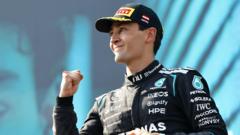
The mainstream motorsport media loves a narrative about a steely underdog seizing glory through sheer force of will. Following the chaos at the Red Bull Ring, the racing press rushed to print variations of the same tired headline: George Russell held his nerve, drove a flawless race, and earned a brilliant victory for Mercedes.
It is a comforting story. It is also entirely wrong.
Let us stop pretending that running third, inherited by virtue of the two fastest cars colliding, constitutes a masterclass in race management. George Russell did not win the Austrian Grand Prix. Max Verstappen and Lando Norris threw it away, and Mercedes simply happened to be the closest bystander when the building collapsed. To frame this as a triumphant return to form for the Silver Arrows is to misunderstand the brutal reality of modern Formula 1 dynamics.
The Illusion of the Flawless Drive
The lazy consensus dominating the post-race analysis suggests that Russell put himself in a position to leverage—to use the paddock vernacular—the misfortune of others through impeccable pace.
Let us look at the actual telemetry and race history. Before Verstappen and Norris turned Turn 3 into a demolition derby on lap 64, Russell was drifting in a lonely third place, nearly fifteen seconds adrift of the lead battle. He was not hunting them down. He was not applying pressure. He was managing a gap to the cars behind, operating in a competitive vacuum.
In Formula 1, true meritocratic victories require a car to possess either a qualifying edge or superior race pace that forces an opponent into a tactical mistake. Mercedes had neither. Russell’s pace was respectable, but it was fundamentally disconnected from the fight for the win.
When the collision occurred, Toto Wolff famously yelled into Russell’s radio, telling him he could win the race. Russell sharply told his boss to let him drive. The media swooned over this exchange, citing it as proof of Russell's intense focus. In reality, it was panic management. Russell knew what the pit wall seemingly forgot: he had a hard-charging Oscar Piastri in a faster McLaren closing him down at a rate of half a second per lap.
Had the race been two laps longer, Piastri would have overtaken him. Russell did not control the race; he survived a ticking clock.
The Flawed Premise of the Paddock Consensus
The standard "People Also Ask" query after Spielberg was predictable: How did Mercedes fix their car to win in Austria?
The premise of the question is entirely flawed. Mercedes did not fix their car to a race-winning standard. The W15 remains the third-fastest car on the grid on a normal Sunday, sitting behind Red Bull and McLaren.
To understand why the mainstream view is wrong, we have to examine the systemic breakdown of the front-runners rather than inflating the performance of the chasing pack.
The Verstappen-Norris Meltdown Mechanics
What actually decided the Austrian Grand Prix was a toxic cocktail of regressive driving standards and pit-stop incompetence.
- The Red Bull Pit Stop Failure: Verstappen’s comfortable seven-second lead vanished due to a sticky left-rear wheel nut during his final stop on lap 52. This single mechanical hiccup brought Norris into DRS range. Without this error, the collision never happens.
- The Moving-Under-Braking Blindspot: Verstappen’s defense against Norris was a throwback to his 2016 driving style. The FIA stewards have spent years trying to eliminate moving under braking, yet Verstappen repeatedly changed his line in the braking zones of Turns 3 and 4.
- The Immaturity of the Attack: Norris, eager to assert dominance over his friend and rival, repeatedly lunged from too far back, destroying his tires and track limits margin.
This was not a tactical chess match. It was an emotional street fight between two drivers who refused to yield an inch. Russell was merely the beneficiary of their mutual destruction. Citing this as a "strategic masterclass" by Mercedes is like praising a lottery winner for their financial acumen.
The Dark Side of Inherited Victories
There is a distinct danger in celebrating wins that mask systemic deficiencies. I have seen Formula 1 teams blow tens of millions of dollars chasing development directions based on anomalous race results. When a team wins a chaotic race, the internal pressure to critique the car’s fundamental flaws evaporates.
Mercedes engineers know the truth, even if the marketing department refuses to admit it. The W15 still suffers from a narrow aerodynamic working window. It struggles with rear-end instability in high-speed snaps and lacks the straight-line efficiency of the Red Bull RB20.
Look at the hard data from the weekend:
| Driver | Average Lap Time (Stint 2 - Mediums) | Ultimate Qualifying Pace |
|---|---|---|
| Max Verstappen | 1:10.230 | 1:04.314 |
| Lando Norris | 1:10.410 | 1:04.718 |
| George Russell | 1:10.850 | 1:04.840 |
The table demonstrates a clear, undeniable deficit. Russell was averaging over four-tenths of a second per lap slower than Verstappen during the meat of the Grand Prix. In a sport measured in milliseconds, that is an eternity.
Celebrating this win as a sign that Mercedes is back in the championship hunt is a delusion. It shifts the focus away from the relentless aerodynamic development required to catch McLaren and Red Bull on pure pace.
Stop Asking if Russell is a Team Leader
Another narrative being pushed down the throats of F1 fans is that this victory cements Russell's status as the undisputed post-Hamilton leader of Mercedes.
This is reactionary nonsense. Leadership in Formula 1 is not defined by being the driver who inherits a win when the leaders crash. It is defined by out-qualifying and out-racing your teammate consistently while dragging a difficult car to positions it does not deserve to be in.
Lewis Hamilton had a terrible weekend in Austria, suffering damage to his floor early in the race and picking up a penalty for crossing the pit entry line. Yet, his race pace, despite the damage, was comparable to Russell's in clean air.
Imagine a scenario where the roles were reversed: if Hamilton had been in third and inherited that win, the media would be calling it "the old magic." Because it was Russell, they call it "the changing of the guard." Neither interpretation is accurate. Both drivers are currently hamstrung by a car that requires track temperatures to be precisely 32 degrees Celsius with a slight crosswind just to balance its front and rear axles.
The Actionable Truth for F1 Fans
Stop buying into the sanitized, PR-driven narratives spun by teams and broadcast partners who need to sell tickets and TV subscriptions.
If you want to know who is actually winning the development war, ignore the podium tracker. Look at the sector times during Friday practice when teams are running high-fuel simulations. Look at the GPS traces showing minimum speed through medium-velocity corners.
Austria proved that McLaren now has a car capable of destabilizing Red Bull on any track layout. It proved that Max Verstappen will still revert to hyper-aggressive, borderline illegal defensive driving when pushed into a corner. And it proved that Mercedes is still waiting in the wings, hoping for scraps from the top table.
George Russell got a trophy, twenty-five points, and a nice entry on his Wikipedia page. But he did not beat the field. The field beat itself, and he was simply the last man standing in the gravel.