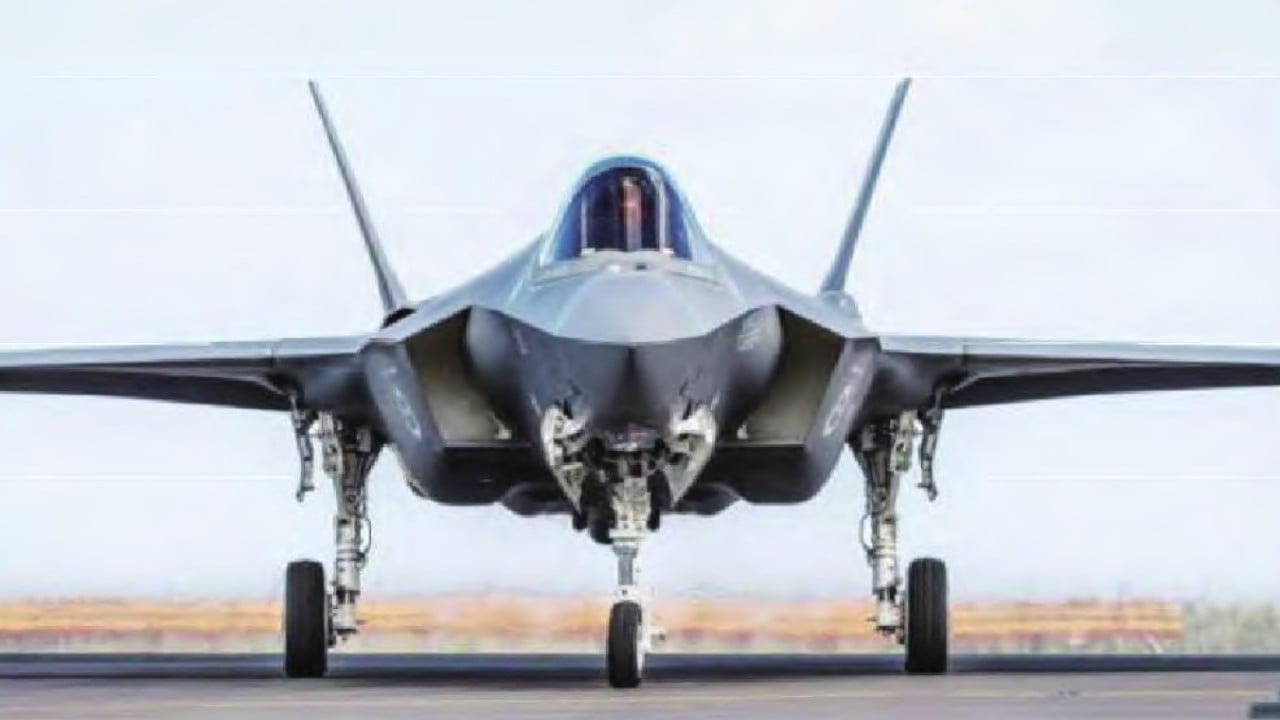
Silence is a heavy thing at thirty thousand feet.
Inside the cockpit of an F-35 Lightning II, the world is reduced to a sanitized glow of glass displays and the muted hum of life support. To the pilot strapped into the ejection seat—let us call him Major Vance, though he could be any aviator flying a patrol over contested water—the true luxury is not the speed or the thrust. It is the absence of noise. Specifically, the terrifying, high-pitched shriek of a radar warning receiver telling you that someone, somewhere, has locked a pair of crosshairs onto your chest. Discover more on a similar topic: this related article.
For decades, that silence has been treated as a law of nature. Radar works by shouting into the dark and listening for the echo. If you coat an aircraft in radar-absorbent materials, shape its fuselage to scatter radio waves like light off a broken mirror, and swallow the emissions inside internal weapons bays, the echo vanishes. You become a ghost. You fly through the electromagnetic ether like a phantom, unseeing and unseen, believing in the absolute security of your own invisibility.
Then the physics of the universe shift. And the silence cracks. More analysis by Wired highlights similar views on the subject.
Across the globe, in a dimly lit university laboratory in Hefei, a team of researchers does not care about your radio waves. They are looking at light.
To understand why a recent breakthrough—a mathematical and physical model suggesting a missile-borne lidar system can spot an F-35 at distances up to 61.5 kilometers—matters, you have to abandon everything Hollywood taught you about stealth. Stealth was never an invisibility cloak. It was a camouflage suit tailored for a very specific predator: the microwave radar.
Imagine standing in a pitch-black forest wearing matte-black clothing. If someone sweeps a broad, sweeping beam of a flashlight around, your clothes swallow the photons, and you remain hidden. That is radar. But what happens when someone decides to sweep the forest with a million tiny, needle-sharp laser pointers instead? What happens when you stop listening for an echo and start looking for the tiny, irreducible distortion of a shadow?
That is lidar. Light Detection and Ranging. Instead of radio frequencies, it fires pulses of laser light—invisible infrared beams—at blinding speeds. When a photon hits an object, it bounces back. Even if the object is shaped to trick a radio wave, it still takes up space. It still blocks the path of light. It still scatters a fraction of those photons back to a sensor that is sensitive enough to count them.
For a long time, the engineering hurdle was monumental. Lasers scatter in the atmosphere. Clouds, fog, dust, and moisture chew up laser beams, turning a clean pulse into a useless smear of light before it can travel more than a few thousand meters. More importantly, mounting a lidar system sensitive enough to catch a stealth fighter onto a fast-moving, high-stress missile guidance computer felt like trying to balance a telescope on the tip of a charging bull.
The Chinese research paper changed the conversation by rewriting the mathematics of that bounce.
By modeling the complex interaction between laser pulses and the specific faceted geometry of modern stealth aircraft, the researchers demonstrated that a missile equipped with an optimized lidar seeker could pierce the atmospheric noise. It could isolate the faint, anomalous scattering profile of an F-35 at a distance of 61.5 kilometers.
Sixty-one point five kilometers.
To a civilian, that number sounds abstract. A long stretch of highway. A comfortable distance. To a pilot flying at Mach 1.6, it is a blink. It is roughly sixty seconds of flight time. It is the distance between life and becoming a streak of burning titanium falling into the sea.
Consider what happens inside that cockpit when the paradigm shifts.
Major Vance does not know the paper was published. He does not study the intricacies of photon scattering cross-sections over breakfast. He trusts his avionics. He trusts the multi-million-dollar software loop that tells him he is a god of the skies, untouchable by surface-to-air systems or interceptor missiles. He banks his aircraft over a cloud deck, the sun catching the angular canopy, feeling the sublime detachment of modern air power.
Below him, on a mobile launcher parked beneath a camouflage net in a rugged interior province, a computer processes a return.
It is not a traditional radar hit. It is a mathematical anomaly. A statistical whisper in a sea of background noise. A photon density drop so slight that a human eye would dismiss it as a glitch on a monitor. But the algorithm does not blink. It calculates velocity, vector, and range.
Lock.
The distance is sixty-one kilometers. The missile wakes up. Its solid-fuel rocket motor ignites with a violent, roaring cough that tears through the silence of the morning.
We have lived through cycles of military technology before. Every shield breeds a spear; every spear breeds a thicker shield. When the dreadnought was built, it rendered every previous warship obsolete overnight, until the torpedo and the submarine rendered the dreadnought vulnerable. When radar was invented during the Second World War, it stripped the night sky of its protective cover, forcing engineers to invent chaff, electronic jamming, and eventually, the science of low-observable design.
We assumed stealth was the final word. We assumed that once you reduced a radar cross-section to the size of a marble or an insect, you had reached the end of history.
Nature is rarely so neat.
The limitation of stealth has always been its specialization. It is optimized for one sensory organ. It is like an animal evolved to hide from predators that hunt by sound, completely ignoring the fact that the new hunter smells in high definition. Lidar changes the sensory palette of the battlefield. It introduces a predator that hunts using the very light of the sun and the artificial spark of infrared diodes.
What does this mean for the future of aerial dominance? It means the death of absolute certainty.
In the high-stakes chess match of modern defense, certainty is the most dangerous drug an army can consume. When commanders believe their stealth fleet is impervious, they deploy them with a specific arrogance. They plan routes through the heart of enemy air defense networks, trusting the invisible skin of the aircraft to keep them safe.
Introduce a 61.5-kilometer lidar threat—even if it is currently confined to a theoretical model or an early-stage hardware prototype—and that arrogance evaporates. Suddenly, the airspace is no longer an open highway. It is a minefield. Pilots must learn to fly differently. They must respect the atmosphere not as a transparent medium, but as a medium that can betray them. They must factor in laser warning receivers, active optical countermeasures, and evasive geometries that account for light-speed tracking.
The researchers in Hefei did not destroy the F-35. They did something much more profound. They reminded us of an ancient truth about human ingenuity: no matter how dark you paint the room, someone will eventually invent a better match.
Back in the simulator or out over the gray expanse of the ocean, the flight continues. Major Vance checks his instruments. The green lights are steady. The fuel is good. The sky looks empty.
Yet, down below, equations are running. Lenses are focusing. Photons are traveling across the miles at three hundred thousand kilometers per second, carrying the news that the ghost has finally learned how to cast a shadow.


