The rain in north-eastern Europe doesn’t just fall. It dissolves the earth. Anyone who has ever spent a week inside an armored personnel carrier knows the specific, suffocating smell of that mud when it mixes with diesel fumes, wet wool, and the sharp, metallic tang of human fear. You are trapped in a steel box. The windows are tiny slits. Every bump rattles your teeth, and every sudden metallic clank outside makes your stomach drop because you know, with absolute certainty, that if a modern anti-tank missile hits that hull, you and the seven people sitting across from you will become a single, horrific statistics report.
For decades, military doctrine accepted this as the price of doing business. To hold ground, you needed boots. To move boots, you needed heavy steel. To move heavy steel, you needed young men and women willing to sit inside the target.
But walking through the exhibition halls in Paris during Eurosatory, the massive defense expo, the air smelled different. It smelled like air conditioning, expensive espresso, and the quiet, electric hum of an ending era.
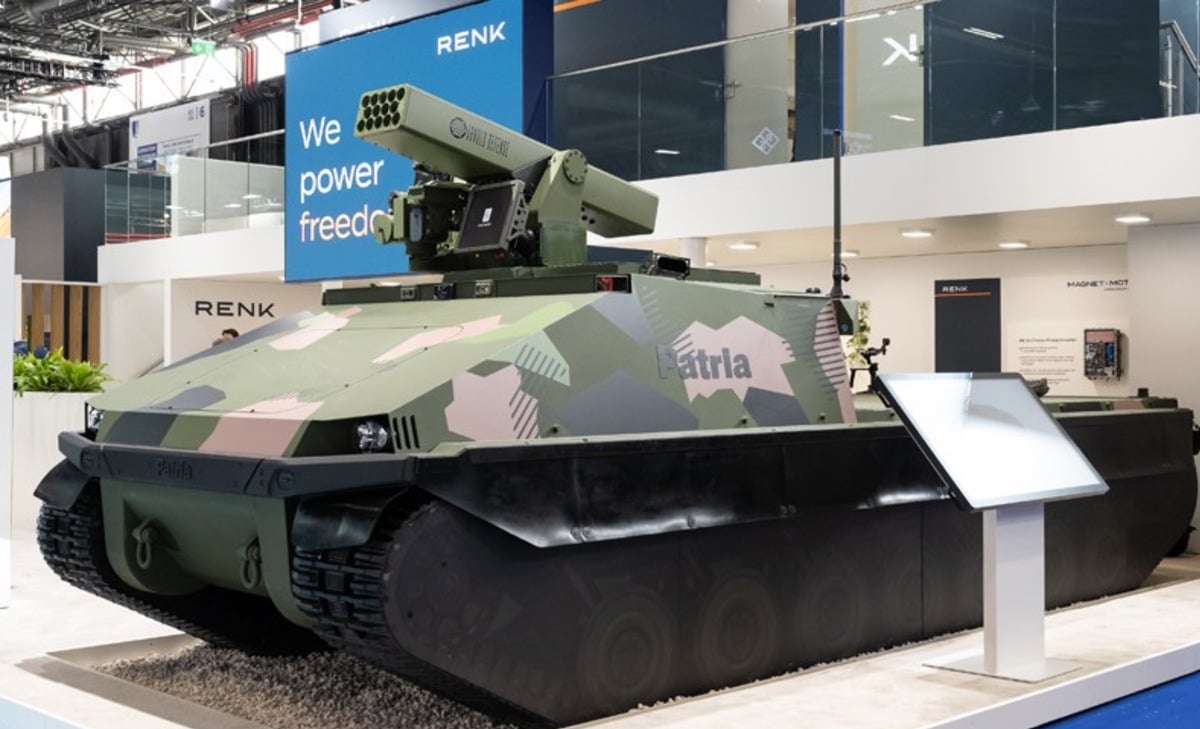
Beneath the bright lights, two defense giants—Finland’s Patria and Germany’s RENK Group—unveiled something that didn’t look like a weapon so much as it looked like a confession. It was a crewless tracked vehicle concept. A robot tank, to put it crudely. But to look at it was to realize that the military establishment is finally admitting a truth that soldiers have whispered for generations.
The weakest part of any armored vehicle is the flesh inside it.
The Weight of Human Absence
When you strip the human beings out of a combat vehicle, everything changes. The silhouette shrinks. You no longer need to build a massive, armored bubble to protect a command crew. You don't need life support systems, heating, cooling, or heavy ballistic glass that can withstand a sniper's round but shatters your visibility.
The vehicle Patria and RENK put on display is a lean, predatory thing. It is built on a heavy-duty tracked platform designed to navigate the kind of brutal, saturated terrain that bogs down wheeled vehicles. But without a steering wheel, a driver's seat, or an escape hatch, it looks less like a machine of war and more like a manifestation of pure intent.
Consider what happens next when a platoon encounters a choked, heavily mined treeline. In the old days—which is to say, last week—a commander had to make a choice that felt like a slow-motion nightmare. You send scouts forward on foot, exposed to artillery fragmentation, or you push an armored vehicle ahead and pray the underbelly plating can absorb an improvised explosive device.
Now, you send the ghost.
The concept relies on a modular design. Patria brings the armored mobility and the integration expertise—the bones and the muscle. RENK brings the transmission and propulsion technology—the heart that allows this machine to churn through deep mire without throwing a track or stalling under load. Together, they have created a platform that can be configured for whatever nightmare the day throws at it. It can carry supplies. It can evacuate casualties. It can carry heavy weapons systems directly into the teeth of an ambush.
And if it blows up?
A logistics officer sighs, a line item on a spreadsheet turns red, and a factory in Europe spins up another assembly line. No one has to write a letter to a mother in Tampere or Dusseldorf explaining why her son isn't coming home.
The Invisible Friction of the Battlefield
It is easy to get caught up in the techno-thriller romance of automated warfare. The glossy brochures talk about payload capacities, torque curves, and remote telemetry. They make it sound clean.
It isn't.
The real challenge of a crewless vehicle isn't making it move; it’s making it smart enough to survive the chaos of an environment where everything is trying to break it. A human driver feels the mud. They know by the shudder in the seat when the ground is giving way, when a marsh is about to swallow twenty tons of steel, or when the slope is too steep for the current gear. They hear the engine strain.
Replacing that biological intuition requires a terrifying amount of engineering. The Patria-RENK concept isn't just a remote-controlled car with tracks. It is an ecosystem of sensors, cameras, and algorithms that must translate the tactile reality of a battlefield into data that can be processed in milliseconds. It must look at a ditch and decide if it is a minor obstacle or a trap.
But the partnership between these two specific companies matters because they aren't tech startups playing with drones in a sunny California park. They are old-world industrial heavyweights. Patria’s wheeled vehicles are already the backbone of several European militaries, trusted for their rugged simplicity. RENK is legendary for transmissions that keep main battle tanks moving when the world is ending around them.
When entities like this pivot toward autonomy, it means the theoretical phase is over. The calculus has changed.
The Changing Shape of the Shield
There is a profound irony in the development of these systems. For a long time, the defense industry focused on making armor thicker. We added active protection systems that shoot down incoming rockets. We slapped explosive reactive bricks onto the sides of tanks until they looked like geometric monsters. We did everything we could to harden the shell because the meat inside was so fragile.
This new concept approaches the problem from the opposite direction. It asks: what if we just remove the target?
This shift ripples backward through the entire logistics chain. A vehicle with no crew requires no food rations. It needs no water storage. It doesn't get tired, it doesn't suffer from sleep deprivation, and it doesn't get tunnel vision after forty-eight hours of continuous bombardment. It can sit in a freezing trench, completely powered down, waiting for days, and then awaken instantly when an encoded pulse tells it to move.
But the true value of this technology lies in the options it gives to a twenty-four-year-old lieutenant standing in a muddy ditch somewhere under a gray sky. Right now, that lieutenant’s choices are governed by an agonizing balance of risk versus human life. When the robot is the vanguard, the equation shifts. You can be aggressive where you used to be timid. You can explore avenues that used to be considered suicidal.
The Silhouette on the Horizon
Walking away from the display in Paris, looking back at the sleek, unblinking face of the vehicle, it was impossible not to feel a cold chill of historical realization. The battlefield of the twentieth century was defined by mass—massed men, massed artillery, massed armor armor clashing in titanic, bloody struggles.
The battlefield of tomorrow looks much lonelier.
It will be a landscape of small, highly dispersed human units operating from deep cover, surrounded by a constellation of autonomous helpers. Overhead, silent drones will map the terrain. On the ground, vehicles like the Patria-RENK concept will chew through the mud, carrying the heavy weight of the war so that human beings don't have to.
We aren't quite there yet. This is still a concept, a declaration of intent rather than a fully deployed fleet. There are still thousands of hours of testing to be done, software bugs to iron out, and doctrinal arguments to be settled in the quiet corridors of ministries of defense.
But the direction of the wind is unmistakable. The future of armored warfare has arrived, and it doesn't have eyes to blink or a heart to break. It just has tracks, an engine, and a job to do.
Somewhere in a freezing forest, a soldier is cleaning his rifle, his boots soaked through, his joints aching from the damp chill of the earth. He doesn't know about the expo in Paris. He doesn't know about the corporate alliances or the engineering breakthroughs. But out there in the dark, the machine that will eventually take his place in the line is already warming up its engine.