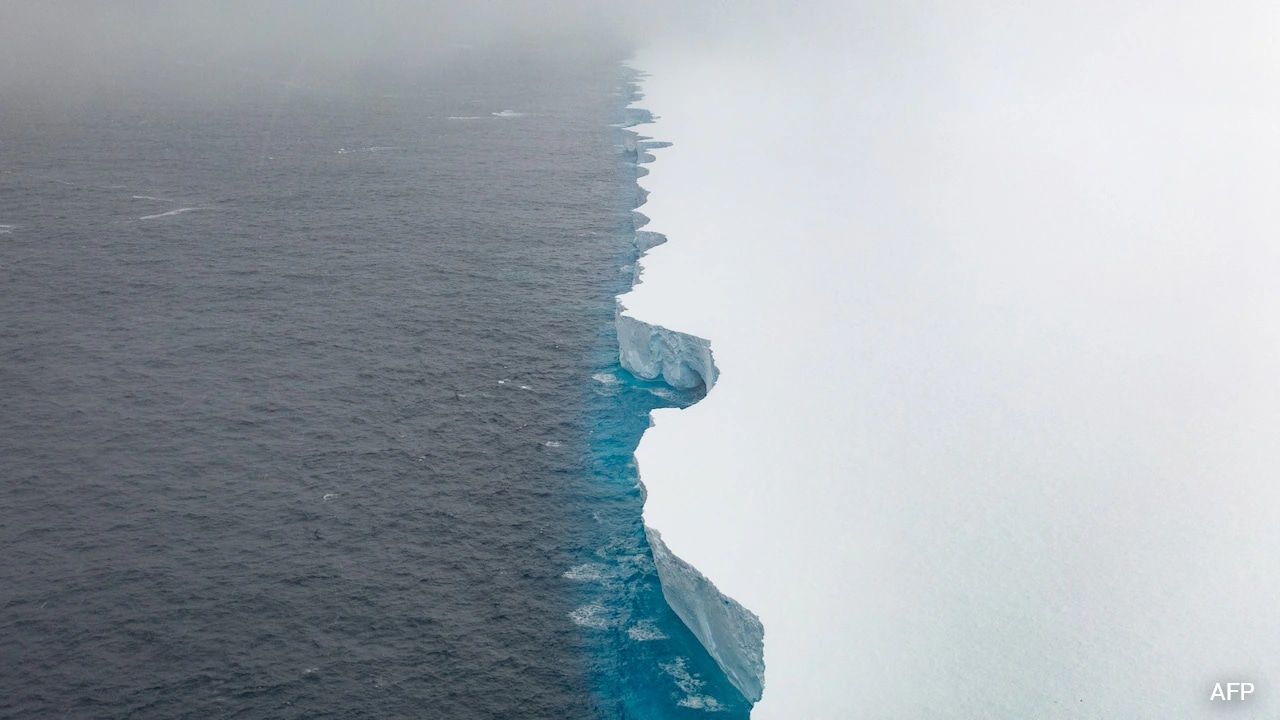
Forty years ago, a frozen continent dropped a piece of itself into the Southern Ocean, and the ocean blinked.
It was not a pebble. It was a monolith. A slab of ancient freshwater ice, torn from the Filchner-Ronne Ice Shelf in 1986, spanning roughly four thousand square kilometers. For perspective, you could have dropped the island of Bali onto its surface and still had room to spare for a few coastal villages. They called it A23a. At the time of its birth, it did not float away; it simply ran aground. The shallow mudbanks of the Weddell Sea caught its heavy keel, sinking hundreds of meters down into the ocean floor, anchoring a floating mountain of compressed snow into the seabed like a frozen tent peg. Building on this topic, you can also read: Inside the Algerian Wildfire Crisis: Capital Punishment, Coordinated Arson, and the Limits of State Retribution.
And there it stayed.
Month after month. Year after year. Through decades of changing human governments, through the rise of the internet, through shifting climate treaties and the slow, quiet warming of the planet’s circulatory system. While the world above water spun through its frantic cycles, A23a remained frozen in time, a stationary white ghost guarding the edge of the Antarctic Peninsula. Observers at Associated Press have shared their thoughts on this matter.
I remember looking at satellite imagery of it years ago, marveling at the sheer stubbornness of the thing. It felt permanent. Glaciers feel like geology, not weather. We look at mountains and ice sheets and project our own desire for stability onto them. We assume that because something takes ten thousand years to form, it possesses some innate immunity to the present.
Then came 2020.
The anchor let go.
Oceanographers noticed the subtle twitch first. Currents, shifting deep beneath the surface, began to erode the submerged base where the giant had touched the bottom. The physics of it are brutal and simple. As the ice thinned from below, buoyancy finally won its quiet war against gravity. The immense mass un-snagged itself from the mud and began to turn.
A beast that size does not drift gracefully. It rotates. Slowly, agonizingly, over the course of months, A23a pivoted on its watery axis and drifted out of the Weddell Sea, entering the furious lanes of the Antarctic Circumpolar Current. This is where ice goes to die. Meteorologists and maritime agencies tracked its escape with a mixture of awe and professional dread. Shipping lanes in the South Atlantic, particularly the passage near South Georgia Island—a haven for millions of penguins and seals—suddenly shared space with an island of ice the size of a small US county.
Imagine standing on the deck of a research vessel, staring out at a wall of white that stretches to the horizon and towers hundreds of feet into the air. The scale defies comprehension. You do not see an iceberg; you see a coastline. You see sheer cliffs of electric blue and blinding white, striated with dust and volcanic ash trapped inside the ice during the Pleistocene epoch. You hear the groan of it—a low, thunderous bass note, like a cathedral organ played underwater, as internal stress fractures tear through millions of tons of frozen weight.
And now, the end has accelerated.
Recent satellite telemetry tells a story of rapid, unstoppable dissolution. Swept north into warmer waters, surrounded by surging waves and air temperatures that belong to a different climate, A23a is fracturing. Huge chunks—calving events that dwarf entire city blocks—break away with the force of tactical explosions. The open ocean is swallowing it. The warm spray of the sub-Antarctic is chewing through its flanks. The giant is shrinking, fragmenting, and melting into the very sea it once helped cool.
To understand what is happening to A23a, you have to understand the anatomy of a dying leviathan.
Icebergs do not simply melt evenly like an ice cube in a glass of whiskey. They roll, they fracture, they calve, and they leak. As the warm water laps at their underbellies, undercut channels form like subterranean caves carved out of crystal. The structural integrity fails. A massive section that was stable five minutes ago suddenly loses its balance, shifting thousands of feet of elevation in seconds, sending towering tsunamis rolling outward across the swells.
For the wildlife of the Southern Ocean, this death is both a disruption and a nutrient injection. As the iceberg melts, it releases centuries of trapped mineral dust—iron, nitrogen, and phosphorus—into the water. This sudden nutrient bloom triggers explosions of phytoplankton, feeding the krill, which in turn feed the whales, penguins, and albatrosses. In its final act of disintegration, the ghost of the ice shelf becomes a feast.
Yet, there is a profound melancholy in watching it go.
A23a was a physical link to a different era of the planet. When it calved in 1986, the atmospheric carbon dioxide levels were drastically lower than they are today. The world was a different place. This block of ice carried the atmospheric memory of 1986 locked inside its tiny, compressed air bubbles, safely isolated from the sky until the moment the ice finally fractured and released that ancient air back into the modern wind.
Now, those bubbles are gone. The water that formed them is mixing with the broader ocean, diluting into the global tide.
We look at statistics like four thousand square kilometers and billions of tons of meltwater, and we try to quantify the loss. But numbers fail us. They flatten the tragedy into a spreadsheet. What is actually happening out there in the freezing grey of the Southern Ocean is a vanishing act on a planetary scale. A landmark, written in water and snow, is being erased.
The current projections are clear. Within a relatively short window of time, what remains of A23a will break down into bergy bits and growlers—small, manageable chunks of ice bobbing anonymously among the waves—before vanishing completely into the salinity of the deep sea. No monument will be left behind. No marker will bob above the spot where an island once drifted.
The water will close over it. The currents will move on. And the ocean will be a little warmer, a little higher, and a little more alone.